From Tatyana Timofeevna’s handwritten notebook “Our genealogy: the Samsonovs”. First person. [?] = unclear passages. Page numbers (p. N) are given in the comments.
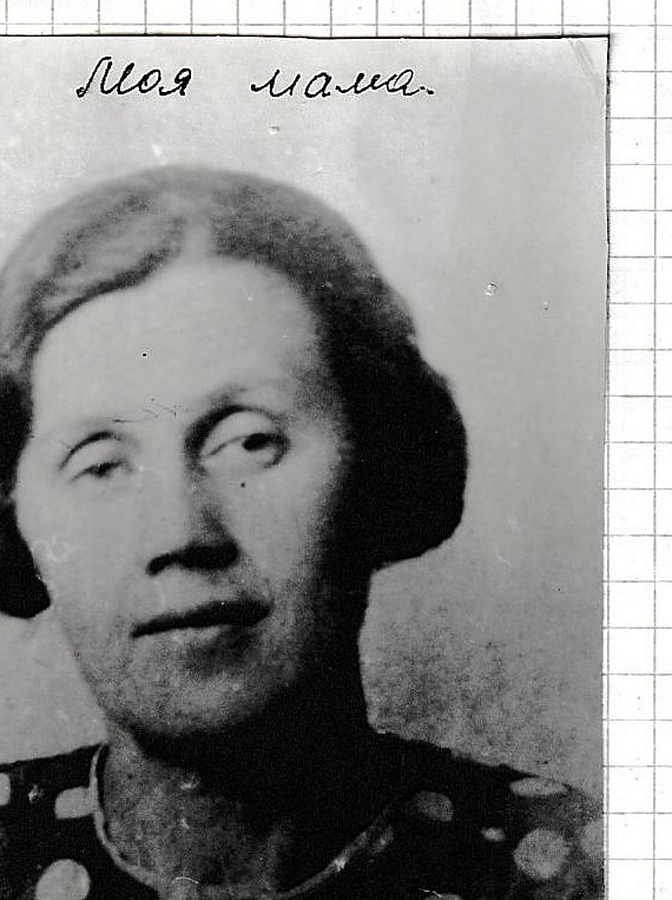
Eva Konstantinovna — “My mother.”.
Mother
My mother is Samsonova Evdokia (Eva — that is what
her father and husband called her) (Morozova)
Konstantinovna.
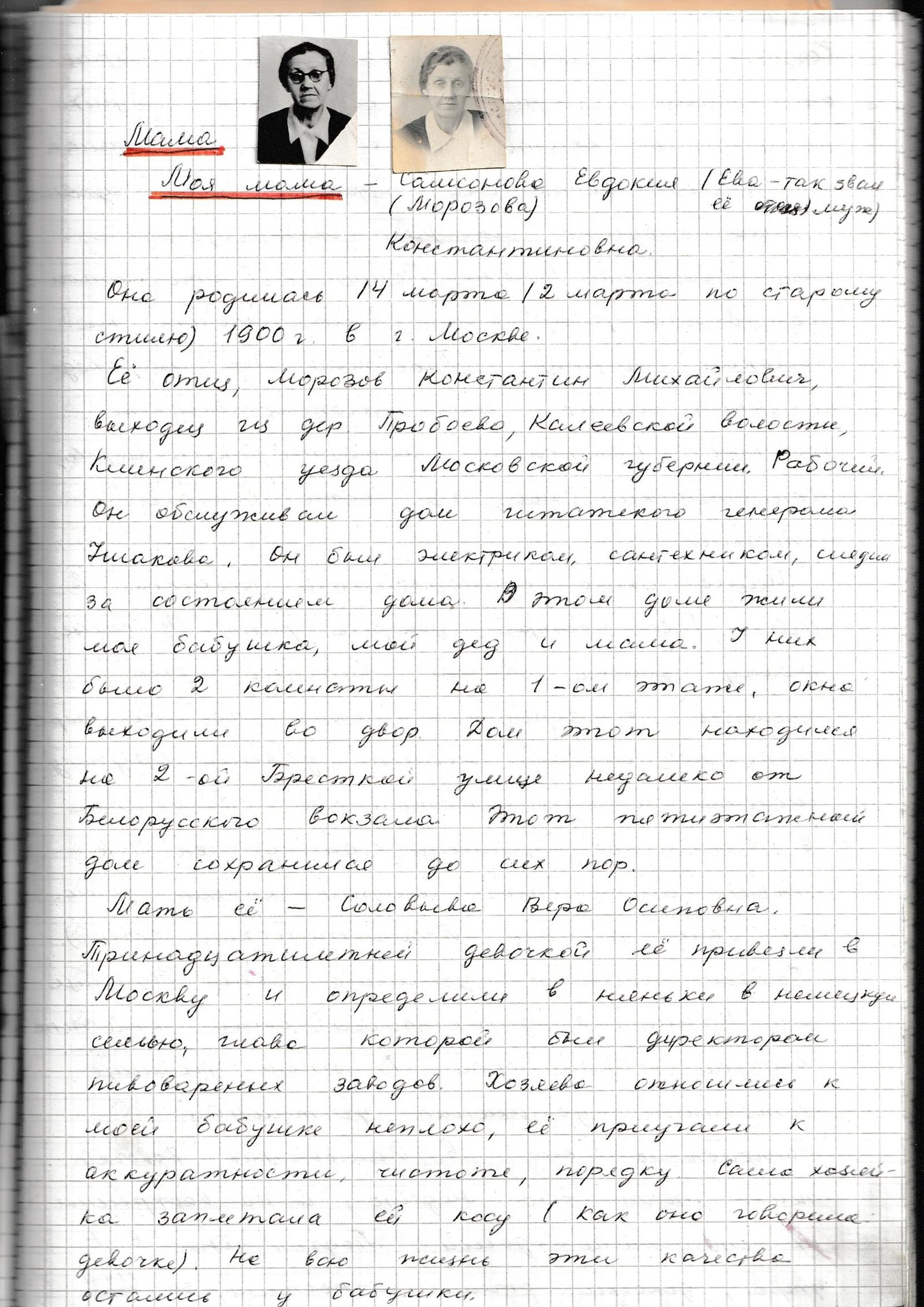
Two portraits of Mama on the notebook leaf (p. 007): in glasses, dark clothes; an earlier lighter portrait.
She was born on 14 March (2 March by the old
style) 1900 in Moscow.
Her father, Morozov Konstantin Mikhailovich,
came from the village of Griboevo, Kaievskaya[?] volost,
Klin uyezd of Moscow guberniya. A worker.
He looked after the house of the civilian general
Tikhanov[? / Chikalyov?]. He was an electrician, a plumber, and watched
over the condition of the house. In that house lived
my grandmother, my grandfather, and Mama. They had
2 rooms on the 1st floor; the windows
looked out onto the courtyard. That house stood
on 2nd Brestskaya Street not far from
Belorussky Station. That five-storey
house still stands today.
Her mother was Solovyova Vera Osipovna.
As a thirteen-year-old girl she was brought to
Moscow and placed as a nanny in a German
family whose head was the director of
breweries. The masters treated
my grandmother fairly well; they taught her
neatness, cleanliness, and order. The mistress
herself plaited her braid (as “her own German
girl”). Not all of those German qualities
stayed with Grandmother.
When the masters prepared to leave for Germany,
they asked Grandmother to come with them. But Grandmother
was afraid to go to a foreign land and stayed
in Moscow. Soon she met her future
[husband?]. Grandmother herself was from Ryazan guberniya,
the village of Bogoslovo (now Poshunovo[?]), which stands
on the bank of the Oka. The village stands on
a high bank. Passing by steamer
along the Oka past the village one can see
the tall belfry of the monastery church,
the monastery wood, where there is a holy
spring.
Mama was the only child in
the family (her sister died early). In the family
they called Mama Dima. At first she
studied at a city school where at recess,
in Mama’s words, they gave a mug of
milk and bread. Then she was placed
in the Ksenia School for girls. (The
general — the master of the house — helped with this.
He was a member of the Board of Trustees.)
The full name of the school was the School
named after Ksenia, and the headmistress was Princess
Drutskaya-Sokolinskaya[?]. At that school
they trained home teachers.
It was located in Khamovniki. The girls
lived there all week, and on Sundays
they were let home. Rise was at 7
in the morning; the girls made their beds; for this
a class mistress watched. Then they went to the wash-
room, where the girls washed to the
waist in cold water (there was no hot water),
combed their hair, cleaned their shoes. At the exit
stood the class mistress and inspected
each girl. If something was not
right, she was sent back to put the
fault right. Then there was a prayer and they went
to the dining room for breakfast. They had free time,
and often they walked in the park. Mama
told many interesting things about her school.
1917. Mama finished school and pinned
a red bow to her coat.
Even in childhood Mama dreamed of becoming
a typist, and passing by a pharmacy
she would stand for a long time at the window watching
the typist who was typing
prescriptions. Mama went to typing
courses and became a typist.
In 1918 her father dies of the Spanish flu (influenza).
He had gone to the countryside for food and fell ill.
At that time Moscow was hungry and
cold. He was buried at the cemetery of the Strastnoy
Monastery; in its place now stands the “Rossiya” cinema.
Grandmother did not work.
Having finished the courses, Mama took a job
with an organization called
“Tsentropechat”[?], and from there she was taken
to work at the Cheka as a typist in
the secret department.
Mama said she was very afraid to go
to work, because she was afraid she would spend all her money
on chocolate. She loved chocolate very much.
But the times were hard: there was not enough bread;
they made cutlets from potato peelings.
The winter was cold. The trams did not run;
Mama ran to work from Belorussky
Station to Lubyanka. Sometimes at work
they were given frozen potatoes, and Mama
hauled a sack of those potatoes on a sled
to Belorussky Station. They worked late,
so she had to drag those sleds through
dark Moscow.
Mama told many interesting things about
old Moscow. “The horse-drawn tram ran along the Garden
Ring, and when it approached Mayakovsky
Square the conductor would shout: ‘Trukhmany
(instead of Triumphal) Gates.’
‘At 6 in the evening Moscow is quieter than water,
lower than grass.’ Mama was sent to Tverskaya
for sweet fruit, and also Grandmother’s —
a kalach. A samovar stood on the table; over
the table hung a lamp (still kerosene);
Grandfather put on his glasses and began to read
aloud the newspaper Moskovskie Novosti.
So Mama works at the Cheka, where she
met her destiny: Samsonov Timofey
Petrovich, head of the secret department.
Soon they married. Father was older than
Mama by 12 years.
Continued in: Father, marriage and children .
← Cover and family charts · Notebook contents · Father, marriage and children →