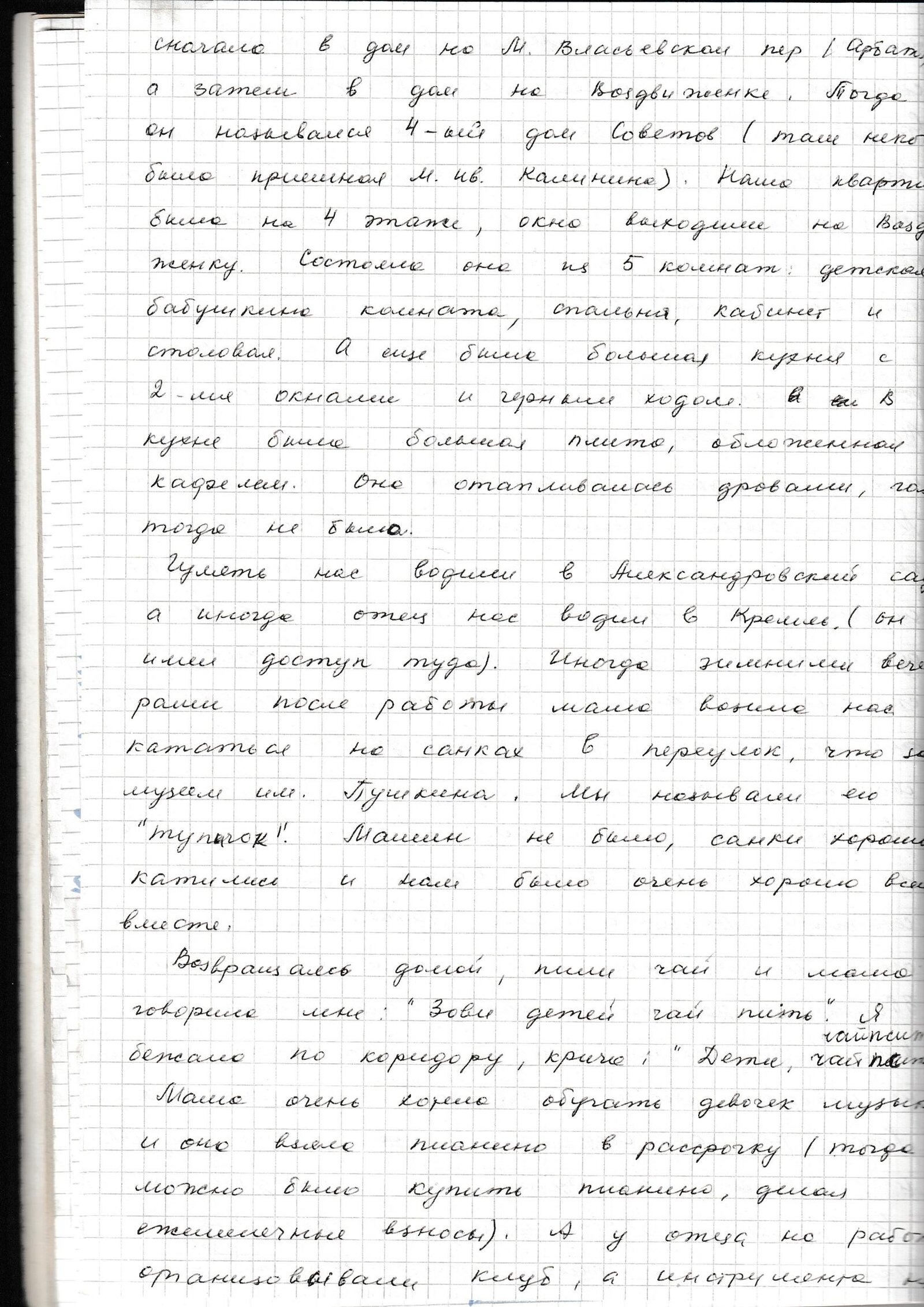
From Tatyana Timofeevna’s handwritten notebook “Our genealogy: the Samsonovs”. First person. [?] = unclear passages. Page numbers (p. N) are given in the comments.
This is a photograph of Papa — one of my favorites
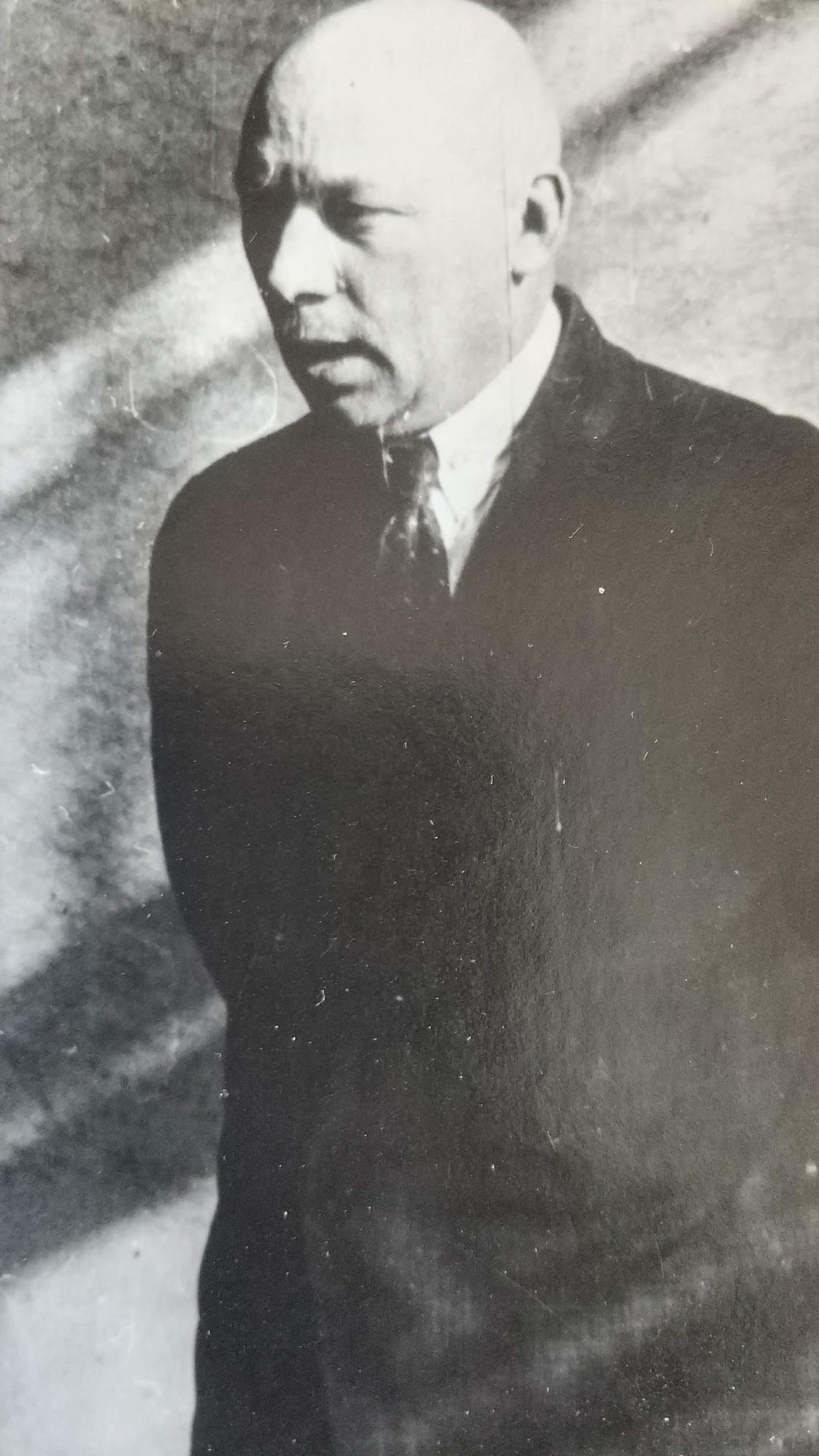
“This is a photograph of Papa — one of my favorites.” Three-quarter profile; on the notebook leaf (p. 033) a note that the print was badly pasted.
[In the margin to the right of the photo, in small writing:]
Badly
pasted
cannot
re-
paste
cannot[?]
Here he looks very much like his true self
Papa
I remember him from about the age of 3. At that time we lived
on Vozdvizhenka. Papa worked a great deal, and
we rarely saw him in the evenings. He loved
children very much and knew how to deal with them.
He never raised his voice at us;
[he was] very restrained[?] with the children. I remember Papa had
spectacles — a pince-nez. I put them on my 3-year-old
nose and ran to the kitchen. Naturally
the spectacles fell to the floor and smashed. Mama
said angrily: “Go on, go to Father and
show him what you’ve done.” I became very
frightened; I walked slowly down the corridor
thinking about how Papa would
scold me.” I went up to Papa, showed him
the spectacles, barely holding back my tears. And Papa said:
“Well done, little girl,” and kissed me on the nose.
I dimly remember one episode.
I was less than 3 years old; I don’t know how man[y].
I only remember that in the evening the whole family
sat down in the evening for tea in [our?]
dining room; a pillow was laid in the middle
of the table, and I was set on the pillow.
I too sat at the table with everyone.
Mama used to tell how when my brother was
still quite little (an infant) Papa often
pulled out a drawer of his writing desk
(while he himself sat and worked); they put
something soft in it, and Teshka
lay in the drawer next to Papa.
Papa said that he worked so well that way.
Mama recalled this incident: we
children were in the nursery, and I was sitting in
my pram; Mama went off to the kitchen,
and left in the room Genya and Tesha,
and of course me. Mama asked them to look
after me. They were delayed somehow
in the kitchen, and suddenly she hears our loud
laughter. Mama came from the kitchen and
found out what they had seen: the children had
poured drawing pins into my pram, and
we were merrily playing with them.
In our flat there was a bath that
was heated with firewood, since then in the house
there was neither gas nor hot water.
Mama put us three into the bath together.
I always got in last, because I
wanted to sit in the water longer.
Then Mama poured warm
water over us from a large jug. Then
the adults bathed, then Mama washed
the dog. (We had an Irish set-
ter[?]), and only then did it come
to “herself.” Having washed, Mama
went into the bedroom, and there hung
such a picture: Papa lying on the bed,
and next to him on Mama’s pil-
low lay Jack’s head; he was resting
after the bath — and I must say Mama
had just put on clean linen.
And Papa lies there and smiles.
(That was how Papa “joked” with Mama)
Once this sort of inci-
dent happened to us. We were sitting in the nursery occupied with trans-
fer pictures. But alas, the pictures ran
out, and we still wanted more and more. Then
my sister and brother decided to take money from Grand-
mother — it lay in the chest of drawers — and
go to Voentorg (the former Economic
Officers’ Society, or as we
called it, “Ekonomka”). This shop was
two or three houses from ours.
I was ordered to sit quietly in the pram.
And they promised to come back quickly; as
they put it, they would go by cab.
I was then 3–4 years old, my brother accordingly
4, my sister — 10. They left, and I grew
bored; it seemed to me they had been
away a very long time. Grandmother was
in the kitchen, and after waiting a little longer
I ran to her. I sat on the bed (? and
behind a screen there stood a bed for the children[?]).
The kitchen was large, two windows.
Grandmother asked me where the children were. I
said “nothing,” then said they
were in the pram, and then they had run about[?].
Just then our parents came home, and
the children still were not there. Suddenly the doorbell rang,
and Mama had to open the door.
I can still see their astonished faces,
and they had thrown all the purchases in the hall.
Here Papa appeared and the “inquir[y]” began.
I was not summoned; I was a “witness.”
First behind closed doors he
talked with Genya; they looked through her [tenyu? / notebook?],
diary (it was brown), and then
came Tesha’s turn (he had a little suitcase
that was black). Neither parent
raised their voice; the punishment was
as follows: Tesha and Genya were stood in
different corners. And I got all
the pictures. As I was led past Tesha, I
smirked: “Predanie”[?]. But afterwards the matter
was settled peacefully.
A music[?] teach-
er[?] used to come to Genya and Tesha. They studied together, and
because of my age I was not taken. This hurt
me very much, to sit and wait until they
would allow me to sing. At the end of the lesson
they sang a German song and called
me to sing. I would jump up with all my might,
take my little chair, sit down, and in Ger-
man sing louder than anyone.
In the evening we drank tea. And Mama would say to me:
“Then[?], call the children to tea.” I would run down the
corridor and shout: “Children, tea”
[Top of the page rubbed out / overwritten; reading uncertain]
Mama [decided to buy?] a piano in order
to teach [the children music?]. Later one
could buy [it] on hire purchase; Mama
paid the [first?] money and the piano
was delivered. Mama carefully made the payments;
a little remained to pay and the piano
would pass into our ownership.
And at that time in Papa’s organization
(the Cheka) they were setting up a club, and there were
no instruments. Then Papa decided to give the
common[?] piano to the club. He told
Mama about it before work. Mama de-
cided that in the evening they would discuss this
question. In the evening, returning from work,
she did not find the piano. Papa
had given the order. (He called “property”
“reversible”[?]).
Mama was very neat and
cleanly. Before a move everything in the house,
the flat, was tidied; the windows were washed,
the floors polished. Mama bought us
new toys and set them
on the étagère, which still
exists now. Papa used to tease her,
saying she herself was not averse to playing.
But our most beloved doll was
the doll Mama had sewn for us.
Its head was not round; the face
was drawn with an indelible pencil,
but to my sister and me it was very
dear, and we often quarreled with her
over whose turn it was to play with it.
And as for the dolls that were
bought for me, I dealt with them like this: [laying?]
the doll on the table, I took a hammer and
struck at the eyes. And the doll’s face
was porcelain, and the eyes closed.
Then I would shake the doll for a long time and one
could hear something rattling
inside. Then I took a towel and
shackled[?] the doll. No one scolded me
for this.
And here is another incident. We lived on
the 4th floor; the windows were large,
and Genya and Tesha opened the inner
window, set me between the windows
and closed the window. I found it interesting
to look out at the street: trams going by,
cabs and cars driving past. And suddenly
Mama came into the room; she froze;
she said not a word, calmly
went up to the window, opened it and
One winter Mama bought us woolen
jumpers: Genya a green one, Tesha a blue jump[er?],
and me a red jumper. I climbed up and sat
in my bed with a mesh and was cutting
something. Mama had bought us special
scissors with rounded ends (I
still have them now). Then
I moved on to the stockings (as I remember they
were black) and began cutting
little windows[?] at the knees. Genya was sitting on my
bed, and I began cutting her new
jumper, but I did not manage it.
And then our resettlement to
the new house began.
The thing was that at that time Papa
was Administrator of Affairs of the Central Committee of the VKP(b);
a new house was being built on Vsekhsvyatskaya
(now Saratovskaya), and Papa was on
the commission for settling this
house. The chairman was Kaganovich.
Looking through the lists of future residents
Kaganovich did not see the name Samsonov.
He asked why? Father answered
that we had a good flat,
only there was no gas, no lift, no
hot water. And in the new house all
of that was there. Father agreed and we
began to get ready. (The new house was
the first house built under Sov.
power). We were given a flat in entrance
12 on the 4th floor. Flat 223.
It had 6 rooms. It seemed to Papa
that that was too many. He said
that other people did not have
such good ones. Being in charge he
simply took and separated off 2 rooms and made
a flat of them. Part of the corridor
was bricked up; on the [stair]
landing a door was hung
leading into the two-room flat.
The Frolovskys lived there. The flat
was furnished; things had been brought in.
When our parents came to look at
the flat they were astonished at the fittings;
Father at once took everything down; the
things were removed, because he said we needed
nothing, we had everything. We slept
on iron bedsteads. One very
large room Father ordered to be di-
vided by a partition, and the result was 2
rooms: the parents’ room with 2
windows and a large balcony, and the 2nd —
the dining room with 2 doors. Tesha and
Grandmother had small rooms
with balconies, and Genya and I had
[Top of the page heavily rubbed out / pale ink]
[A large?] room with […], oct-
agonal[? …]. That is where we settled
with Mama. The new block. This was at
the end of 1930 [and/or] 1931. The house was still
being finished; not everything was built yet.
Rubbish. Not [clean?] we walked…
That is how I [met?] my future girl-
friend Marina [surname?]. She was [about] our age.
We were then about [6–7? / 4 years?]. She
informed me: “My papa has died, and Mama
is sitting at Grandfather’s (F. Kon) and crying.”
They lived in entrance 10.
During the move an unpleasant incident happened
with my brother. He loved cars very much and
at the first opportunity climbed into a
car and sat at the wheel. That is how
it happened this time. Tesha was about
6–7. We were just moving to
another house. By our entrance
stood a passenger car; some
things were being loaded into it; the car
door was open. Teshka
climbed into the car, sat at the wheel
and somehow released the brake. The car
began slowly to roll downhill, since
the street at that place was sloping,
leading toward the Manezh. Fortunately the door
caught on a lamppost, and
the motion slowed a little. And
at that moment the chauffeur came out of the entrance
(Novikov — he was a good man) and rushed
to the car and pressed the brake.
And pulled out from there a brother frightened half to death.
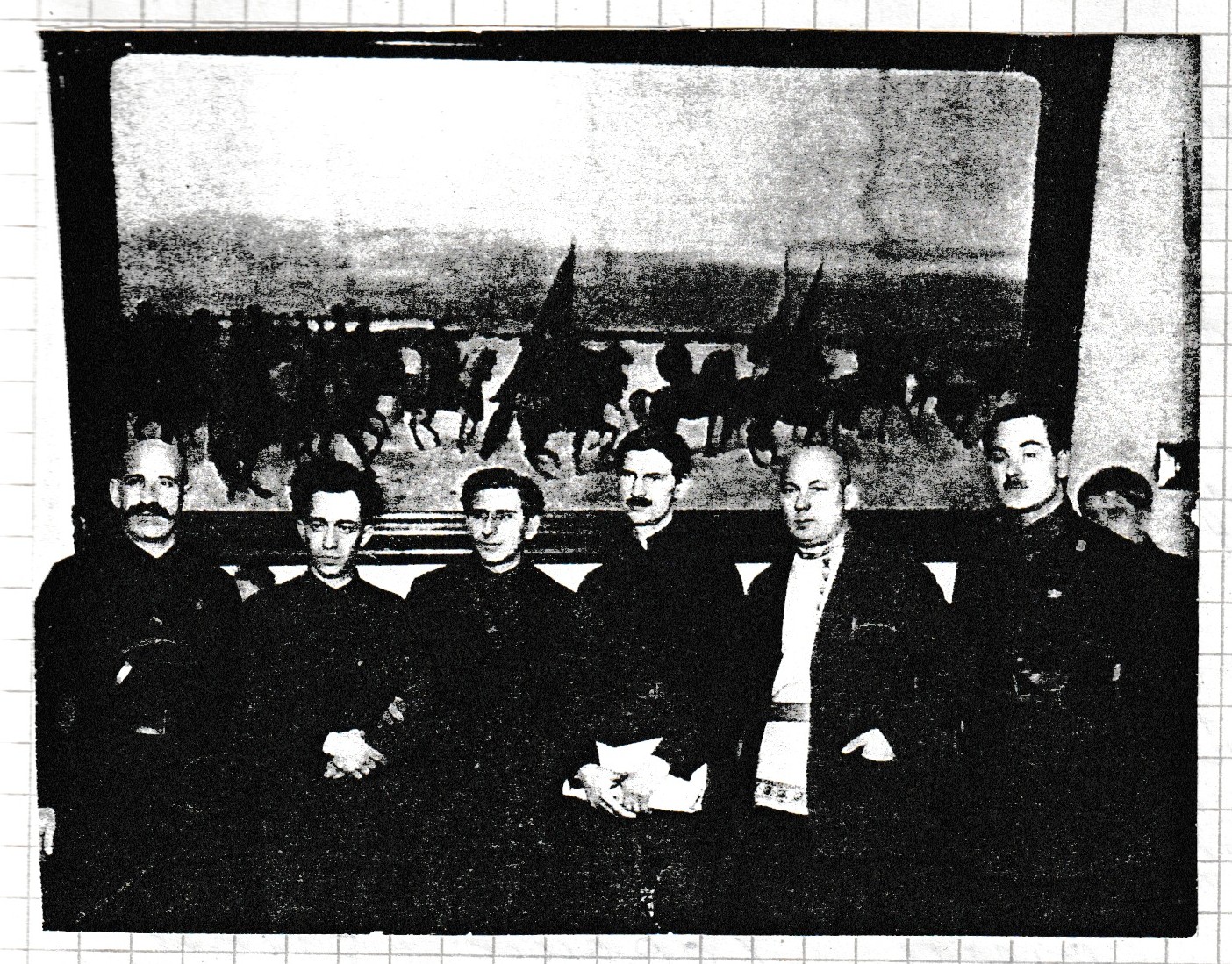
At the Central Committee of the VKP(b). Papa is second from the right; third next to him is Postyshev. Papa — Administrator of Affairs of the CC.
[Caption on the right:]
At the Central Committee of the VKP(b)
Papa is second
from the right.
Third next to
him is Postyshev.
Papa — Adminis-
trator of Affairs of the CC
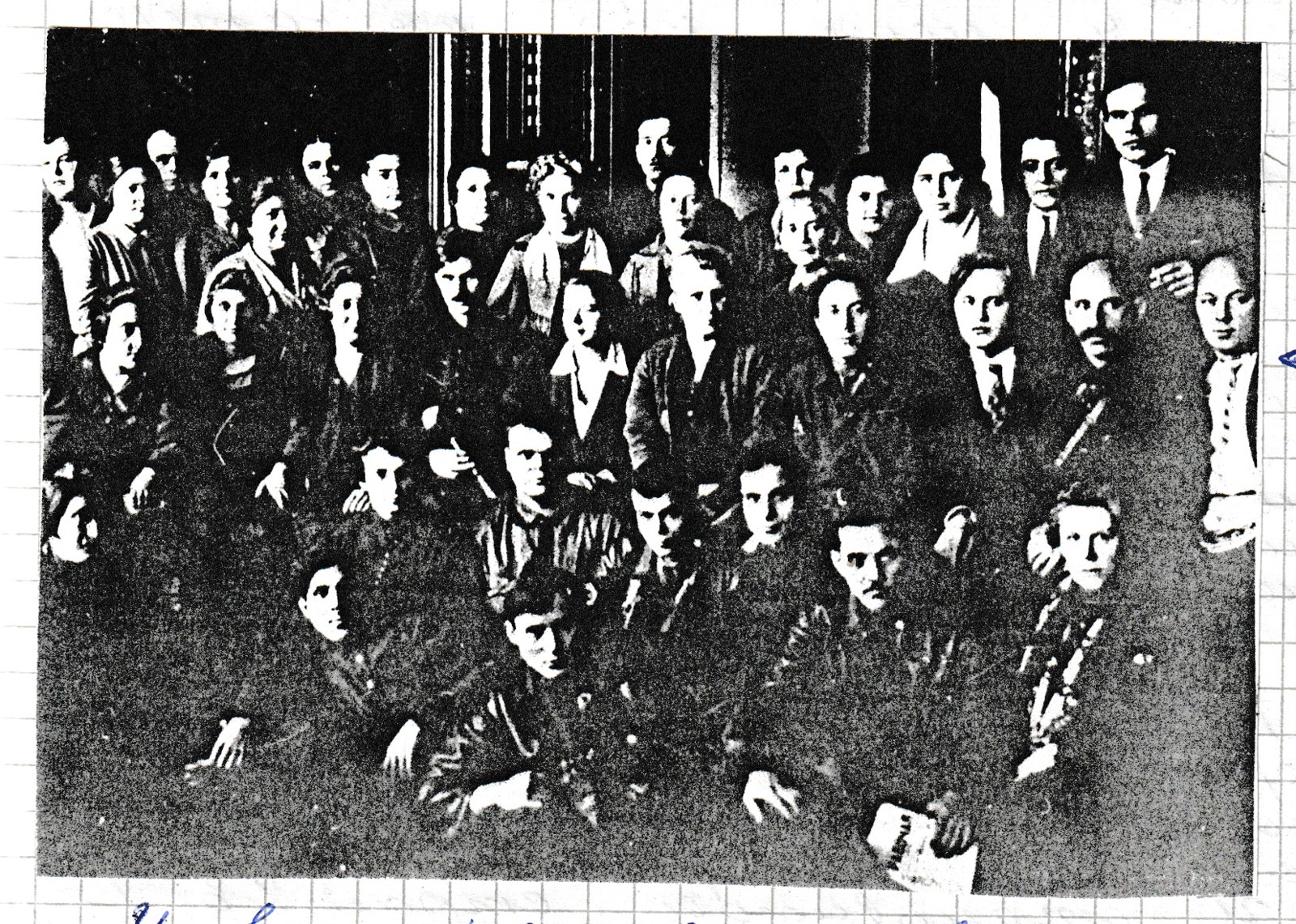
A meeting at the CC. Papa — at the edge (← Papa).
[Caption on the right:]
Some
meeting at the CC
Papa — at the edge
← Papa.
And so a new life began in the new
house.
Papa was a great book lover; he
and Mama collected a large library.
When Papa was free on weekends
he often went to bookshops; he especially loved
to visit second-hand bookshops. In our
old house on Mokhovaya there was such
a little shop. By nature Papa
was a Slavophile and especially loved
Russian history, which he knew very
well. He was particularly interested in the age
of Peter I. He had collected the works of Klyu-
chevsky, Solovyov, Kostomarov, Rozhkov,
and others.
Papa treated books with great care and
neatness. And he trained us
to the same attitude toward the book
We had no right without his permission
to take his books. If we needed
a book, we asked him.
We had Brehm’s work, and for
zoology I often had to look up
pictures of animals. I remember Papa
would take the book; we found what we needed; he
took tissue paper and traced
the picture, and then I myself
transferred it into my notebook.
Papa published a book, Outside the Law. In it he described exile to Siberia.
Our[?] children, the parents also collected
a library. A cupboard was specially bought
for our books. From
childhood we were brought up to the book.
And Papa also knew geography
very well. Above my bed hung
a large geographical map
of both hemispheres, and as far as
possible Papa and I made jour-
neys.
Father was very neat, and
he had a good penknife
(I still have it to this day). It lay
in a special place[?] of leather.
And I very much loved it when Papa
sharpened pencils for me; they came
out even and true for him.
I return to books. Papa especially
loved Lermontov and wrote a little
himself. From earliest childhood I memorized
the poem “The Airship,” and it became frightening when
he reached the lines: “Then from the coffin
the emperor, waking, appears at once,
on him a tricorne hat and a grey
campaign coat.” At that I tried
to keep close to[?] Papa. Sometimes he would hum
this poem to a melody of his own.
I remember it. Then my most
beloved writer was Lermontov.
Now, already grown up, with grown
sons of my own, I still cannot understand how
our parents, without shouting and smacks, man-
aged to bring us up in such a way.
We could not touch our parents’ things,
especially the books; we did not climb behind
Papa’s[?] writing desk; we had
our own [places] at the table; each had
his own place: Papa — in the center, Mama —
The sentence breaks off. No continuation was found in the available leaves.
Manuscript, squared notebook; continuation of family memoirs (cats, kitchen garden, the south).
There were always cats in our house. We children
often quarreled over them. Each
wanted to drag a cat into bed with them.
Of course when we went away to the dacha, the
cat was taken along, and the tom Lyubik
hated cats; our cat he
tolerated and even sometimes ate with her from the same
bowl.
Papa and Mama loved cats too.
Even when we had grown up, the
parents still had a cat, Ksanka;
when she had kittens, Papa took a large
basin, laid all sorts of soft things in it
and installed the whole feline family
under his bed. And when the kittens
grew up a little, Papa played with them, made
them various little paper airplanes,
and then Mama looked for good
people to place
a kitten with. With tears in her
eyes she parted with a kitten.
Ksanka (or Ksenia Zakharovna) was their
last cat.
In the kitchen garden we also had to work:
we weeded a little, watered a little; when
the nights were cold and the cucumbers were small,
we covered them for the night with news-
papers.
When the cucumbers began to grow, we
wanted to try them. But they were
so small it seemed a pity to pick them.
And my brother and I crawled along the path
to the cucumbers, thinking no one
saw us, while Grandmother stood on the
porch and shouted: “I see you, I see you!” And we
went away empty-handed.
When the carrots grew, I
very much wanted to try them. I went up
to the bed, pulled out a carrot. Seeing
that it was small, I stuck it back
into the ground, and of course it died.
Papa could not understand what
was the matter with the carrots — they were wilting.
Papa advised us to dig our own beds
and look after them. We gladly
made our beds, planted, and then
the ardor faded; we forgot about them
and nothing grew for us.
Sometimes in summer our parents went south
to Sochi and took us in turn, or even
two or three of us. We stayed at good
rest houses (“Vasilyevka,” “Zinovyevka”). These were
small non-standard dachas, named
after their old owners! The places were
fairy-tale.
Once Papa took me with him on leave
to Kislovodsk. He suffered from his stomach and went
to the waters for a month at a time. We were with him at
the sanatorium “10 Years of October.” I remember: I—
I[?] Papa and I traveled a great deal;
I was about 6. It was spring.
Papa and I went around all the environs
of Kislovodsk. He showed me how to climb
mountains, and to this day, when I climb
a height, I always remember
him and his advice. Sometimes Papa had
to climb first, and I stayed
below; I grew frightened; Papa
above, and no one around. Then Papa
winked at me, and the fear passed!
Papa nearby. And then we rode not
in cars, either in little carts-wagons, or in
[?]ines, water. I don’t remember exactly. Only
in my memory remained the beauty of those
mountains, wild poppies — whole fields. Papa
showed me Lermontov’s grave.
(in the left margin, by the paragraph on walks / Lermontov:)
And of course during our walks
Papa read Lermontov to me.
When Papa worked in Metrostroy
(he was the director) he took me to
Leningrad; he was going on a business trip.
We stayed at the Hotel “Evropeis-
kaya”; our room was luxurious!
I was struck by the bath: large, a room,
with extraordinarily beautiful taps,
and the bath itself large, extraordinary.
The suite was made of 2 rooms. When
Papa was busy, I sat in the room
and looked at everything with love-delight[?].
I had never yet seen such luxury.
When Papa was free, he
showed me Leningrad, and at Gostiny
Dvor he bought me a doll and for it
a bed, and also for it[?] me[?]; it
was green with black. Afterwards the
girls in the courtyard teased me.
Sometimes Papa held meetings in
the room; many people gathered, and
I sat quietly as a mouse somewhere
in a corner.
I remember that one summer we had
staying with us the director Gudkin[?]; something
had happened to him, and Papa invited
him to our dacha to rest.
I remember that he very much[?] like goods[?]
semolina porridge. He very much liked
how our grandmother cooked,
and she did cook truly deliciously!
Manuscript (blue ink); a sheet apparently from a letter/address to a child or grandchild; on the scan the text is often turned “on its side” (landscape). At the top: “-1-”.
My dear little friend!
I don’t know whether it interests you to read
about your grandma? But all the same I decided
to continue. So I am 4 years old, and
we are moving to a new house, the one on
Serafimovich Street. Our flat No. 223
was on the 4th floor, and the windows
looked out onto the Moskva River and onto the back
courtyard, which for some reason we
called “Stinky.” In our flat
there were 6 rooms, but Papa decided that
was too many. Since
it was in his hands, the CC dachas and the management
of this house (of which he was the house[?]),
he decided upon the settling of this
4th floor to create another flat.
Our entrances were different. We
were simply neighbors on the floor. And
one large room Papa divided
into 2 and the result was the parents’
room and the dining room. My sister and I lived
in one room, fairly large.
Auntie and Grandmother’s rooms were
small ≈ 10½ sq. And so I found myself
in the new house and, as you know, stayed[?]
in it a long time. Here I
met new girls
with whom I lived as neighbors.
Only one remained — Inna.
Reference notes for this chapter
Names and places mentioned
People
- Narrator — Tatyana (as a child; writes “about your grandma” on p. 050 — address to a descendant).
- Papa — Samsonov T. P. (Timofey Petrovich): worked a great deal; head of a department of the CC of the VKP(b), Party membership from 1919; played billiards well; loved the flower garden/kitchen garden; director of Metrostroy (in the text — “in Metrostroy… he was the director”); took his daughter to Kislovodsk and Leningrad; read Lermontov to her; held meetings in the hotel room.
- Mama — Papa’s arrival at 5 in the evening; told about the crows at the dacha; with Papa loved cats; looked for homes for kittens.
- Brother — sat to Mama’s right at table; slept in a large dark room; crawled with the narrator to the cucumbers.
- Sister — next to the narrator; lived with her in one room (on Serafimovich Street).
- Grandmother — room at the dacha; on the porch shouted “I see you, I see you!”; cooked deliciously (incl. semolina porridge for the director).
- Auntie — room ≈10½ sq. in the flat on Serafimovich Street.
- Residents of the dacha’s 2nd floor: Lavrukhina[?], the Pavlunovskys (nanny/ovarka Venka), family of chauffeur Novikov, the Lilyakins[?] (margin).
- Tom Lyubik; cat Ksanka / Ksenia Zakharovna (the parents’ last).
- Director Gudkin[?] — stayed at the dacha.
- Childhood friend Inna — remained from the neighboring girls.
- In the printed lists underlined/marked Samsonov T. P. (see below).
Places
- Serebryany Bor, dacha from 1927: 1st prosek (line), house No. 2, circle of bus stop bus No. 4; nearby a school (pre-rev., one-storey, of century-old pines) — a camp in summer.
- Dacha: log, 2 storeys; balcony, billiards, 2 entrances (main onto the balcony / back); plot, flower garden, kitchen garden.
- Serafimovich Street, flat No. 223, 4th floor; windows onto the Moskva River and the courtyard “Stinky”; originally 6 rooms, then reconfigured (a 2nd flat on the floor).
- Kislovodsk, sanatorium “10 Years of October”; Lermontov’s grave; rest houses “Vasilyevka,” “Zinovyevka” (Sochi / the south).
- Leningrad, Hotel “Evropeiskaya”; Gostiny Dvor.
- Sochi — parents’ summer trips with the children in turn.
Dates / ages / Party biography (Samsonov T. P.)
| Event | Details on the pages |
|---|---|
| Dacha at Serebryany Bor | from 1927 |
| Move to Serafimovich Street | narrator 4 years old |
| Kislovodsk with Papa | ~6 years, spring |
| 16th conf. of the VKP(b) | 1929, No. 519 (extract) |
| 16th Congress of the VKP(b) | 1930, delegate with consultative vote, No. 685 |
| 17th conf. of the VKP(b) | 1932, No. 398 |
| 17th Congress of the VKP(b) | 1934, delegate with consultative vote, No. 570 |
| 15th Congress of the VKP(b) (print) | in list No. 601: Samsonov T. P., head of a department of the CC of the VKP(b), Party membership 1919 (p. 045) |
| 17th Congress, consultative vote (print) | No. 570: the same (p. 046; check mark) |
Everyday life / objects
- Papa’s routine: home at 5, an hour’s rest, work again; returned when the children were already asleep.
- At the dacha: large deal sofa, children’s billiards; cabin for a domestic worker.
- Flowers: mignonette, daisies, carnations, marigolds (tagetes), snapdragons, spitsy[?], sweet tobacco, sweet peas.
- Kitchen garden: cucumbers (covered with newspapers), carrots; children’s beds.
- Doll (green with black) and a bed for it — purchase at Gostiny Dvor.
- Flat after the division: parents’ + dining room from one large room; children in one large room; auntie and grandmother — small rooms.
Genre of pages 042–047
- 042 — handwritten extracts on the participation of Father (Samsonov T. P.) in congresses/conferences.
- 043–047 — pasted-in/scans of printed lists of delegates of the VKP(b) (15th; lists with consultative vote; Appendix III), with handwritten headings “Father’s participation in the work of the congress” / “…of the 17th congress.”
Uncertainties (do not invent)
- Residents’ surnames: Lavrukhina / Paerkhina[?]; “ovarka Venka”; “the Lilyakins” in the margin.
- “spitsy” in the list of flowers.
- “house[?]” in the wording about the house management (p. 050).
- Director’s surname: Gudkin / Goodwin / Gutkin[?].
- Some minor surnames and dates in the printed tables (marked
[?]). - Exact correspondence of No. 685 (16th Congress, p. 042) to pages 043–047: on 043 the list breaks off at 665; on 047 under No. 685 — Tskhakaya (another list/edition).
Names and places (earlier pages)
Persons
| Who | How named | What is said |
|---|---|---|
| Author’s father | Timofey Petrovich Samsonov (Papa) | Bust/museum: 1885–1955 (plaque); centenary — 9.V.1985, v. Mikhaile[ny?]. Administrator of Affairs of the Central Committee of the VKP(b). Loved children, never raised his voice; pince-nez spectacles. Book lover, Slavophile, history (age of Peter I). Book Outside the Law (on exile to Siberia). Loved Lermontov, wrote a little himself; sang, incl. “Reve, tai stohne…,” “The Airship” to his own melody. Sharpened pencils with a penknife. |
| Author / narrator | T. (Tatyana; signature “T.” by the bust photo) | Remembers Father from ~age 3; youngest among “Genya, Tesha, I” in a number of episodes. Has grown sons (at the time of writing). |
| Sister | Gena / Genya | Author of verses about Papa. In the Voentorg episode — “sister — 10” when the author was 3–4. Shared a room with the author in the new house. |
| Brother | Tesha / Teshka | As an infant lay in the drawer of Father’s writing desk. ~4 years old in the Voentorg episode; ~6–7 — the car incident at the move. |
| Mother | Mama | Strict but without shouting; sewed a doll; bought a piano on hire purchase; woolen jumpers for the children; neat, cleanly. |
| Grandmother | Grandmother | Money in the chest of drawers; was in the kitchen; in the new house — a small room with a balcony (with Tesha — each?). |
| Friend | Marina [surname?] | Author’s friend; lived in entrance 10 of the new house; said her papa had died, Mama is crying at Grandfather’s (F. Kon). |
| Neighbors | the Frolovskys | Two-room flat separated from the Samsonovs’. |
| Chauffeur | Novikov | “He was a good man”; stopped the car with Tesha. |
| Colleagues / well-known | Kaganovich | Chairman of the commission for settling the new house. |
| Postyshev | In the photo “At the CC of the VKP(b)” — third next to Papa (Papa — second from the right). |
Places
- v. Mikhaile[ny?] — unveiling of the bust and museum of T. P. Samsonov, 9.V.1985.
- Vozdvizhenka — the flat where they lived when the author was ~3.
- Serebryany Bor — summer songs in the garden with Papa (burka, tobacco flowers).
- Voentorg / “Ekonomka” (former Economic Officers’ Society) — 2–3 houses from the old flat.
- Mokhovaya — old house; nearby a little second-hand bookshop.
- Vsekhsvyatskaya (now Saratovskaya) — the new CC house; “the first house built under Sov. power.”
- Entrance 12, floor 4, flat 223, originally 6 rooms (2 separated off → for the Frolovskys).
- Street sloping, led toward the Manezh.
- Entrance 10 — friend Marina.
Dates / ages
- Plaque on the bust: 1885–1955.
- Unveiling of bust/museum: 9 May 1985.
- Author: <3 (tea on the pillow); ~3 (pince-nez; Vozdvizhenka); 3–4 (Voentorg; brother 4, sister 10).
- Move: end of 1930 / 1931; Tesha ~6–7; author then ~6–7 (by her words about meeting Marina).
Objects / everyday life
- Dog: Irish setter[?], name Jack.
- Bath heated with firewood (no gas or hot water in the old house).
- Piano bought on hire purchase → given to the club of Father’s organization (the Cheka).
- Doll sewn by Mama (face with indelible pencil); bought porcelain dolls.
- Brehm (zoology); tissue paper for tracing pictures.
- Geographical map of both hemispheres above the author’s bed.
- Father’s penknife (the author still has it “to this day”).
- Iron bedsteads in the new house; places at the table: Papa in the center, Mama — [breaks off].
Books / culture (Papa)
- Works: Klyuchevsky, Solovyov, Kostomarov, Rozhkov and others.
- His own book: Outside the Law (exile to Siberia).
- Lermontov: “The Airship” (quotation about the emperor, the tricorne hat, the grey campaign coat).
- Sang Ukrainian: “Reve, tai stohne Dnipr shyrokyi.”
Photos on the pages
- 031 — bust of T. P. Samsonov (plaque 1885–1955).
- 033 — portrait of Papa (“looks very much like his true self”).
- 039 — two group shots at the CC of the VKP(b); in the upper one Papa second from the right, Postyshev next to him; in the lower — “at the edge,” arrow “Papa.”
Uncertainties (do not invent)
- Exact spelling of “Koblan[?] dog” / “with faith — tail” in Genya’s verses.
- The word “[tenyu?]” (Genya’s thing at the “inquiry”).
- “Predanie” — the author’s remark at the punishment.
- Surname of friend Marina; expansion of “(F. Kon).”
- Full top of rubbed-out paragraphs on 036 and 038.
- Correspondence of the age “sister — 10” with other genealogy sources — only as recorded here.
← Father, marriage and children · Notebook contents · War, 1941 →