From Tatyana Timofeevna’s notebook “Our genealogy: the Samsonovs”. First person. [?] = unclear.
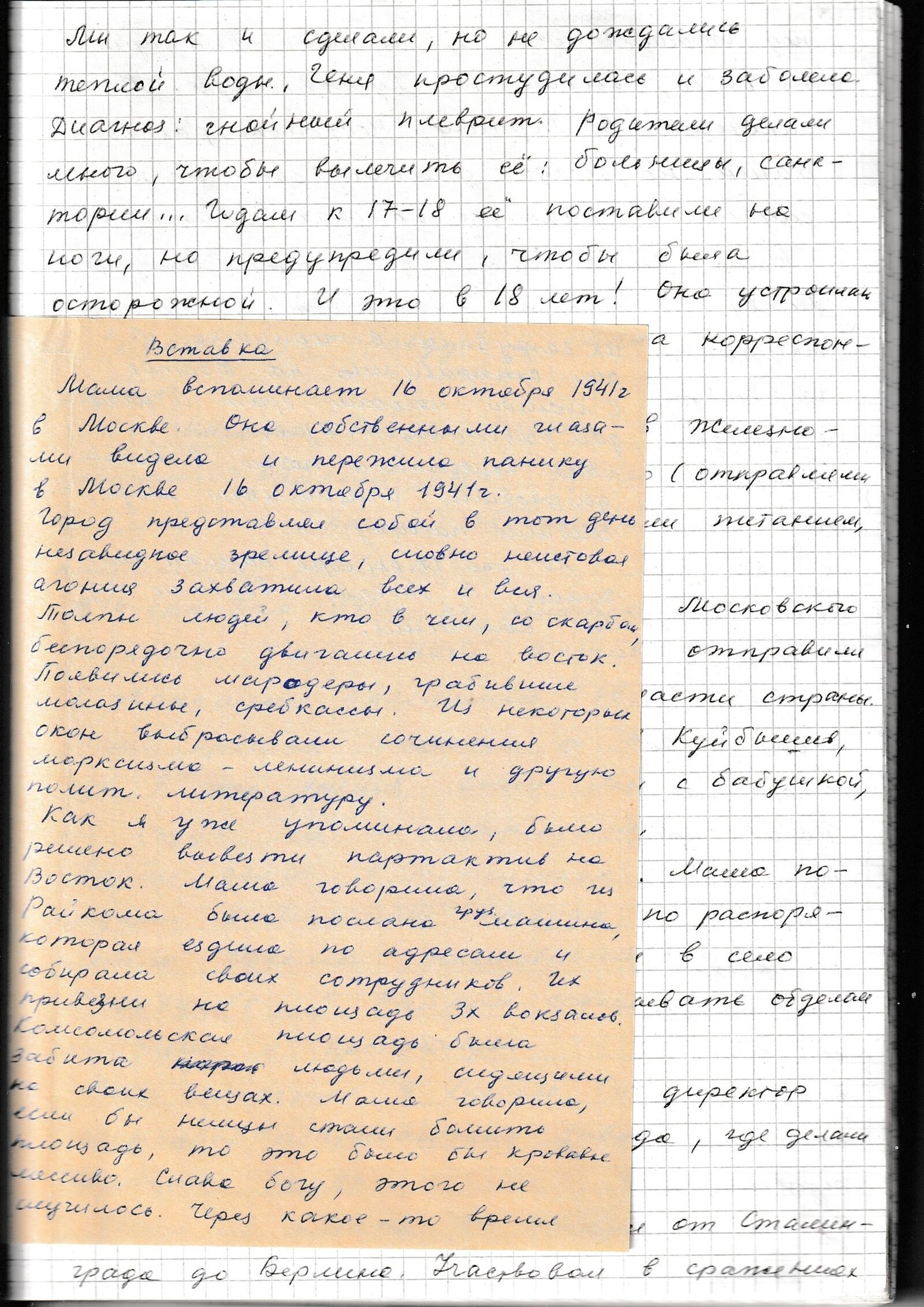
Insert about 16 October 1941.
On the notebook page lies a separate insert leaf (“Insert”) covering the middle of the notebook text. To the right and below the continuing notebook text is visible (the full text of the same notebook page is on p. 016).*
Notebook (top, above the insert)
We did just that, but did not think of warm water; Lelya[?] caught cold and fell ill. Diagnosis: purulent pleurisy. The parents did a great deal to cure her: hospitals, sanatoriums… By 17–18 they had got her on her feet, but warned her to be careful. And that at 18! She got a job
[…] as a correspon-
Insert (leaf)
Insert
Mama recalls 16 October 1941 in Moscow. She saw with her own eyes and lived through the panic in Moscow on 16 October 1941. The city that day presented a sorry sight, as if an inhuman agony had seized everyone and everything. Crowds of people, in whatever they had, with their belongings, moved disorderly eastward. Looters appeared who robbed shops, ran off[?]. From some windows they threw out the works of Marx–Engels–Lenin–Stalin[?] and other political literature.
As I have already mentioned, it was decided to evacuate the Party aktiv eastward. Mama said that from the District Committee 4 cars were sent that went round the addresses and collected their staff. They were brought to the Square of Three Stations. Komsomolskaya Square was packed with people sitting on their things. Mama said if the Germans had started bombing the square it would have been a bloody mess. Thank God that did not happen. After some time
Notebook (margins right / bottom, fragments under and next to the insert)
…at the Railway
…(they were sending
…echelons,
…of the Moscow
…they sent
…regions of the country.
…Kuibyshev,
…with Grandmother,
…Mama
…by order
…to the village
…to head the department
…director
…yes, where they made
…from Stalin-
grad to Berlin. Took part in the battles
(The full connected notebook text — see p. 016.)
We did just that, but did not think of warm water; Lelya[?] caught cold and fell ill. Diagnosis: purulent pleurisy. The parents did a great deal to cure her: hospitals, sanatoriums… By 17–18 they had got her on her feet, but warned her to be careful. And that at 18! She got a job at Pionerskaya Pravda and became a correspondent.
- The war began. There was a great deal of work at the Railway District Committee (they sent echelons to the front, supplied the echelons, received the wounded.)
On 16 October 1941, by decision of the Moscow City Committee, the Party aktiv was sent into evacuation to various regions of the country. Mama asked to be sent to Kuibyshev, where at that time Grandmother and we were, but she was not allowed there.
They travelled a long time, in teplushki [boxcars]. Mama ends up in Chelyabinsk, from where by order of the Regional Committee she is sent to the village of Moskrousovo, to the District Committee to head the agitation and propaganda department.
Father remains in Moscow. He is director of a metalworking plant where they made grenades and so on.
The son is at the front. He went from Stalingrad to Berlin. Took part in the battles
they were loaded into teplushki and set off eastward. With Mama went my brother and our house worker Rus[?].
As it later turned out, special people were operating in Moscow sowing panic.
But already on 17 October the panic was over. A state of siege was introduced in Moscow.
Context: evacuation / return (a village near Ryazan, the monastery belfry).*
toward Ryazan. It flies low, about to touch us. (So it seemed to us.) Morning came. Mama went to those girls and asked to stay with them until someone came for us. Mama and Grandmother stayed there, and Zhusa[?] and I went on foot to our village (the village of Poshchupovo), 18 km from the station.
At last we arrived. Uncle Misha went to the kolkhoz, asked for a horse and cart, and we set off for Grandmother and Mama. I was so tired; my legs ached, and besides we had not slept the night. I went into the garden, lay on the grass and at once fell asleep. Toward evening ours arrived. That was the 1st stage of our return to Moscow.
Mama was busy sending telegrams and letters to Moscow asking for a pass for us. And Grandmother needed care too, for she was very weak.
I began to work on the kolkhoz; we weeded something and so on.
We stayed with Grandmother’s brother Uncle Misha. There was little food; in the kolkhoz shops they gave us a little bread; we cooked soup of sorrel, whitening it with milk. At night they would suddenly sound an air-raid alert: they beat on a suspended rail. At first we went out of the izba, and then we got used to it. German planes flew toward Ryazan, and the landmark was the belfry
of the monastery that stood in that village. Food was scarce, and money was short too. And Mama and I went to the market to sell a few things and buy food. One had to see Mama as she (and I) stood in the traders’ row holding our things. At last everything was sold and we bought a little rye and potatoes. And it was a long way to walk; by evening we were home.
At last Mama received a pass from the District Committee, for herself, and I was not included in that document. But we decided to go with Mama; come what may. Grandmother had to be left with her sister, Aunt Larisa.
So we are going to Moscow: Mama bought me a ticket from station to station. Her Railway District Committee pass helped her out, because it was impossible to buy a ticket; people stood for days at the ticket offices. And we were also hauling luggage. So we got as far as Ramenskoye; from there electric trains already ran. And here we are in Moscow. But how to leave the station when I had no pass. We decided thus: I supposedly take Mama in charge[?], showing my Moscow birth certificate, and Mama — her pass. We checked our things as luggage and went by metro home. What joy! We are in Moscow! At last we reached home.
In the neighbours’ flat two rooms were occupied by staff of the Sovnarkom[?], the Flats[?].
Many of our things had disappeared: crockery, linen, curtains, sheet music, books and even toys. As if Mamai had passed through the flat. Carpets that had been sewn[?] disappeared; Grandmother’s handsome table; the carpet that lay on the couch. Father received us coolly; something had gone wrong between him and Mama. We had to begin life again. And the war goes on. Mama was very well received in the district. The bread factory gave us bread and rye rusks that they made for the front; the Babayev confectionery factory gave us 2 bottles of delicious syrup.
And then we were given ration cards: Mama — a worker’s (that is 800 g of bread a day), and me — a dependent’s (that is 400 g of bread a day).
Mama began to work at the District Committee; our school was not working, and at first I entered an externat that was housed in the Mining Institute.
In later years she worked at the Ministry of Railways, where she headed [Targin/Park/? — illegible].
In 1950 she was no longer working for health reasons; by then she was a Group 2 invalid.
Mama was a true comrade and
[end of page; continuation cut off / unreadable]
Text in the notebook (ballpoint, over the paste-in)
…medals: “For Valiant Labour in the Great [Patriotic?] War”
“30 Years of Victory in the Great Patriotic War” and others.
But while on pension she actively took
part in the work of the Party organization: she was
deputy secretary of the Party organization, an agitator,
spoke in military units, before stu-
dents.
Pasted-in letter (violet ink)
Dear Eva Konstantinovna!
In memory of our meeting we are send-
ing you photographs.
Once again we express to you our deep
gratitude for the meeting with you.
We wish you firm health
and many years of life.
In the large photograph you are talking
with the head of the political department, Colo-
nel Zinurov[?] Sergey Zagilyevich[?].
In the other photograph you are presenting
a Komsomol card to Private
Kudaev V. V.
With respect, the instructor
for Komsomol work
[signature] — Isaulova—
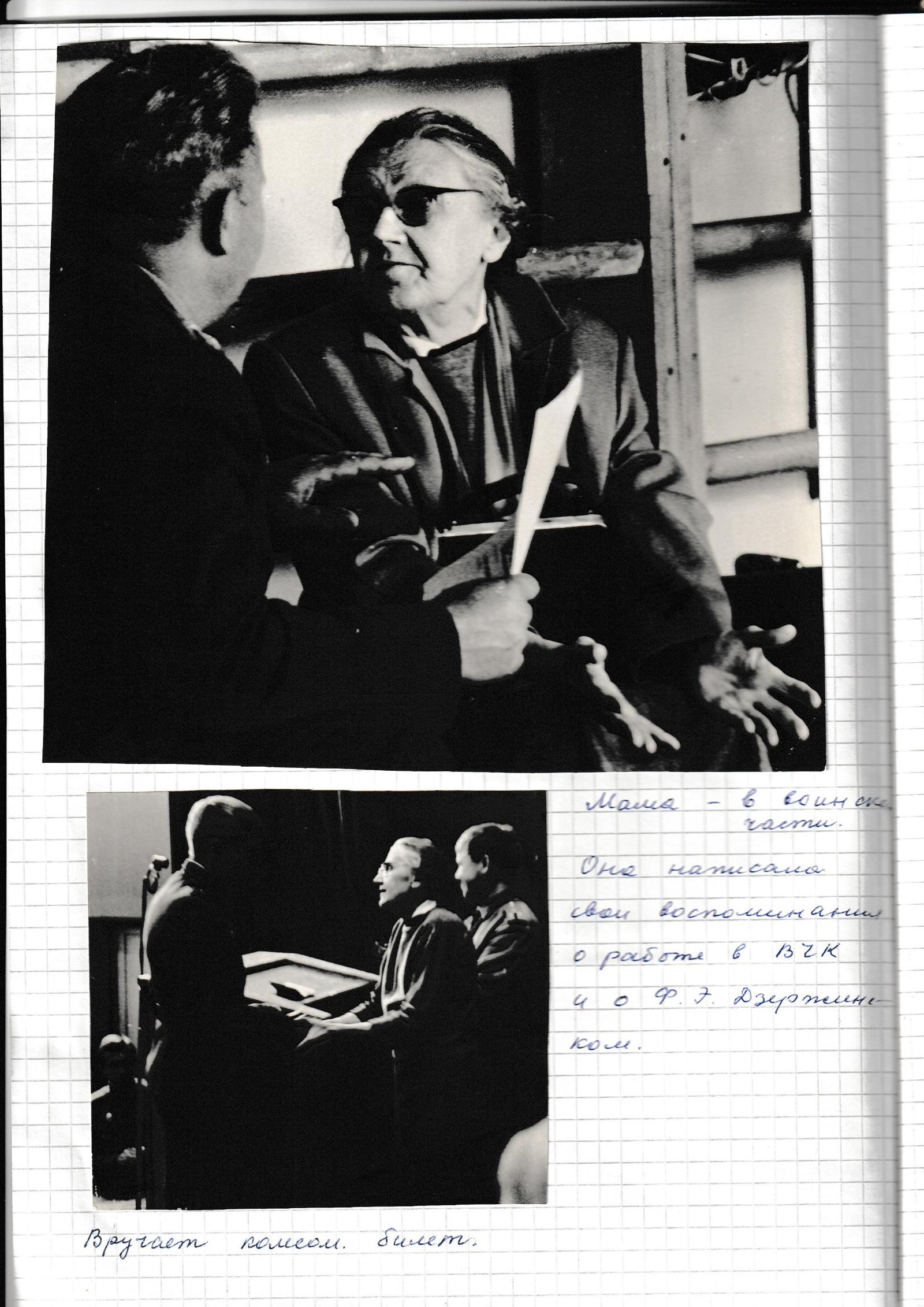
Notebook page 22: Mama at a military unit; captions in the author’s hand.
Photo 1 (upper, larger)
An older woman in glasses (Mama — Eva Konstantinovna) talking with a man in a dark suit; she holds a paper; hand gestures.
Photo 2 (lower)
The same woman presents a document (a Komsomol card) to a young man in military uniform; other service members nearby.
Captions (ballpoint)
To the right of the lower photo:
Mama — at a military
unit.
She wrote
her recollections
of work in the Cheka
and of F. E. Dzerzhin-
sky.
Under the lower photo:
Presenting a Komsom. card.
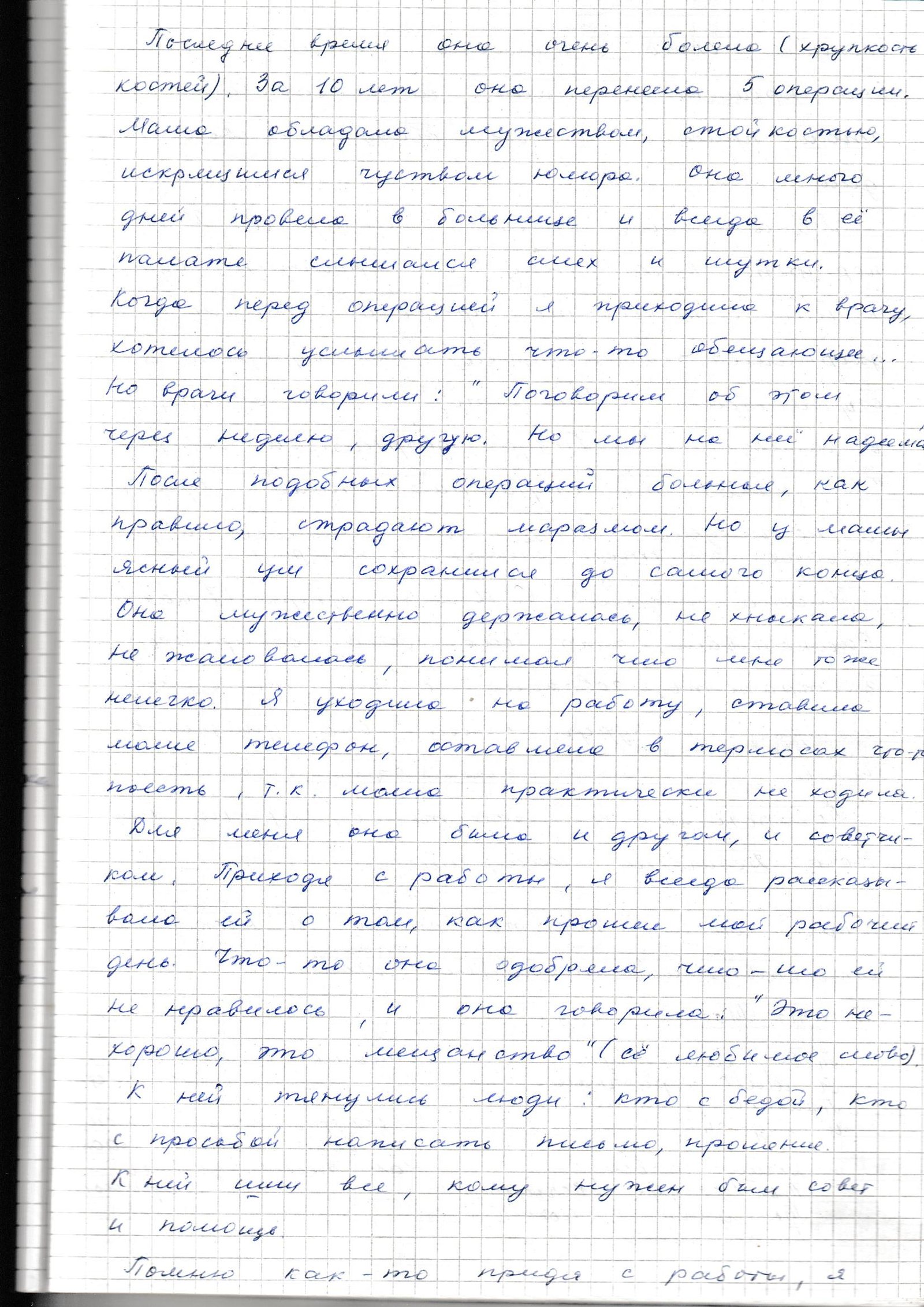
Notebook page 23: Mama’s last years of illness.
In recent times she was very ill (fragility
of the bones). Over 10 years she underwent 5 operations.
Mama had courage, fortitude,
a genuine sense of humour. She spent many
days in hospital, and always in her
ward one heard laughter and jokes.
When before an operation I went to the doctor,
I wanted to hear something encouraging…
But the doctors would say: “Let’s talk about that
in a week or two.” But we still hoped.
After operations of that kind patients, as
a rule, suffer from marasmus. But with Mama
a clear mind remained until the very end.
She held herself bravely, did not whimper,
did not complain, understanding that for me too
it was not easy. I would leave for work, leaving
Mama the telephone, leaving food in thermos flasks and
something to eat[?], since Mama practically did not walk.
For me she was both a friend and an advi-
ser[?]. Coming home from work, I always told
her how my working day had gone.
Some things she approved; some things she
did not like, and she would say: “That is not
good; that is philistinism” (her favourite word).
People were drawn to her: some with trouble, some
with a request to write a letter or a petition.
Everyone came to her who needed advice
and help.
I remember once, coming home from work, I
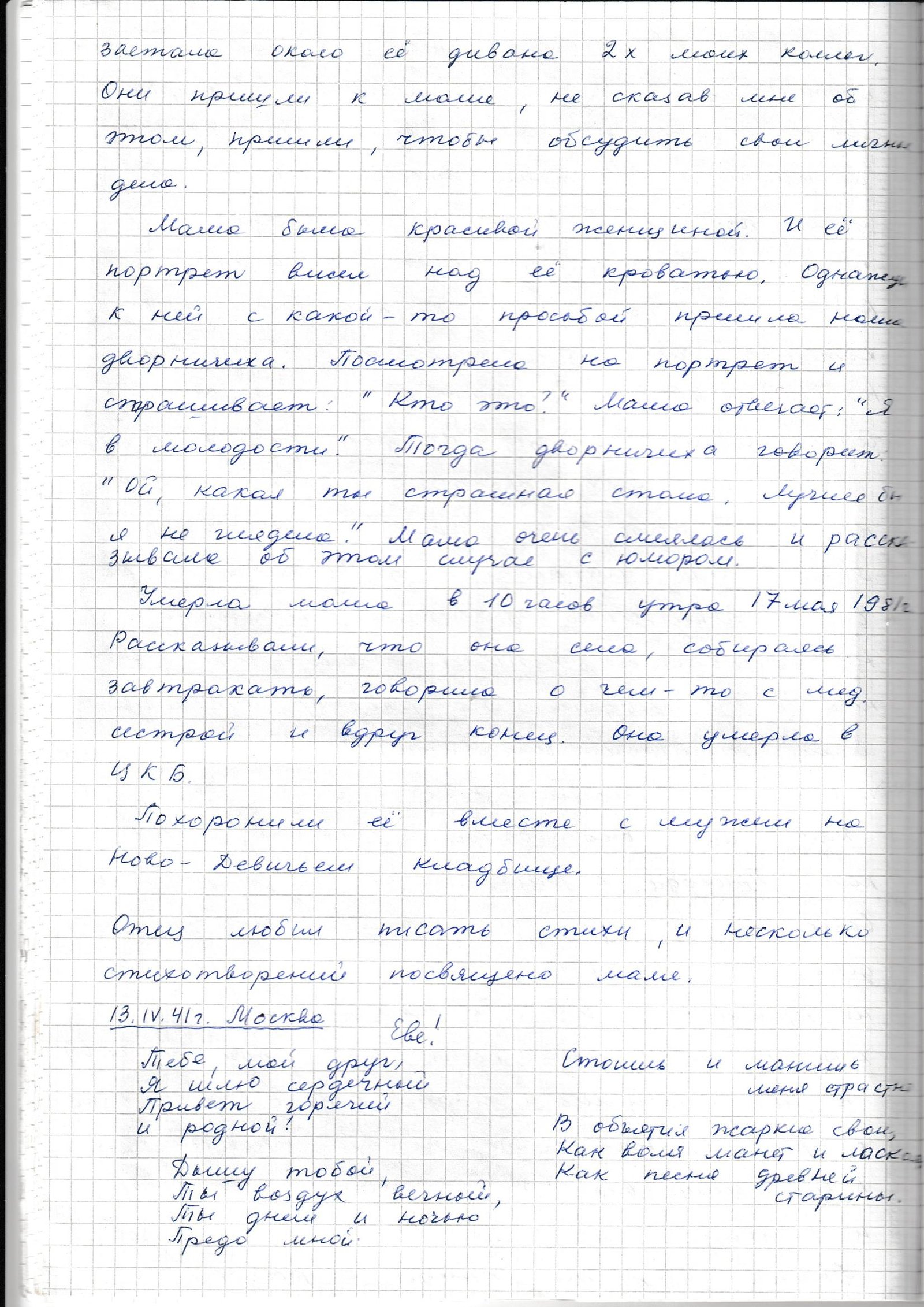
Notebook page 24: death of Mama, 17 May 1981; beginning of the poem “To Eva!”.
find by her sofa two of my colleagues.
They had come to Mama without telling me
about it; they had come to discuss their personal
affairs.
Mama was a beautiful woman. And her
portrait hung above her bed. Once
our yard-keeper came to her with some request.
She looked at the portrait and
asks: “Who is that?” Mama answers: “I
when young.” Then the yard-keeper says:
“Oh, how dreadful you have become; better
I had not seen.” Mama laughed a great deal and
told about this incident with humour.
Mama died at 10 o’clock in the morning on 17 May 1981.
They said she sat up, was about to
have breakfast, was speaking of something with the
nurse and suddenly — the end. She died in
the Central Clinical Hospital (TsKB).
She was buried together with her husband at
Novodevichy Cemetery.
Father loved to write verses, and several
poems are dedicated to Mama.
13.IV.41. Moscow To Eva!
| (left column) | (right column) |
|---|---|
| To you my friend, | You stand and beckon |
| I send a heartfelt | me passionately[?] |
| Warm greeting | Into your ardent embrace, |
| and dear! | As freedom beckons and [yearning?/Mosc-?], |
| As a song of ancient | |
| I breathe you | times. |
| You — eternal air, | |
| You day[?] and night | |
| Before me. |
← Childhood in Moscow · Notebook contents · Father, the Cheka, and verses →