From Tatyana Timofeevna’s notebook “Our genealogy: the Samsonovs”. First person. [?] = unclear.
Without you I have no joy;
No portion and no peace,
I shall fall into the abyss of night[?],
If I remain without you.
Waves beat, spray leaps
Along the stony shores
You are not here, my dear one,
I will give you to no one.
T. S.
Mama often recalled her work
in the Cheka, her friends.
She was about 19–20. Young, beautiful,
a little headstrong.
Once, having been late for work with a friend,
they approached their entrance and saw
a long queue and the commandant
checking passes. They decided
not to join the queue, but to come
later. They went to the square by the Bolshoi
Theatre and sat on a bench. After sitting
for quite a while, they went
to work. The duty officer let them through
without any trouble, thinking they had been
out on an errand. When in the department
they were seen safe and sound, there was
a great deal of laughter.
There was a lift in the building, and everyone
used it, starting with F. Dz. and so on.
Again late for work, Mama
flew into the lift, bumping someone
in the stomach. When she raised her head, she saw
Dzerzhinsky, began to apologize, and he only
smiled.
Episode 3
Typists had to take turns
on duty with the Presidium of the Cheka–OGPU. In 1923,
during one of the typing shifts there was little
work, and by the end of the shift — toward midnight —
she was very tired. Fifteen minutes before
the end of the typing duty her
relief arrived. Noticing how she looked,
the other said:
— You’re very tired, I can see. I’ll get
my ration now (a piece of herring, a sweet, and
a quarter-pound of bread) and start
work, and you stop typing, rest.
Mama did just that: she left the typewriter,
sat in a soft armchair and closed her
eyes[?], feels that someone is coming toward
her, and she decides she will not
type[?].
— Are you the duty typist? — he asked.
— Yes, — she answered, without looking at him.
— I need a document typed urgently.
— Another typist will come presently; she
will type it. But he does not leave and
goes on:
— I’ve heard that you are a very good typist,
and I would like you to type it,
and I would dictate to you.
Then Mama looked up and saw that
F. Dz. was standing before her. Greatly embarrassed, she
quickly stood up and went to the typewriter. F. Dz.
dictated the text to her, said thank you and left.
She was very upset and did not apologize for her
behavior.
In a dejected state she went home. The
next day she told about what had happened in
the department. Everyone sympathized with her, and she expected
a proper punishment. Days passed, and
no reprimand was announced. At that time she could
not understand why her misdeed had been
forgiven by the Chairman of the Cheka.
Later she understood: F. Dz. was a warm-hearted,
sensitive and attentive person. He
well understood how hard things were
for young people (and she was then 19).
Episode 4.
Workers often saw F. Dz. in the departments,
met him in corridors, on staircases;
he always looked friendly, neat.
His kind face and eyes seemed to say:
“I see it’s hard for you, but what can
one do? The situation requires it…”
Mama’s recollections of Dzerzhinsky were printed
in the collection F. E. Dzerzhinsky in the Cheka
(Library of the magazine Pogranichnik No. 14, 1967)
(the heading “Mama’s recollections…” and the imprint data in the notebook are underlined in red)
Handwritten heading
Papa
My papa is Samsonov (Babiy) Timofey
Petrovich
(b. 1888, Bessarabian Governorate, Khotyn uyezd,
village of Mikhayleny)
Note to the right of the portrait
Article
published
in the newspaper
Sovetskaya
Moldaviya
21 May 1988.
Clipping (printed text)
THROUGH THE STORM OF TIME
(FOR THE 100TH ANNIVERSARY OF THE BIRTH OF T. P. SAMSONOV)
On 19 February 1919 Pravda published
a “Letter to the Editor” in which a group of anarchist-
communists, responsible workers
of the staff of the 3rd Army of the Eastern Front,
openly renouncing the erroneous political
dogmas that had weighed upon them, expressed their ardent wish
to join the ranks of the Bolshevik party.
Assessing this important step, taken
in the hardest time for the Republic of Soviets
and becoming a turning point in
his complex personal fate, one of
the authors of the letter, our fellow countryman T. P. Sam-
sonov, late in life wrote: “If one
transports oneself back to that epoch, it becomes
perfectly clear that people who lived for the revo-
lution could not have acted otherwise.”
[column 1]
Timofey Petrovich Samso-
nov (Babiy) was born on 9 (21)
May 1888 in a large
family of a poor peasant of the vil-
lage of Mikhayleny, now of the Bri-
chany district. Having early known
want and hardship, already as a
primary-school pupil he was
forced each summer, together with his
father, to work as a hired hand for
kulaks and landowners. No eas-
ier was it for him while
studying at the Khotyn real
school. There, as a
third-year pupil, in the spring
of 1906 he joined a Social-
Democratic circle, in
which under the guidance of
one of the active participants
in the December armed
uprising of 1905 in Moscow,
who was in hiding in Khotyn,
he becomes acquainted with Marxist
literature, takes part in dis-
tributing among the peasants
of the surrounding villages leaflets and ap-
peals.
[column 2]
The first responsible
assignment that fell
to the young revolutio-
nary was participation in the secret
delivery, from a local private
printshop, of type for an under-
ground press set up
in Kamenets-Podolsk by the gu-
bernial Social-Democratic
committee.
Over the long revolutionary
activity of T. P. Samsono-
v he [more than once? / repeatedly?] was subjected to po-
lice persecution.
“I sat,” we read
in one document, “in pri-
sons from the end of 1907 to 1910.
In 1910 I again
go into exile. On the way
I fall ill with typhus, first in
Kursk and then in Samara
prisons. In the prisons, as
everyone well knows, one
got it hard. Especially if
one considers that I was in the Ki-
ev, Kursk, Tula, Sa-
mara, Krasnoyarsk, Ir-
kutsk prisons and in the Alek-
sandrovsk hard-labor cen-
tral”
[column 3]
Yet this list
of prisons is far from complete; it
was preceded by other pri-
son casemates…
Timofey Petro-
vich was first arrested in September
1906 and, together with other
members of the Social-Democratic
circle, brought to ju-
dicial responsibility. But,
released temporarily on
bail, he at once goes into hiding and
soon again plunges into the whirl-
pool of revolutionary
events. But already under the under-
ground nickname “Foma” and as
a member of a group of anarchist-com-
munists. Inability to wait for
the class struggle, desperate
personal courage led to
Samsonov, following
the tactics of his group, already in
early 1907 becoming
one of the organizers and lead-
ers of the flying detachment
of anarchist-communists “Des-
troy and Create,” which became
a terror to the propertied classes
not only in the Khotyn region but
also in the area of Kamenets-Podol-
sk.
(Portrait: a middle-aged man in a suit with a necktie, balding.)
[column 1]
Later, during one of the party
purges, he explained these
actions thus: “The unorganized,
reckless peasant
element surrounding me then… pushed me onto
the path of peasant upris-
ings, and in essence onto the path
of despair, the path of petty-bour-
geois revolutionary spon-
taneity.” Answering the ques-
tion what he specifically did
while an anarchist-com-
munist, he indicated: “…I took
part in several expropri-
ations, prepared and carried
out arsons of landowners’
estates, organized pea-
sant circles of peasants.
The peasants willingly followed
me because they knew
I was of their milieu; they
trusted me more than the urban
ones….”
But the tsarist satraps did not
sleep either. On 16 December 1907,
at one of the safe houses in the village
of Gvozdoutsy of Khotyn uyezd,
T. Samsonov was seized and
thrown into Khotyn prison.
There he first met
G. I. Kotovsky, whose name as
a people’s avenger in
the years of the first Russian revolu-
tion thundered throughout Bessara-
bia. A long, friendly conversa-
tion behind bars with the renow-
ned Moldavian haiduk etched itself
for life in the memory
of the young revolutionary figh-
ter. Full of optimism and
hope, Grigory Ivanovich
told him then of preparations
for his next escape from
prison. Timofey was preparing for this
too. But they did not manage
to carry out their plans.
The investigation lasted more than
a year and a half. At last, by decision
of the Odessa judicial chamber
of 28 May 1909, Timo-
fey Petrovich was sentenced in sum (on
three cases) to 5
years’ imprisonment
and to lifelong exile in Si-
beria. He served the harsh sentence
in a number of prisons, and then
was sent into exile
in Irkutsk Governorate: first
to Ichera volost, and from
1914 to Bodaybo, where
since the mid-19th century had been
the main base of the Lena–
Vitim gold-mining
region. But even here,
where the memory of the Lena shooting of 1912
was still fresh,
he did not lay down his arms. For
close ties and anti-state
activity among
political hard-labor prisoners Samsonov
was soon arrested and sentenced
to 6 months in prison.
Breaking free, Ti-
mofey Samsonov escapes
from hard labor, reaches
Vladivostok, where he soon se-
cretly boards the steamer
Novgorod and emigrates to
England. On arrival in Li-
verpool he takes a job as a
dock worker, joins the lo-
cal organization of anarchist-
communists and under the name
Mikhail Nemchinov de-
velops political,
mainly anti-war
activity among Rus-
sian sailors and English
dockers.
[column 2]
which especially
intensifies after the joyful
news of the victory of the February
Revolution in Russia, far
from pleasing to the English
authorities. In the spring of 1917, during
a speech at a multi-
thousand-strong rally against the im-
perialist war, Ti-
mofey Petrovich was arres-
ted and sentenced to 5 months
hard labor, immediately re-
placed by compulsory de-
portation of the defendant to Rus-
sia.
Such a turn of events
only gladdened T. P. Sam-
sonov, for he longed with all his soul
for the Motherland, seized
by the rising revolution-
ary storm. Arriving on the eve
of Great October in Arkhan-
gelsk, Timofey Petrovich
at once hastens to the Urals, where in
the October days of 1917
he takes part in the uprising of the Chelya-
binsk railwaymen,
and somewhat later in the sup-
pression of the counter-revolutio-
nary mutiny in Irkutsk. As
a member of the Chelyabinsk Soviet of Wor-
kers’ and Soldiers’ Depu-
ties, chairman of the city
department of the railwaymen’s trade
union and of the labor exchange, he
carries out responsible as-
signments of Tsentrosibir (CEC of the So-
viets of Siberia).
Barely returned from the
2nd All-Russian
Congress of Labor Commissars held in May 1918
in Moscow,
Samsonov was forced
to take up arms again:
the outbreak of the Czechoslovak
mutiny began a new
stage of the civil war,
when alongside the expansion
of its scale the balance
of forces was on the side
of internal and external counter-
revolution. In the hard situ-
ation that had arisen, Timofey
Petrovich, true to his re-
volutionary duty, at once
forms a fighting workers’ de-
tachment which, together with oth-
er units loyal to the Republic of So-
viets, fights against
Czechoslovak mutineers
and SR–White Guard
detachments. Soon his detachment
merges into the 3rd Red Ar-
my of the Eastern Front, which
in July–August 1918
conducts stubborn battles on
the Zlatoust–Chelyabinsk, Ekate-
rinburg and Perm di-
rections.
In the course of these battles the com-
mand, valuing Samsonov’s
devotion to the cause of the revolution
and his readiness for ruthless
struggle with the enemies, recalls
Timofey Petrovich to army
headquarters and appoints him first
investigator and then se-
nior instructor of military
control. The honesty,
courage and decisiveness natural to him
prove useful in the new
post already in the hard
days when the 3rd Army, after
stubborn battles and heavy
losses, was forced
in December 1918 to leave
Perm and retreat under the on-
slaught of Kolchak’s hordes.
[column 3]
The energetic and decisive
measures taken by Timofe-
y Petrovich to strengthen
army units and raise
their combat readiness were duly
appreciated by F. E.
Dzerzhinsky — a member of the spe-
cial commission of the CC
of the RCP(b) and the Republic’s Defense
Council, which arrived by
order of V. I. Lenin on
the Eastern Front to investi-
gate the causes of the defeat
at Perm. At the same time
Felix Edmundovich approved
Samsonov’s proposal to con-
vert military control into the Special
Department of the Cheka of the ar-
my and recommended him for
the post of head of that
department. On parting Dzer-
zhinsky gave Timofey
Petrovich his personal re-
volver of the Colt system and
handed him a certificate for
the right to carry it.
The personal meeting with F. E.
Dzerzhinsky played an impor-
tant role in the further fate
of T. P. Samsonov. It was
precisely it that prompted Timofey Petro-
vich, as well as his colleagues
on the army staff, to break in
February 1919 with anarch-
ism and join the ranks
of the RCP(b). In March of the same
year, by order of Felix Ed-
mundovich, Samsonov was re-
called to Moscow and appointed head
of the Special Department and
member of the Collegium of the Moscow Cheka, and a
few months later — head
of the Military Intelligence
Directorate of the Main Staff
of the RKKA. On the recommendation
of the Chairman of the Cheka, Timofey
Petrovich in 1920 be-
comes Administrator and
head of the Organizational-
Instructor Department
of Glavkomtrud of the RSFSR, whose
chairman concurrently
was F. E. Dzer-
zhinsky.
The seething energy of T. P. Sam-
sonov, his many-sided acti-
vity devoted to the cause
of the party and the strengthening of the So-
viet state, especially
vividly showed itself in 1921–1924,
when he headed
the Special Department and was a member of
the Collegium of the Cheka–OGPU. With his
name is linked the enormous work
of Soviet chekists in
uncovering and neutralizing
a whole series of major
counter-revolutionary conspir-
acies. Here is the suppression
of the Kronstadt mutiny,
which broke out inspired
by the RCP(b)[? — in the text, proba-
bly “by SRs/the Entente”; the bottom
of the column is damaged], and also the [Kho-
lostoy?] Antonov mutiny in the Tambov
region. Here is the uncovering of the ca-
det conspiracy headed
by former minister of the Provi-
sional Government Kish-
kin. Here is the skillfully car-
ried-out operation of the arrest in
Kiev of the last under-
ground congress of the party of Right SRs…
Many years will pass,
and abroad a whole
series of books will appear in which were…
shamelessly, falsely, and
other unfinished deadly
enemies of the Land of Soviets
will tearfully recount how
under the leadership of “Iron
Felix” Timofey
Petrovich dealt one after
another inimitable blows
to the supporters of strangling So-
viet [power…]
(The bottom of column 3 is partly cut off/unclear; wording about “inspiration” and the end of the phrase — from the visible edge, with [?].)
Printed text (continuation of the article, 2 columns)
[column 1]
His contribution to
the struggle against counter-revolution, to
the cause of strengthening the organs of state
security
was duly noted: in
1921 he was awarded
the Order of the Red Banner, and
somewhat later he was
granted the title of Honorary
Chekist and issued a certifi-
cate over the personal signature of F. E.
Dzerzhinsky.
Yet the most respon-
sible and at the same time most
honorable assignment that
T. P. Samsonov had to car-
ry out as head of
the Special Department of the Cheka was,
as he himself considered, ensur-
ing the security of V. I. Lenin in
early 1922. As is known,
by decision of the Party CC of
31 December 1921 Vladi-
mir Ilyich was granted
a six-week leave
for treatment and rest. The first
week he lived at Gorki,
but since the whole territory
there was open and it was
unsafe for Lenin to live, on
assignment from F. E. Dzerzhins-
ky Timofey Petrovich after
several days of searching chose
a new place — a small
house near the village of Ko-
stino, where V. I. Lenin together
with N. K. Krupskaya and M. I.
Ulyanova lived from 17 Jan-
uary to 1 March 1922.
By order of the Chairman of the Cheka
full responsibility for
the security of Vladimir Ilyich for
all that time was laid
on Samsonov.
[column 2]
Wherever the Party CC later
sent him,
T. P. Samsonov every-
where justified the high trust of the par-
ty: as head of
a Directorate of the VSNKh, as Ad-
ministrator of the CC of the VKP(b),
and then of the Executive Committee of the Comin-
tern, and in subsequent high
and responsible posts
connected with the development
of the country’s economy, science and culture.
Evidence of his
maturity and of the trust in him
is that T. P.
Samsonov was elected a delegate
to the 16th and 17th Party Congresses,
to a number of all-union party
conferences, and twice was
a deputy of the Moscow Soviet.
Already on well-earned
retirement, T. P. Samsonov con-
tinued to engage actively in
public activity.
Resuming work on his
recollections begun back in
the 1930s, he labored
persistently on the manuscript
Notes of a Chekist. But
he was not fated to finish this work:
on 28 October 1955
the faithful son of Lenin’s party
and ardent patriot
of the Soviet Motherland was no more.
The working people of Moldavia, like
all Soviet people, highly
value the glorious deeds of their
fellow countryman. On the house in which
T. P. Samsonov was born a me-
morial plaque has been installed,
and the Mikhayleny secondary school
has been given his name.
I. BOBEYKO,
senior research asso-
ciate of the Institute of Party
History under the CC of the CP of Molda-
via, Candidate of Histori-
cal Sciences.
Facsimile / pasted-in certificate
From the Collegium of the GPU
The honorary
title of chekist
requires
vigilance,
resoluteness
and courage.
To Mr.[?] / Comrade
Samsonov
Timofey
Petrovich
is conferred the title
of Honorary Chekist
[and awarded?] badge No. [?]
Seal: G. P. U. / N. K. V. D.
Signature: Chairman of the GPU [F. Dzerzhinsky]
(text of the certificate partly small/worn; sense from visible words)
Manuscript to the right of the certificate
In the secondary school of the village of Mi-
khayleny a museum of Father was orga-
nized, and
in front of the school they set
up a bust of Father.
(Though not a very success-
ful one).
Photograph (bottom of the page)
Interior of a museum/exhibition: a woman (the diary’s author?) writes in a visitors’ book; on the walls portraits and exhibits; display cases.
Caption to the right of the photo:
Sergey and I
were
there at
that time
Lower handwritten line
(1888–1988) [For the cente?]nary in his native village of Mikhayleny a
museum dedicated to his memory was opened. I am writing a review
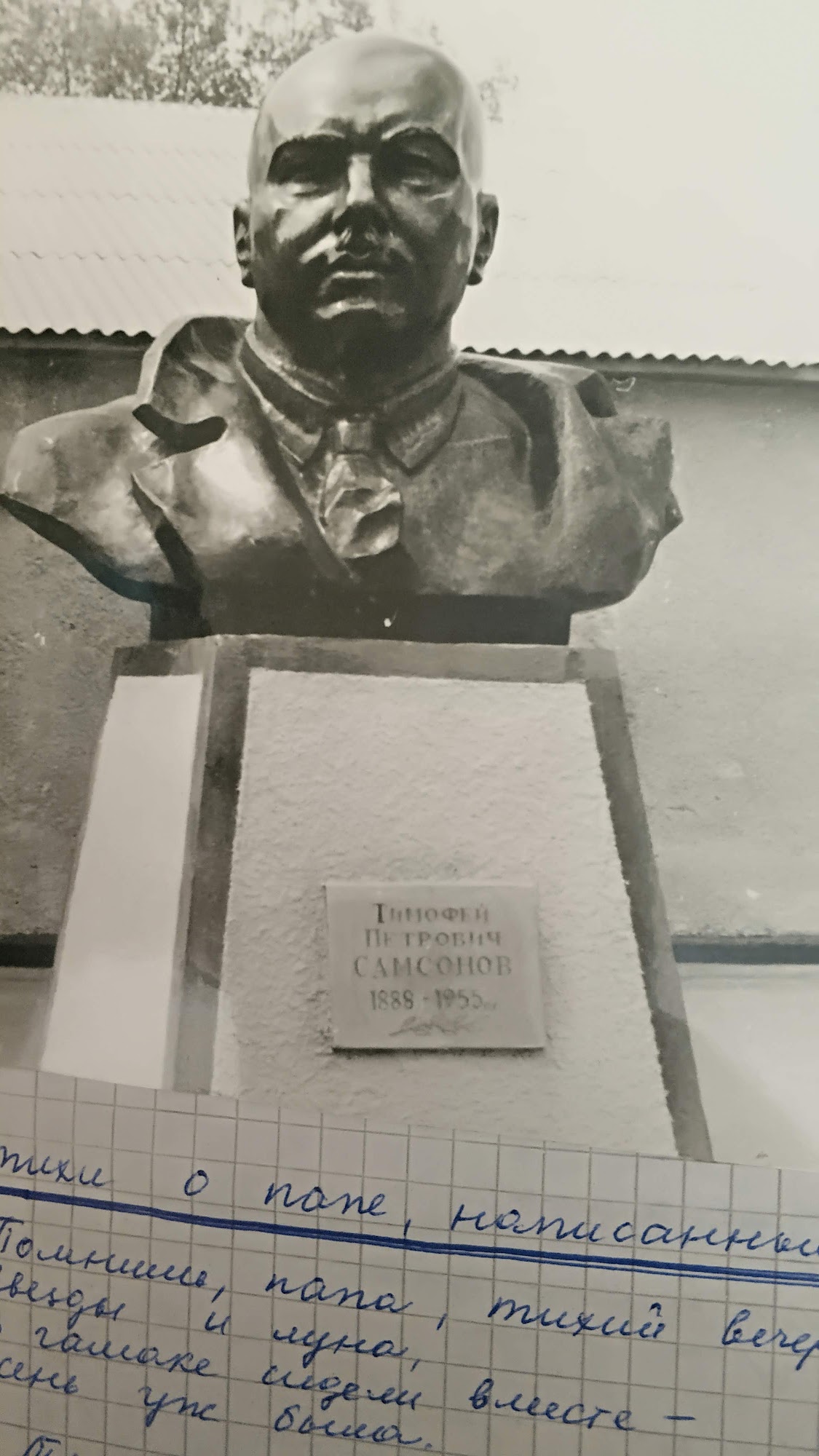
Bust of T. P. Samsonov on a pedestal. Plaque: “Timofey Petrovich Samsonov 1888–1955.” Below on the notebook leaf — verses about Papa.
Plaque on the pedestal (as on the print):
TIMOFEY
PETROVICH
SAMSONOV
1888–1955
[Caption to the right of the photo:]
9 May 1985
Unveiling of the bust and
museum in the village of Mikhayle[ny?]
in honor of the 100th anniversary of the
birth
of T. P. Samsonov.
(Though the bust is not entire[ly]
like Papa. T.)
Verses about Papa written by my sister Gena
Do you remember, Papa, the quiet evening,
Stars and the moon,
We sat together in the hammock —
Autumn already was.
You spoke verses like a song,
Helped us.
Papa, do you remember that evening —
We were together.
And then, who knew what would be,
A year passed, night followed day,
But your dear close image
Your daughter will not forget.
The heart beats, the eyes flow,
For this is life!
Daughters leave their fathers,
It forever flows into the past.
But those good years —
Can they be forgotten?
I wished, Papa, (that)
They could forever return
Do you remember, Papa, how you sang to us
Your storm and thunder
“The wide Dnieper roars and groans.”
We still ask afterward!
Tell us, dear Papa,
How in one village
There lived “Koblan[?] the dog,”
With a [faithful?/verom?] — tail.
And till late at night you spend evenings
Our native home
Filling with shouts, laughter,
All sang together.
And then far from home,
Everywhere steppe and steppe.
We would go out on the porch
To sing of childhood.
Golden time of childhood,
Neither cares nor tears,
Only the wind of life swiftly
Carried it forever away.
Flew with children’s[?] laughter
Dreams and wishes.
Life itself comes to meet us,
Where are you, childhood?
Where are your games, jokes,
Mischief sometimes,
Yes, they went, the minutes went,
I can no longer be that one.
But I will safely keep
In my memory
The native home, the native family,
The joy of past days.
My dear and beloved,
My dear father,
I love you, I kiss you,
And a thousand rings.
Gena
Gena remembers the time when we
sang in summer in Serebryany Bor, and in the evenings,
when Papa was free, we sat
in the garden, he — in the middle, wearing a burka,
and we [all?] sat side by side, wrapped
in the burka. It was joyful,
warm and calm. Papa sang
songs, and all around flowers bloomed, it smelled
of tobacco (the flowers)… and we sang.
← War, 1941 · Notebook contents · Documents and congresses →