Continuation of Tatyana Timofeevna’s handwritten notebook: biographical notes about Father, then the story of her sister Genya.
From the handwritten notebook “Our genealogy: the Samsonovs.”
Timofey Petrovich’s story continued (pp. 080–086)
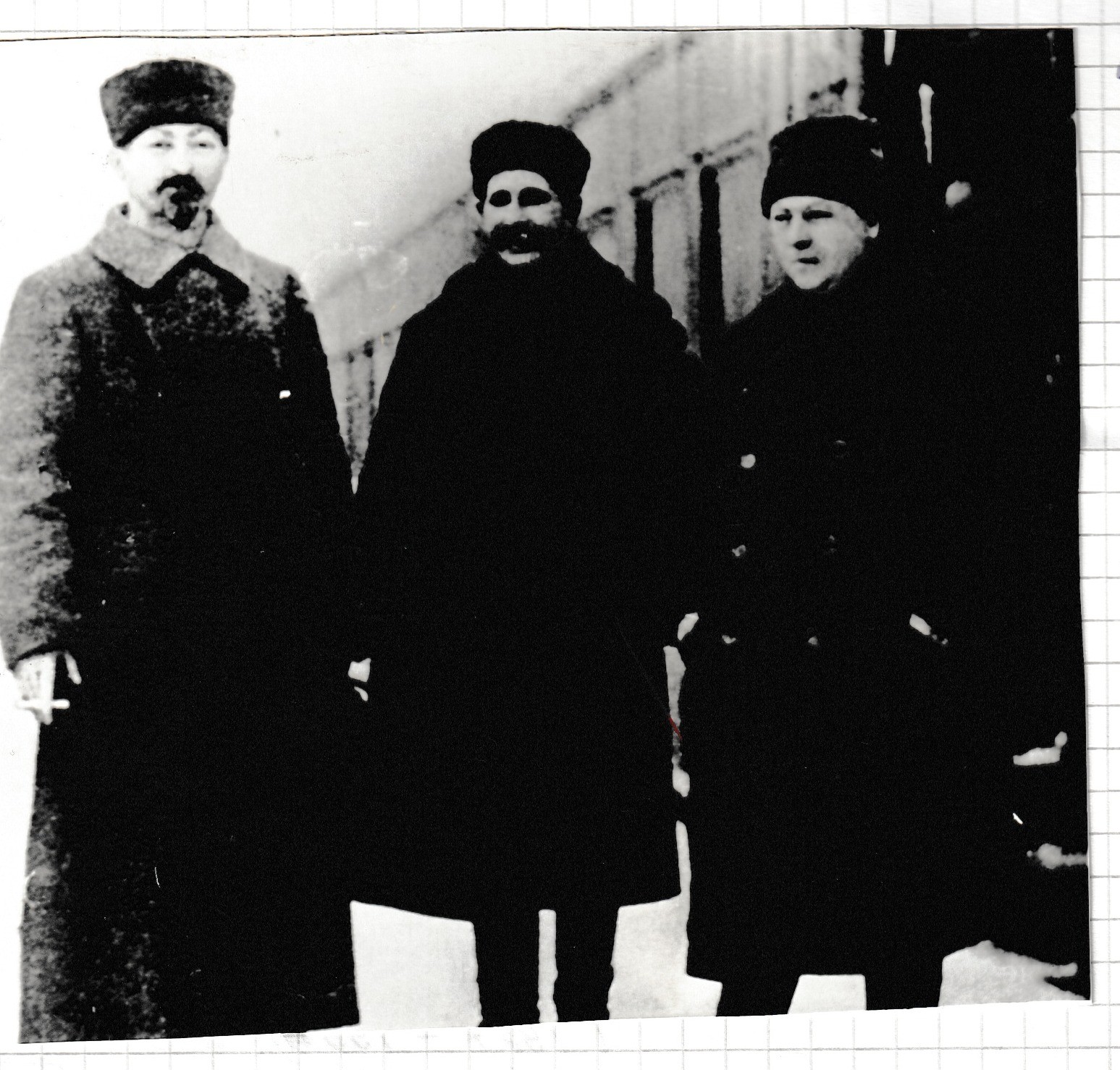
F. E. Dzerzhinsky; Belenky (Vilensky?); Papa.
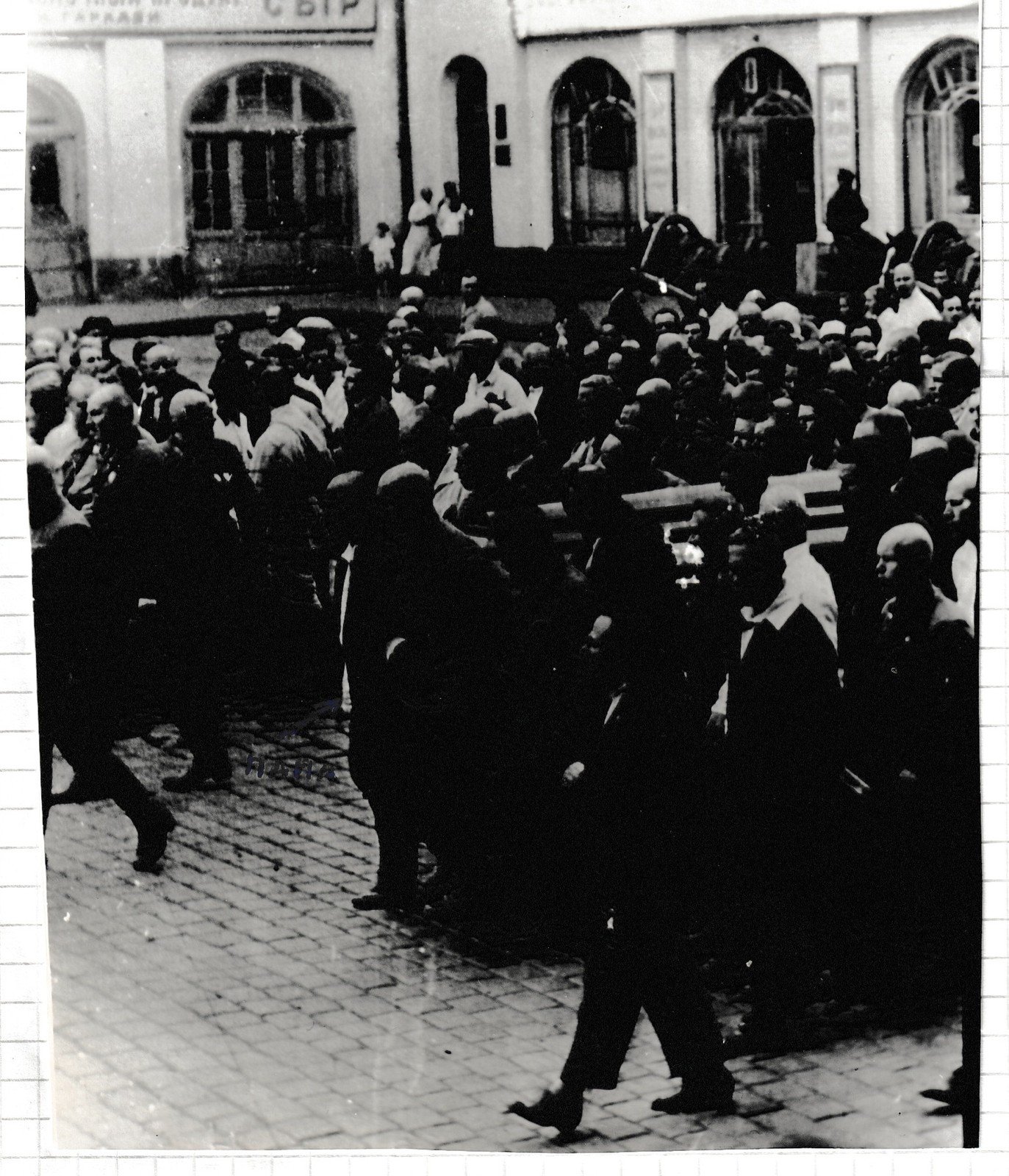
Funeral (c. 1926?). F. E. Dzerzhinsky; Papa.
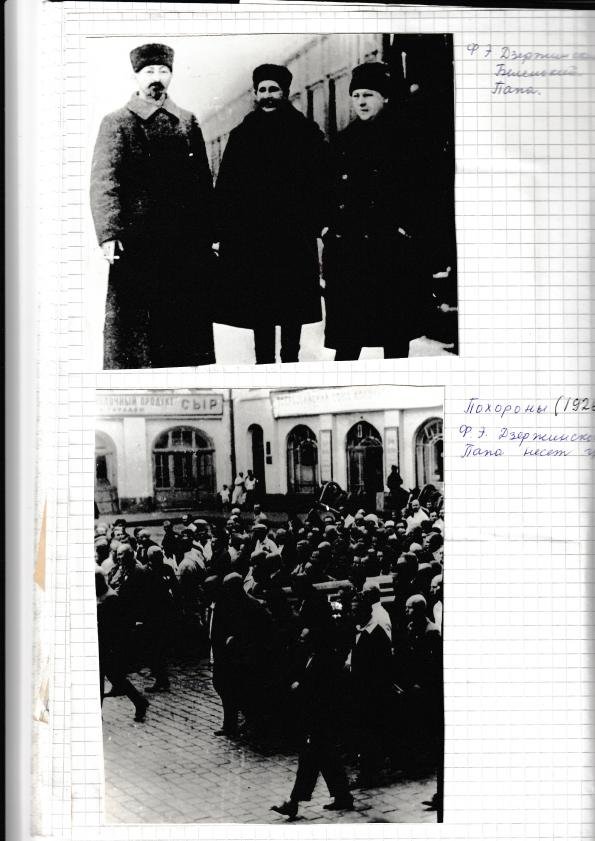
Full notebook leaf p. 080 — photo collage and author’s captions.
Captions on the leaf (blue ink, right of the upper print):
F. E. Dzerzhinsky
Belenky[?] / Vilensky[?]
Papa.
Captions (lower print):
Funeral (192[6?])
F. E. Dzerzhinsky
Papa is carrying [?]
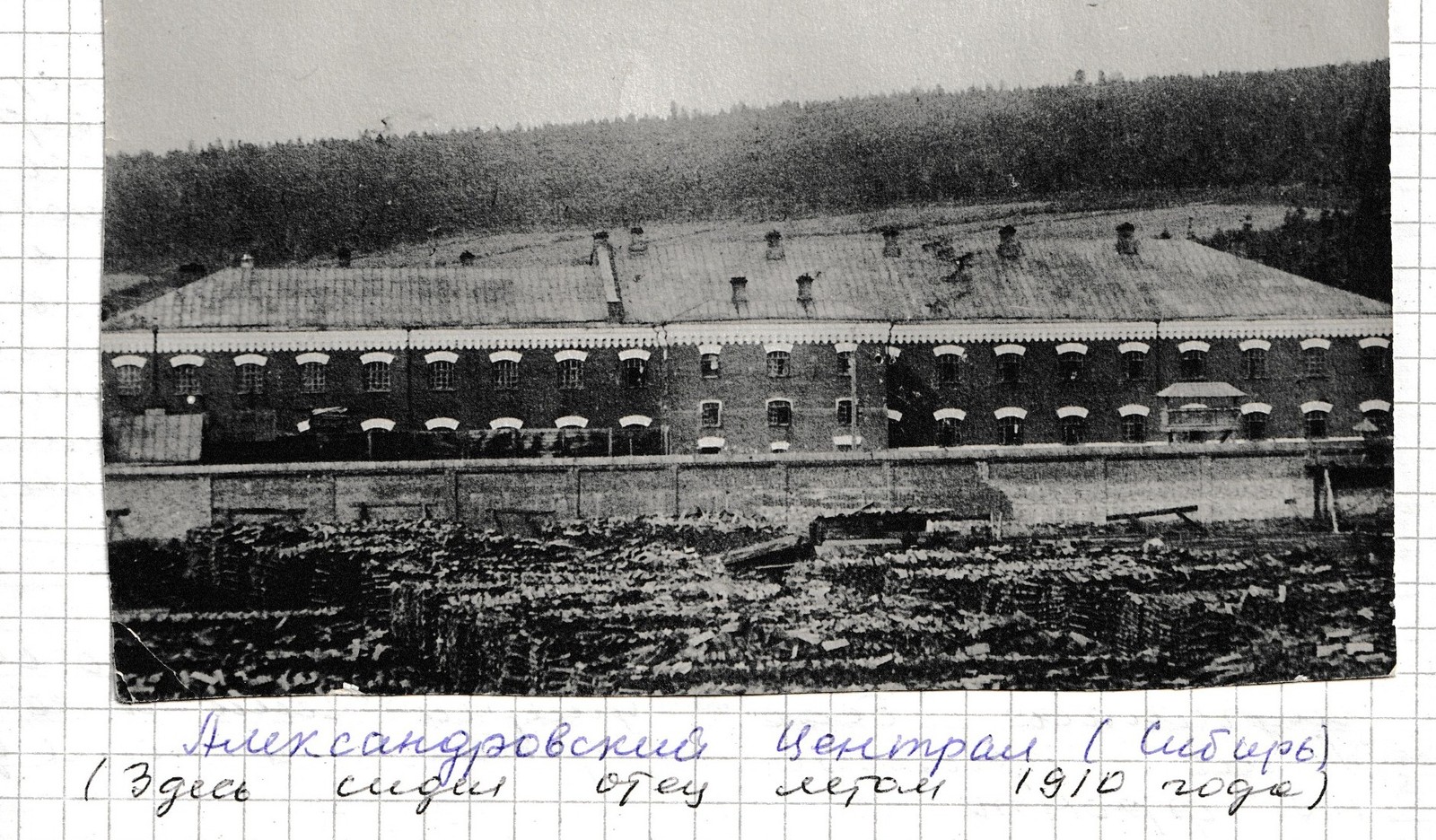
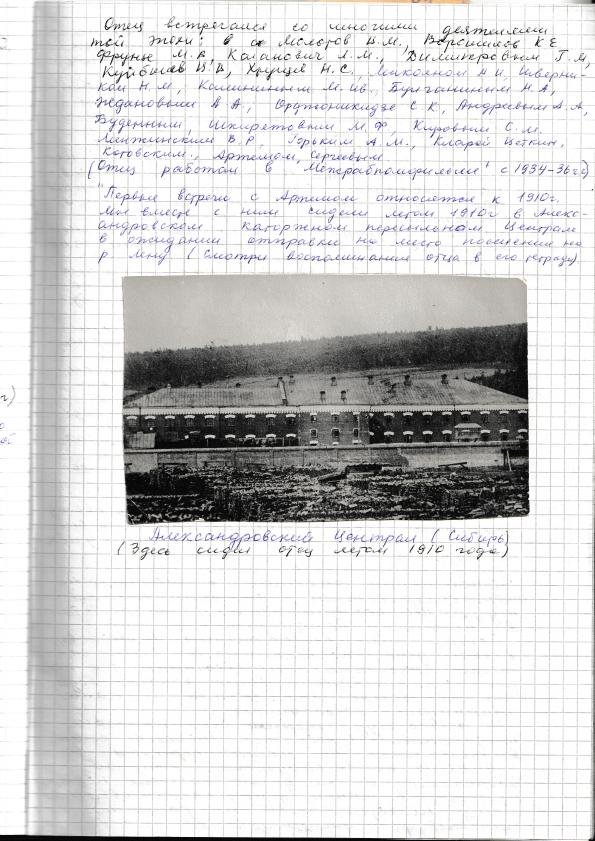
Alexandrovsky Central (Siberia), 1910. “Father was imprisoned here in summer 1910.”
Full notebook leaf p. 081 — Father’s meetings; Alexandrovsky Central.
Father met many figures
of that era: including Molotov V. M., Voroshilov K. E.,
Frunze M. V., Kaganovich L. M., Vyshinsky A. Ya.,
Kuibyshev V. V., Khrushchev N. S., Mikoyan A. I., Kalinin M. I.,
Kaminsky I. I., Bukharin N. I.,
Yagoda G. G., Ordzhonikidze G. K., Andreev A. A.,
Budenny, [?] M. F., Kirov S. M.,
Antonov-Ovseyenko V. A., Gorky A. M., Clara Zetkin,
Kotovsky, Artyom, Orlov
(Father worked at “Mezhrabpomfilm” from 1934–36)
First meetings with Artyom date to 1910.
We sat with him in summer 1910 in the Alexandrovsky
katorga transit Central
awaiting dispatch to the place of settlement on
the Lena river. (See Father’s recollections in his notebook)
Caption on the print:
Alexandrovsky Central (Siberia)
(Here Father sat in summer 1910)
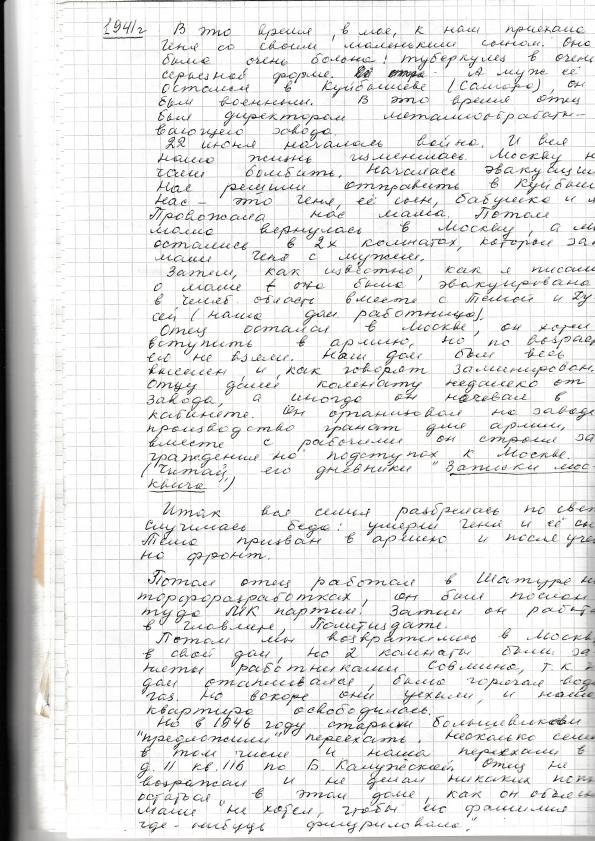
1941, evacuation.
- At that time, [people?] came to us
[?] with their little children. They
were very ill: tuberculosis, in a very
serious form. [Her?] husband
was left in Kuibyshev (Samara); he
was a serviceman. At that time Father
was director of a metal-working
plant.
[I?] very much [?] everyone. And all
our [?] [?]
began [to leave?]. Evacuation began.
We were to be sent to Kuiby-
shev — that was [Mama?], her son, Grandmother and I
[?] like Mama. Then
Mama returned to Moscow, and we
stayed in 2 rooms which were oc-
cupied by [?] and her husband.
Then, as is known, as I wrote
about Mama, [?] was very much [evacuated?]
to [?] [?] together with [?] and Ku-
[?] (Mama [?] worked).
Father remained in Moscow; he wanted
to join the army, but by age
he was not taken. Our house was entirely
cleared and, they say, mined,
[?] [?] [combine? / plant?] not far from
the factory, and sometimes he [?] in
[?]. He organized at the plant
the production of grenades for the army,
together with the workers he built [?]
[?] on [?] toward Moscow.
(Read his diary “Notes […]
book[?]”)
So all [?] scattered to their
[?]. [?] died [?] and her [?]
[?] were called into the army and after that
never returned.
Then Father worked at Shatura on
peat works; he was sent
there [by?] the Party. Then he left
for [?] Leningrad.
Then we returned to Moscow
to our house, to 2 rooms. One [?]
[?] [?] with [?] [?]
[?] [?] [?] [?]
[?] [?]
flat [?]
“[?]” moved; several families
including ours moved to
bldg 11, apt 116 on B. Kaluzhskaya. Father did not
object and made no [?]
“[?]” into that house, as he [?]
“[?] did not want us to [?]
somewhere else still [?]”.
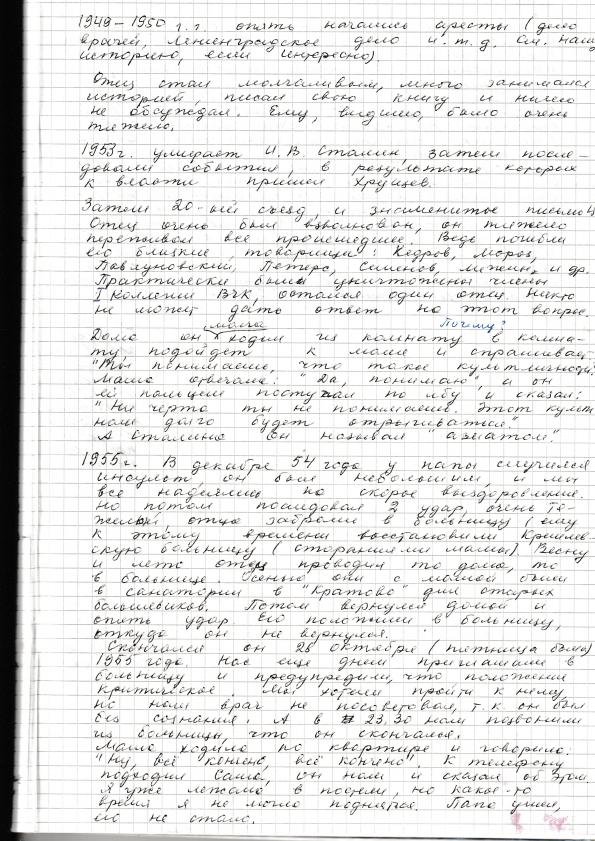
1948–1955, Father’s illness and death.
1948–1950. Arrests began again ([?]
doctors, the Leningrad affair, etc. See our
history, if of interest).
Father became silent, worked much at
history, wrote his book and discussed
no one. It seems it was very hard for him.
- I. V. Stalin dies; then followed
events as a result of which
Khrushchev came to power.
Then the 20th Congress and the famous letter[?]
Father was very shaken; he took
all that had happened hard. All his close
comrades perished: Kedrov, Moroz,
Pavlunovsky, Petrov, Senkov, Metelin and others.
Practically the members of the
First Collegium of the Cheka were destroyed; Father alone remained. No one
can give an answer to this question.
Why[?]
[Once?] he comes into the room with [?]
[?], goes up to Mama and asks:
“Do you [?] what the cult of personality is[?]”
Mama answers: “Yes, [?],” and he
[?] [?] “Well then, but I’m not going” and said:
“Well [?] you don’t understand. This cult
[?] [?] they will build[?].
[?] he called [?]”.
- In December 1954 Papa had a
stroke; he was immobile, and we
all hoped, but rather [?]
but then a second stroke, a very se-
vere one; Father was taken to hospital ([?]
to this [?] all-Union [?]
[?] hospital [Strashno? / terrible?] [?] [?]
and Father’s mother spends days there, days
in the hospital. In autumn, they with Mama, Father
in a sanatorium at “Kratovo” [?]
[?] Then [?] [?]
[?] [?] him [?] to hospital,
from which he did not return.
He died on 28 October (Friday)
1955. We were still [?] invited to
the hospital and warned that the condition
was critical. We wanted to go in to him
but the doctor did not advise it, because he was
[?] [?] And at 23:30 they telephoned
from the hospital that he had died.
Mama, [?] in the flat and [?]
“Well, it’s all over. It’s all over. To [?]
[?] Sasha, he [?] and said to her:
“[?] [?] in [?] [?]
[?] [?] [?] [?]
[?] [?] [?] [?] [?]
[?] [?] [?] [?] [?] [?]
[?] [?] [?] [?] [?] [?]
The text breaks off on this page; other notebook entries follow.
Father’s grave; visitors from the KGB.
So he never fulfilled his promise
to write “Notes of a Chekist” and the history
of his life, and also his [?] [?]
[?] He knew so much, and
took it all with him.
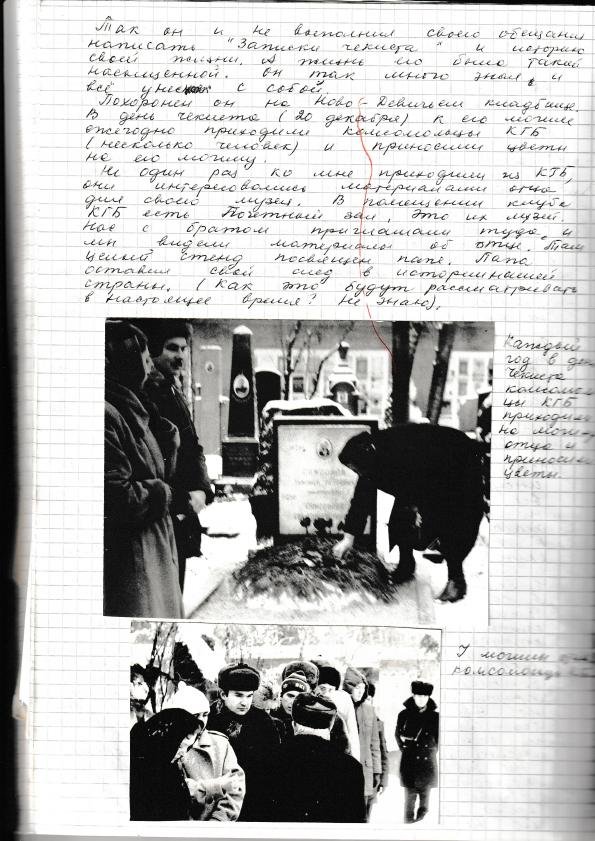
He is buried at Novodevichy Cemetery.
On the day of remembrance (20 December) Komsomol members from the KGB
came yearly to his grave
([several?] people) and brought flowers
to his grave.
And once people from the KGB came to me;
they were interested in Father’s materials
for their museum. In the chekist club
of the KGB there is an Honor Hall. That is their museum.
How with my brother they admitted us there, and
we saw materials about Father. There
[?] a stand is devoted to [?] Papa. Papa
left his mark in the history of our
country, (how will this be regarded
at the present time? I do not know).
Photographs on the leaf (see figure above): people at a cemetery monument in winter; a dog; a group of people in winter at the cemetery.
Caption (right):
“[?]
[?] in [?]
[?]
[?] KGB
came
to Father’s
grave and
brought
flowers.”
Caption (lower frame):
[?] [?]
[?] [?]
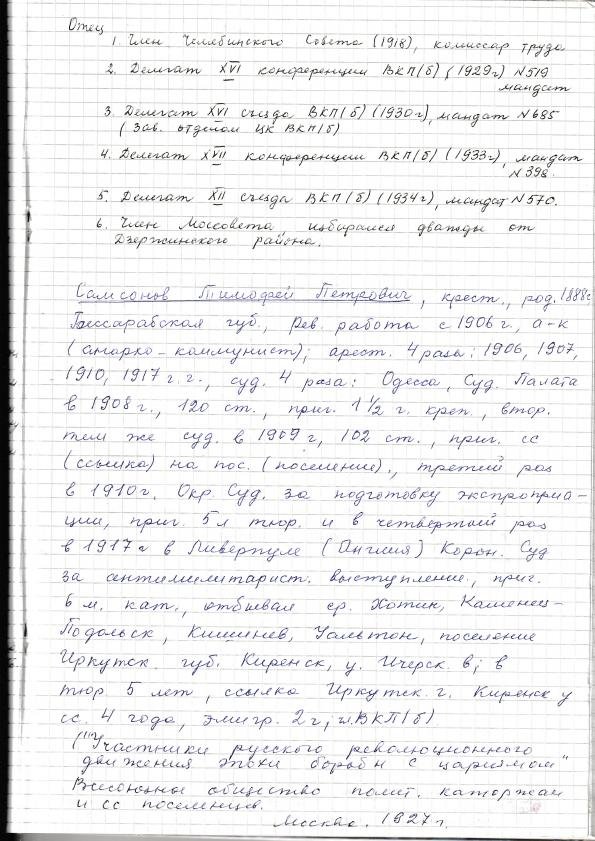
Posts and biography of T. P. Samsonov (list).
Father
- Member of the Chelyabinsk Soviet (1918), commissar of labour
- Delegate to the 16th Conference of the VKP(b) (1929), No. 570
mandate - Delegate to the 16th Congress of the VKP(b) (1930), mandate No. 685
(Head of a department of the CC VKP(b)) - Delegate to the 17th Conference of the VKP(b) (1932), mandate
No. 398[?] - Delegate to the 17th Congress of the VKP(b) (1934), mandate No. 570[?]
- Member of the Moscow Soviet, elected twice from
the Dzerzhinsky district.
Samsonov Timofey Petrovich, peasant, b. 1888
Bessarabia guberniya, [?] work from 1906, [?]
(anarcho-communist), arrested 4 times: 1906, 1907,
1910, 1917; tried 4 times: Odessa, Judicial Chamber
in 1908, Art. 120, sentenced to 1½ y. fortress[?], a second time[?]
by the same court in 1909, Art. 102, sentenced [?]
(exile) to settlement, a third time
in 1910 District Court for preparation of an expropria-
tion, sentenced to 5 y. prison, and a fourth time
in 1917 in Liverpool ([England?]) Crown Court
for [antimilitarist?] speech, sentenced
[?] [?] [?] [?] [?] [?] [?]
[?] Khotin, Kamenets-
Podolsk, Kishinev, [?] [?] settlement
Irkutsk guberniya, Kirensk uyezd [?] [?]
[?] 5 years, exile Irkutsk g. Kirensk u.
[?] 4 years, emigr. 2 y.; [?] VKP(b)
(“Participants in the Russian revolutionary
movement. [?]” [?]
[?] [?] [?] [?]
[?] [?] [?] [?] [?]
Moscow, 1927.
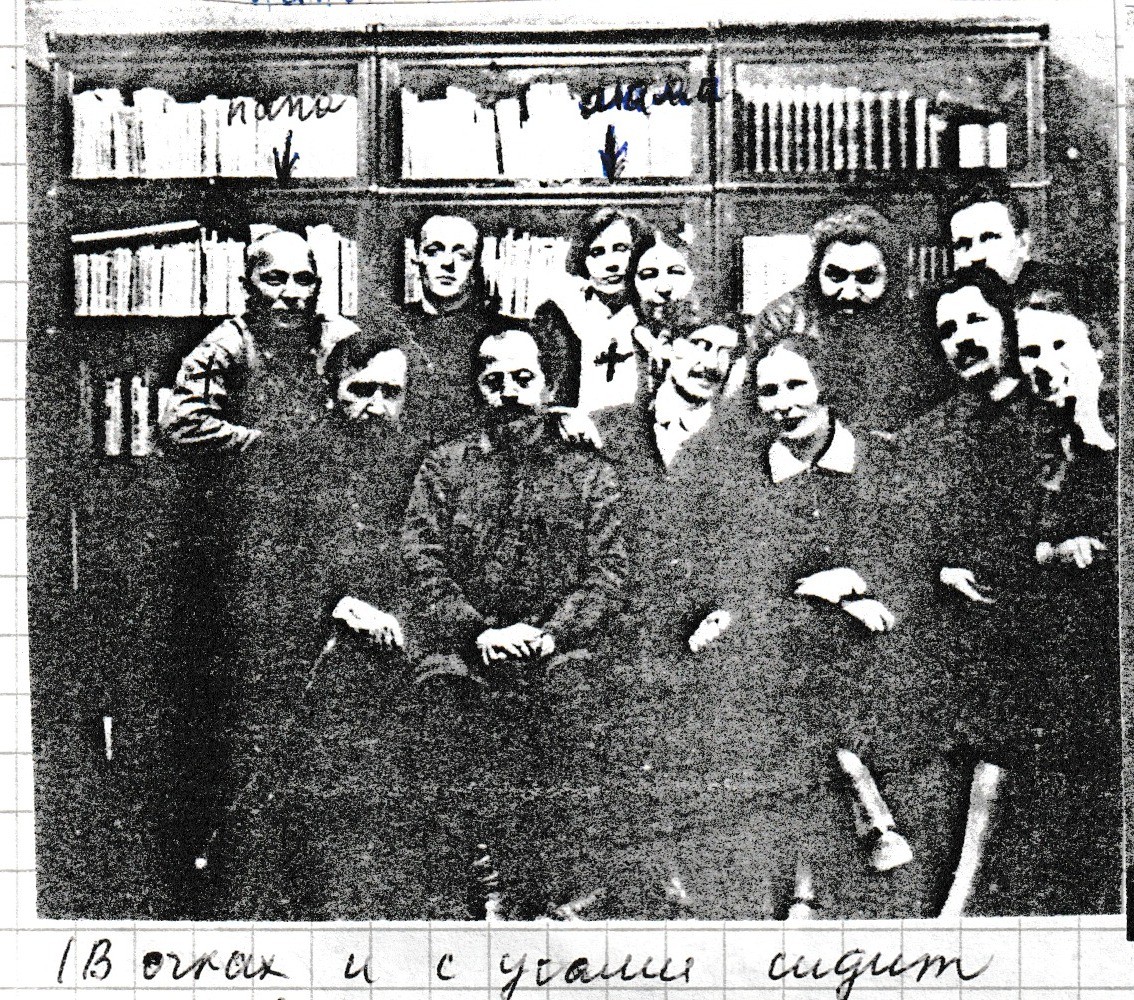
Mama and Papa visiting Povstukha (Gvostukha).
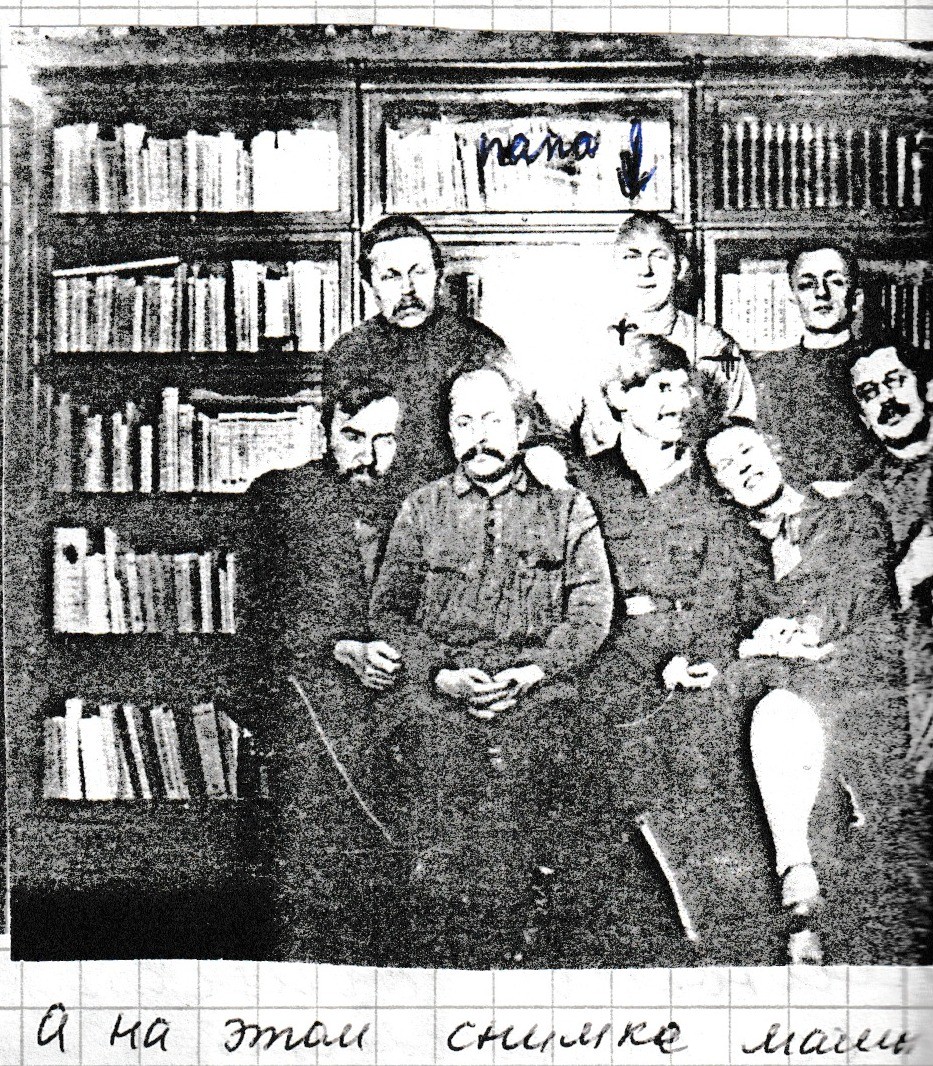
The same visit: second frame.
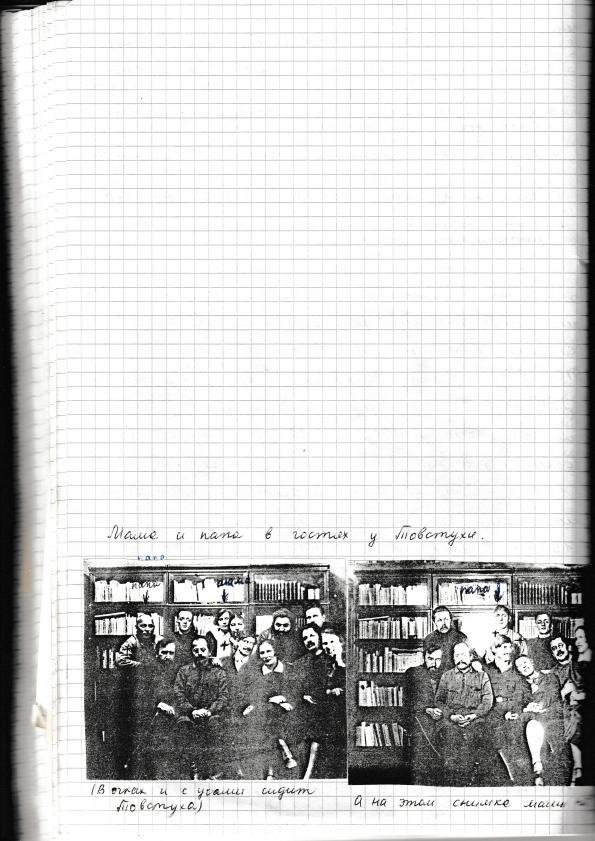
Full notebook leaf p. 086 — Mama and Papa visiting Gvostukha.
Mama and Papa visiting Gvostukha.
Captions on the leaf:
(In glasses and with a moustache sits
Gvostukha)
And in this picture Mama —
Sister Genya and brother Tyoma (beginning, pp. 087–089)
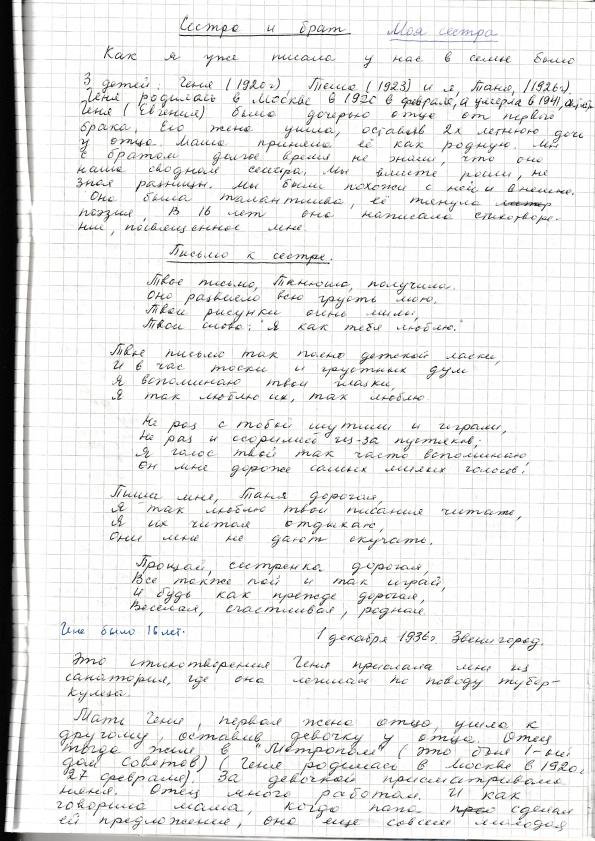
Sister and brother; Genya’s letter-verses, 1936.
Sister and brother
My sister
As I already wrote, there were
3 children in our family: Genya (1920), Tyoma (1923) and I Tanya (1926)
Genya was born in Moscow in February 1920 and died in 1941, [?]
Genya (Evgenia) was Father’s daughter from his first
marriage. Her mother died, leaving a two-year-old daughter
and Father. Mama took her as her own. For a long time
my brother and I did not know that she
was our half-sister. We grew up together, not
knowing any difference. We looked alike outwardly too.
She was talented; she was drawn to
[?]. At 16 she wrote [verses?]
[?], dedicated to me.
Letter to my sister.
Dear Tanya’s letter I have received.
It woke all the sadness of mine.
Your drawings are very sweet,
Your [?] how I love you.
Your letter is so full of a child’s tenderness,
And in the hour of longing and of sad thoughts
I remember your little eyes,
I love them so, I love them so
More than once we joked and played together,
More than once we quarrelled over trifles,
And your voice is so pure and tenderly kind —
Dearer than the dearest of voices.
Write to me, Tanya, my dear,
I love your Tanya letters so,
I read them for rest,
They do not let me grow bored.
Farewell, dear little sister,
Only sing and play just so,
And be as before, my dear,
Merry, happy, my own.
She was 16. 1 December 1936. Zvenigorod.
This poem Genya sent me from
a sanatorium where she was treated for tubercu-
losis.
Genya’s mother, Father’s first wife, left for
[?] [?] [?] [?] [?]
[?] to his wife in “Petrograd” ([?] [?] in the 1st
[?] [?] (Genya was born in Moscow in 1920
[?] [?] [?] [?] [?]
[?] Father married [?] [?] [?] [?]
[?] [?] [?] [?] [?] [?] [?] [?] [?] [?]
[?] [?] [?] [?] [?] [?] [?]
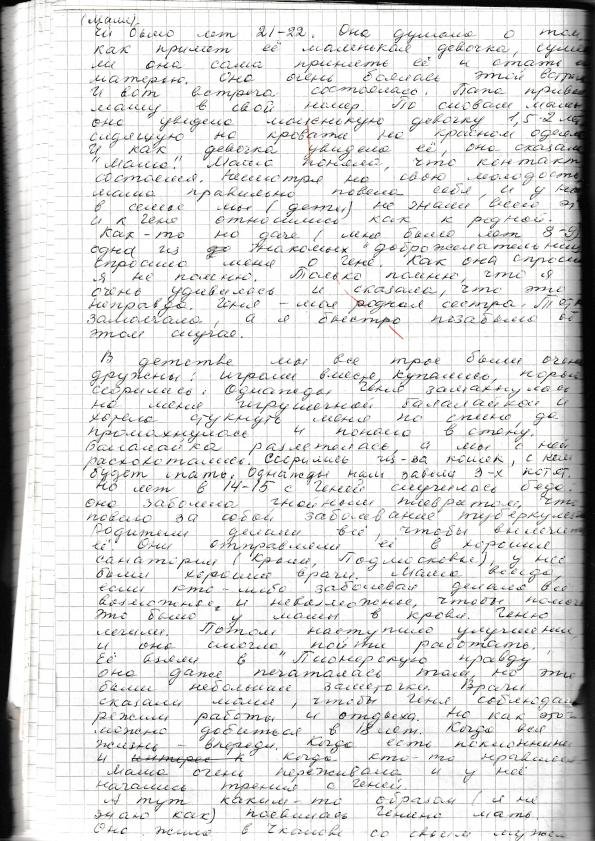
About sister Genya, illness, work.
[?]
she was about 21–22; she thought about
how the little girl would receive her, whether
she would be able to accept her and become
a mother. She was very afraid of that meet-
ing, and then the meeting. Then [?]
Mama into her room. According to Mama
she saw a little girl of 1½–2 years
sitting on the bed, [?] [?]
[?] as the girl saw her, she said
“Mama!” Mama [?] that contact
[?] [?] [?] [?] [?]
Mama [?] [?] [?] [?] [?]
in my family ([?] [?] [?]
[?] [?] [?] [?] [?] [?] [?]
Somehow at the dacha [?] [?] [?] [?]
[?] [?] [?] [?] [?] [?]
[?] [?] [?] [?] [?] [?]
[?] [?] [?] [?] [?] [?]
[?] [?] [?] [?] [?] [?]
[?] [?] [?] [?] [?] [?] [?]
In childhood we three were very
close: we played together. [?] [?]
[?] [?] [?] [?] [?] [?]
[?] [?] [?] [?] [?] [?]
[?] [?] [?] [?] [?] [?]
[?] [?] [?] [?] [?] [?]
[?] [?] [?] [?] [?] [?]
[?] [?] [?] [?] [?] [?]
But around 14–15 a misfortune happened to Genya.
She fell seriously ill. What
[?] [?] [?] [?] [?] [?]
The parents did everything to cure
her. She was sent now to [?]
[?] [?] [?] [?] [?] [?]
[?] [?] [?] [?] [?] [?]
[?] [?] [?] [?] [?] [?]
[?] [?] [?] [?] [?] [?]
[?] [?] [?] [?] [?] [?]
[?] [?] [?] [?] [?] [?]
[?] [?] [?] [?] [?] [?]
She was taken on at “Pionerskaya Pravda”.
She even published there, but it
was a short calm. [?] [?]
[?] [?] [?] [?] [?] [?]
[?] [?] [?] [?] [?] [?]
[?] [?] [?] [?] [?] [?]
[?] [?] [?] [?] [?] [?]
[?] [?] [?] [?] [?] [?]
[?] [?] [?] [?] [?] [?]
[?] [?] [?] [?] [?] [?]
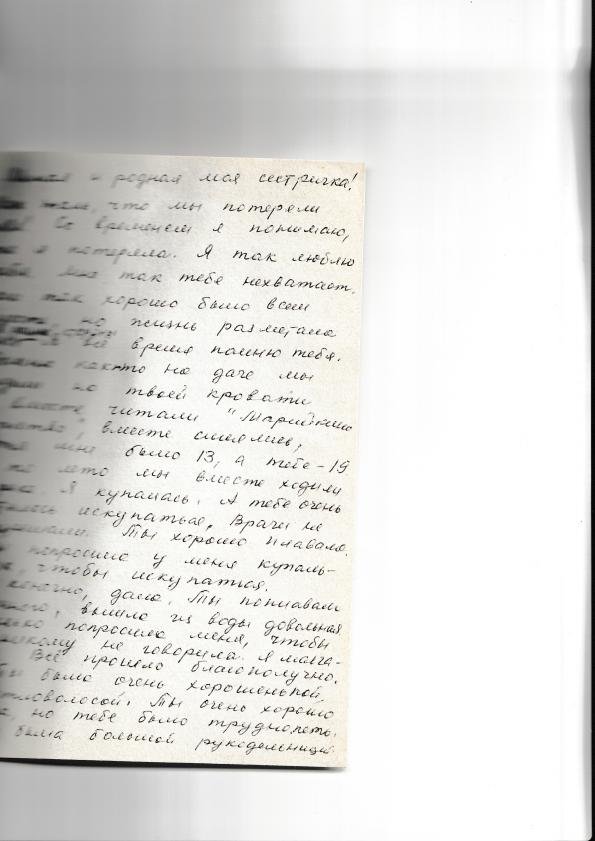
Letter-verses to sister (continuation / insert).
[insert / letter on a separate leaf; edges cropped]
Dear and beloved little sister of mine!
[?] [?] [?] [?]
[?] [?] [?] [?]
[?] [?] [?] [?]
[?] [?] [?] [?]
[?] [?] [?] [?]
[?] [?] [?] [?]
[?] [?] [?] [?]
[?] [?] [?] [?]
[?] [?] [?] [?]
[?] [?] [?] [?]
[?] [?] [?] [?]
[?] [?] [?] [?]
[?] [?] [?] [?]
[?] [?] [?] [?]
[?] [?] [?] [?]
[?] [?] [?] [?]
[?] [?] [?] [?]
[?] [?] [?] [?]
[?] [?] [?] [?]
[?] [?] [?] [?]
[?] [?] [?] [?]
[?] [?] [?] [?]
[?] [?] [?] [?]
[?] [?] [?] [?]
[?] [?] [?] [?]
[?] [?] [?] [?]
[?] [?] [?] [?]
[?] [?] [?] [?]
[?] [?] [?] [?]
[?] [?] [?] [?]
[?] [?] [?] [?]
[?] [?] [?] [?]
[?] [?] [?] [?]
[?] [?] [?] [?]
[?] [?] [?] [?]
[?] [?] [?] [?]
[?] [?] [?] [?]
[?] [?] [?] [?]
[?] [?] [?] [?]
[?] [?] [?] [?]
[?] [?] [?] [?]
[?] [?] [?] [?]
[?] [?] [?] [?]
[?] [?] [?] [?]
[?] [?] [?] [?]
[?] [?] [?] [?]
[?] [?] [?] [?]
(edges of the leaf cut; some lines unreadable)
← Documents in the notebook · Notebook contents · Sister Genya and brother Tyoma (pp. 090–098) →