Continuation of the account of sister Genya and brother Tyoma: the end of a letter, Genya’s fate, family photographs, and memories of the brother.
From the handwritten notebook “Our genealogy: the Samsonovs.”
On p. 093 the brother is named Timofey Timofeevich (Tyoma); later the manuscript often calls him Zhenya.
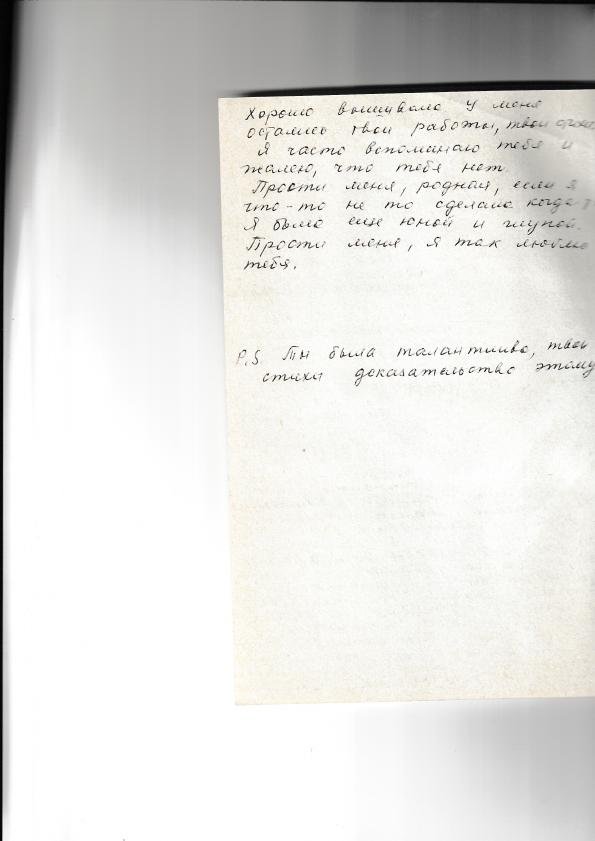
Continuation of the letter insert to her sister.
[insert / separate leaf; right edge cut / glare]
You embroidered well[?]. I still have
your works, I very much[…]
I often remember you and
it is a pity you are gone.
Forgive me, dear one, if for
anything I did wrong sometime.
I was still young and foolish.
Forgive me, I love
you so.
P.S. You were talented, your
verses are proof of that[?]
(leaf edges cut; some line endings unreadable)
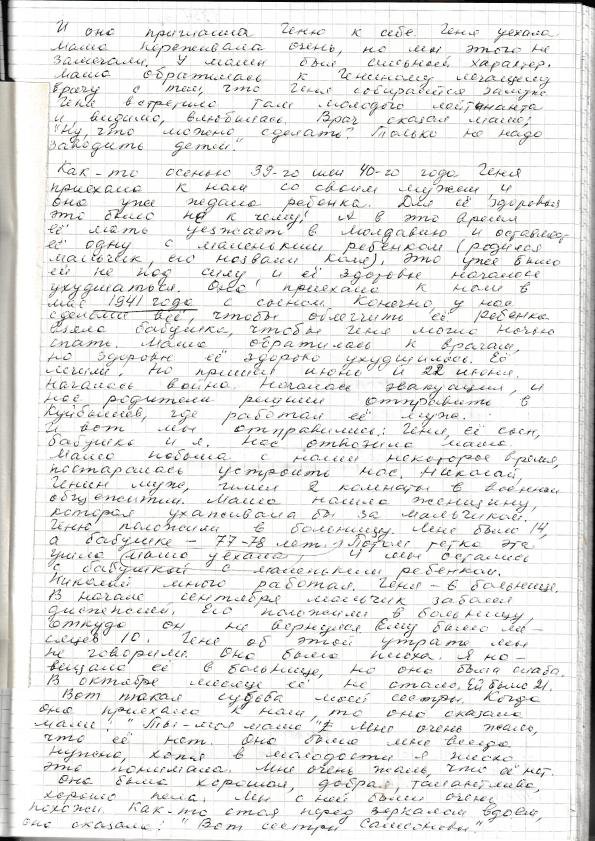
Fate of sister Zhenya, 1939–1941.
And she invited Zhenya to stay with her. Zhenya left.
Mama was very worried, but we did not
notice. Mama had a strong character.
Mama went to a well-known Moscow
doctor about the fact that Zhenya was going to marry.
Zhenya had met a young lieutenant there
and apparently fallen in love. The doctor said to Mama:
“Well, what can one do? Only she must not
have children.”
Sometime in the autumn of ’39 or ’40 Zhenya
came to us with her husband and
she was already expecting a child. For her health
that was no good, and at that time
her [mother? / husband?] leaves for Magadan and leaves
her alone with a little child (a boy was born,
they named him Kima[?]); it was already beyond
her strength and her health began
to worsen. She came to us in
May 1941 with her son. Of course we
did everything to surround[?] her; Grandmother
took the child so that Zhenya could sleep
at night. Mama went to the doctors,
but her health grew much worse. They
treated her, but June passed and on 22 June
the war began. Evacuation began, and
our parents decided to send us to
Kuibyshev, where her husband worked.
And so we set off: Zhenya, her son,
Grandmother and I. Mama took us.
Mama stayed with us for a while,
tried to settle us. They found
for Zhenya, her husband, and us 2 rooms in a military
hostel. Mama found a woman
who would look after the boy.
Zhenya was put in hospital. I was 14,
and Grandmother 77–78. [At first Mama still
managed?] to leave, and we remained
with Grandmother and the little child.
[Nikolai?] worked a great deal. Zhenya — in hospital.
At the beginning of September the boy fell ill
with dysentery; he was put in hospital,
and from there he did not return. He was
10 months old. Zhenya did not tell us
of this loss. She was [quiet?]. I vis-
ited her in hospital, but she was weak.
In the month of October she was gone. She was 21.
Such was the fate of my sister. When
she came to us, she said
to Mama: “You are my mama”[?]. I am very sorry
she is gone. She was always
needed by me, though in youth I [somewhat?]
understood that. I am very sorry she is gone.
She was kind, good, talented,
sang well. We were very
alike. Once, standing before the mirror together,
she said: “Here is sister[?] Samsonova[?].”
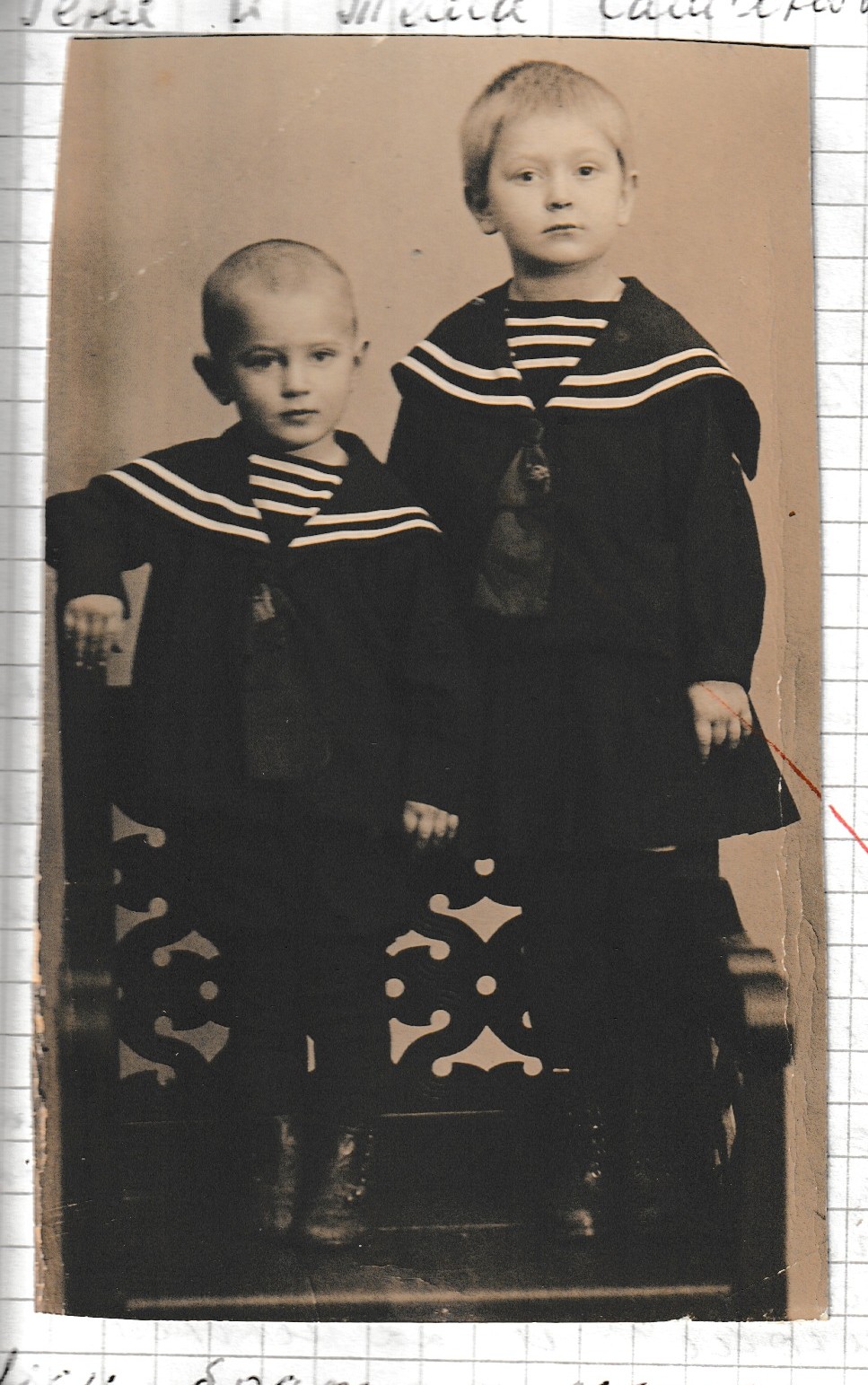
Zhenya and Tyoma Samsonov.
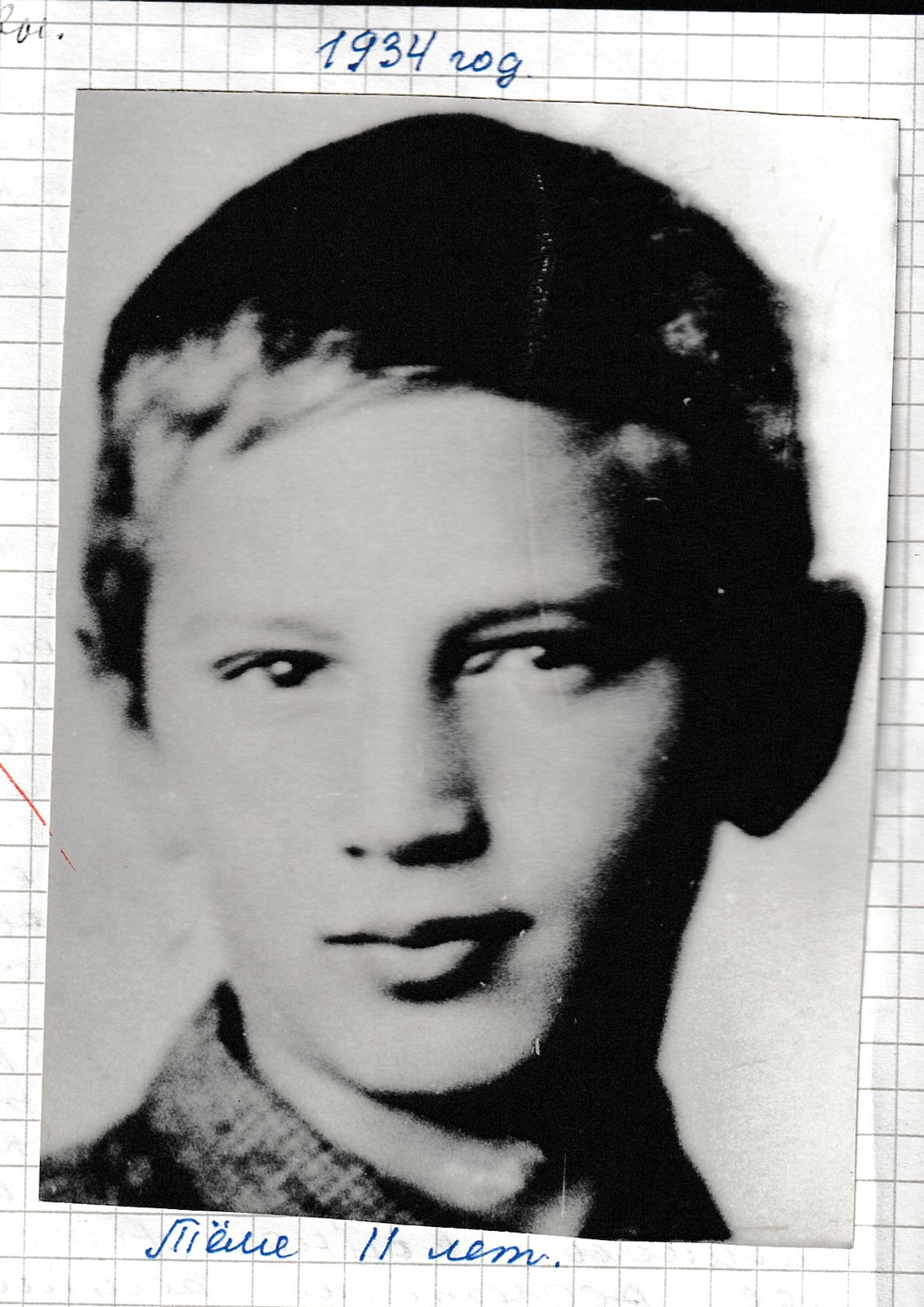
1934 — “I am 11 years old.”
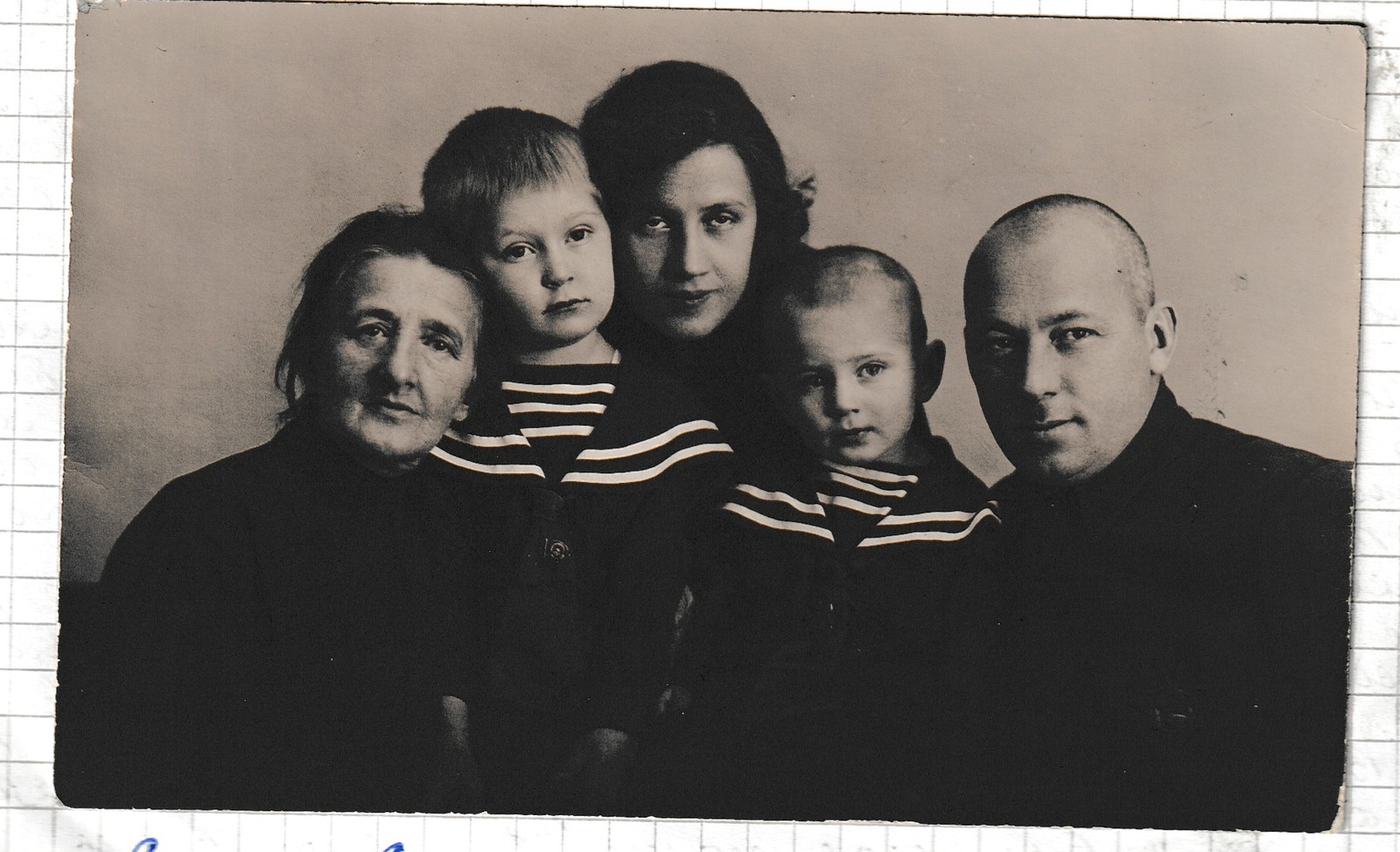
November 1925. The Samsonov family.
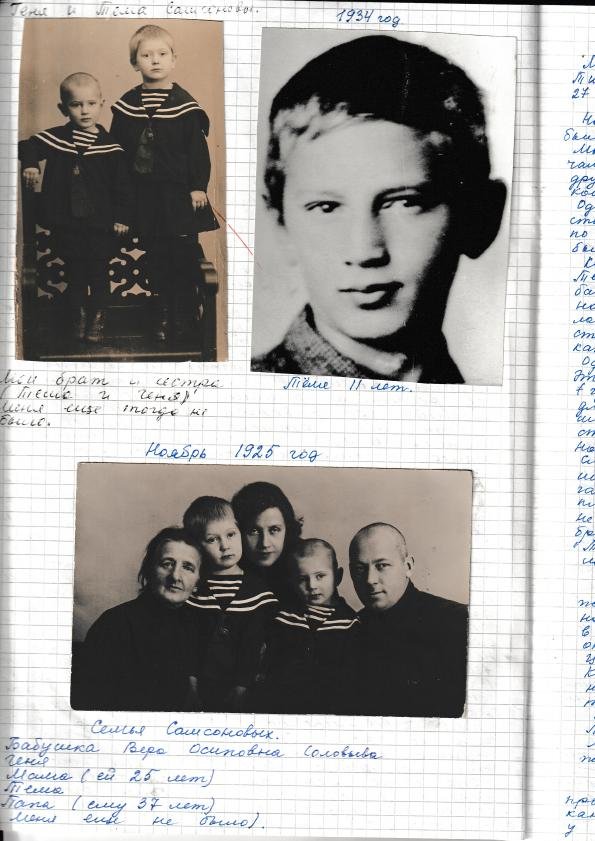
Full notebook leaf p. 092 — family photographs.
Captions on the leaf (see figures above):
Zhenya and Tyoma Samsonov.
1934
I am 11 years old.
My brother and sister
(Tyoma and Zhenya)
I was not yet
there then.
November 1925
The Samsonov family.
Grandmother Vera Osipovna Solovyova
Zhenya
Mama (she is 25)
Tyoma
Papa (he is 37)
I was not yet there.
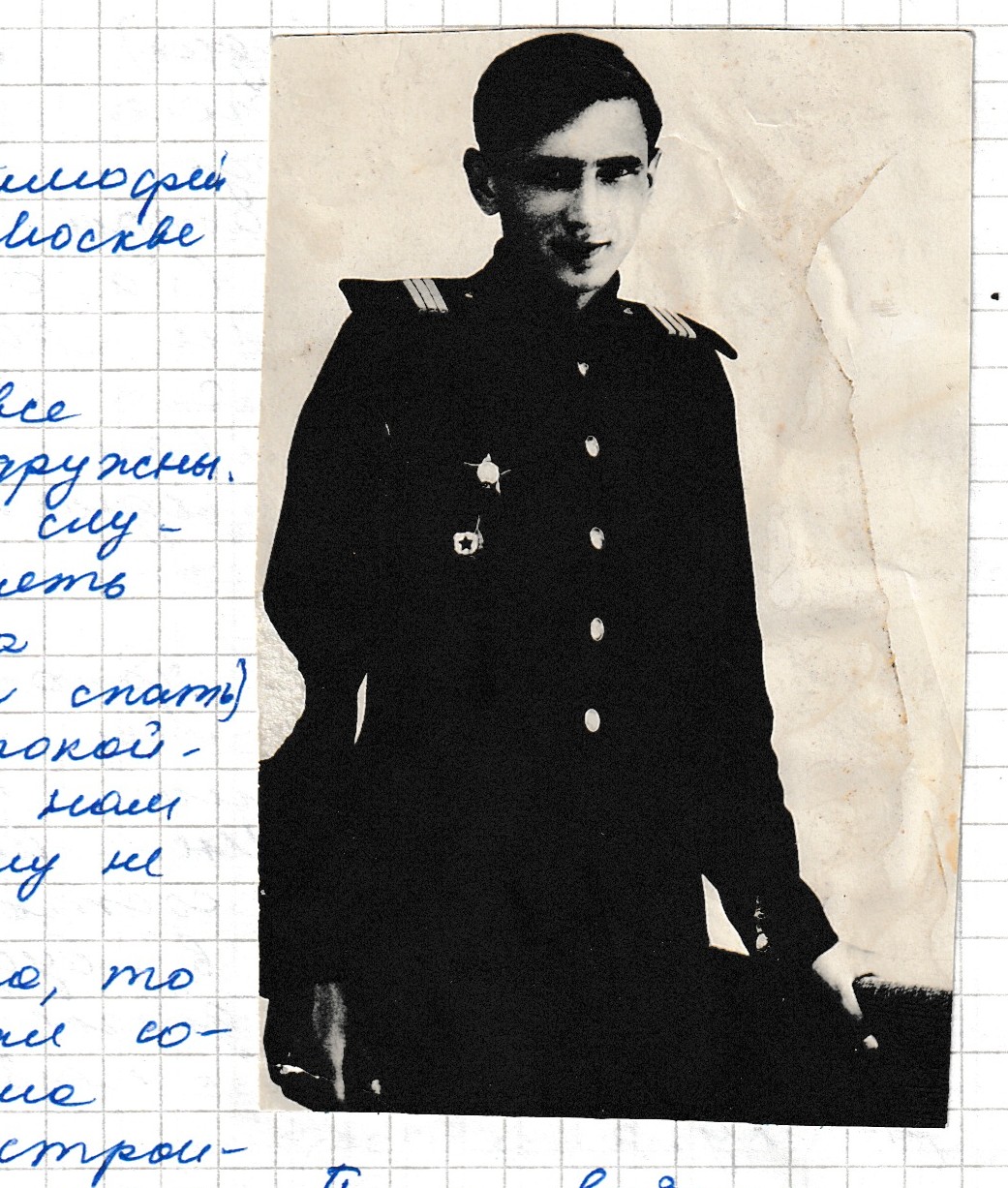
Brother — Samsonov Timofey Timofeevich. “After the war.”
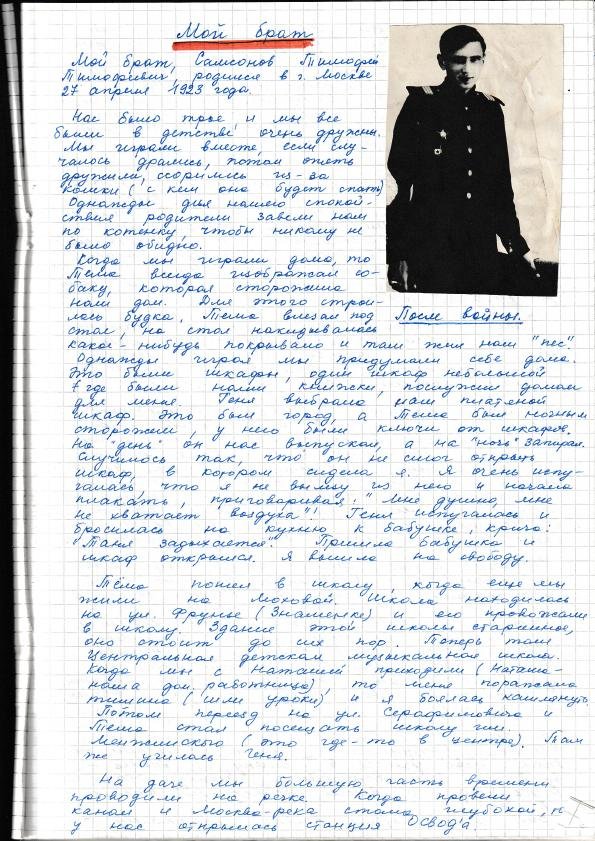
Full notebook leaf p. 093 — “My brother”.
My brother.
Caption by the portrait (see figure above): After the war.
My brother, Samsonov Timofey
Timofeevich, was born in the city of Moscow
on 27 April 1923.
There were three of us and in childhood we were all
very close.
We played together; if it hap-
pened we fought, then again
made friends, quarrelled over
the cat (with whom she would sleep).
Once, for our peace of
mind, our parents got us
each a kitten so that no one would
feel left out.
When we played at home,
Zhenya always pretended to be a
dog that guarded
our house. For that a kennel was
built; Tyoma crawled under
the table, some cover was thrown
over the table, and there lived our “dog.”
Once while playing we invented a house for ourselves.
These were wardrobes; one small wardrobe
where our books were served as a house
for me. Zhenya chose our clothes
wardrobe. This was a town, and Tyoma was the chief
of the guard-post; he had the keys to the wardrobes.
By “day” he let us out, and by “night” locked us in.
It happened that he could not open
the wardrobe in which I sat. I was very fright-
ened that I would not get out and began
to cry, saying: “I’m stifling, I
haven’t enough air!” Zhenya took fright and
rushed to the kitchen to Grandmother, shouting:
“Tanya is suffocating.” Grandmother came and
opened the wardrobe. I came out free.
Tyoma went to school while we still
lived on Mokhovaya. The school was
on Frunze Street (Znamenka) and they walked him
to school. The building of that school is old;
it still stands. Now the
Central Children’s Music School is there.
When Natasha and I came (Natasha —
our house worker), the silence astonished me
(lessons were on), and I was afraid to cough.
Then the move to Serafimovich Street and
Tyoma began to attend the Menzhinsky
school (somewhere in the centre). Zhenya
studied there too.
At the dacha we spent most of our time
on the river. When they built
the canal and the Moskva River grew deep,
the station “Okrug” opened near us.
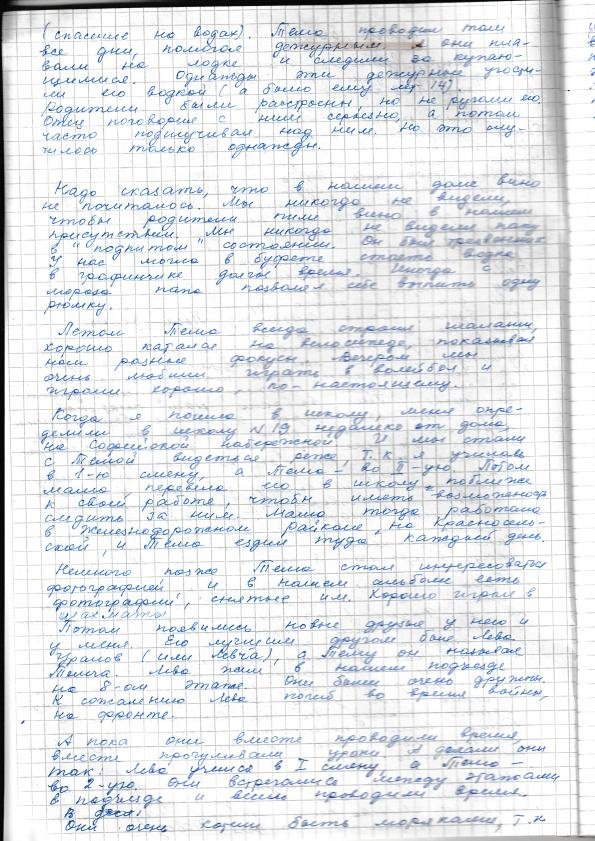
Brother — dacha, school, friends.
(who had saved [him?] from the water). Zhenya spends
all his days there, swimming[?], [on duty?], and they
[?] in a boat and watched the bath-
ers. Once those on duty treat-
ed him to water (and he was about 14).
Our parents were upset, but did not scold him.
Father spoke with him seriously, and then
often teased him. But that hap-
pened only once.
It must be said that in our house wine
was not held in honour. We never saw
our parents drink wine in our
presence. We never even saw
in the “underground” [vessels?]. [It?] [was?]
allowed[?] to stand in our sideboard, [suddenly?]
even a little carafe at times. Sometimes after
the cold Papa allowed himself one
glass.
In summer Zhenya always built huts,
played the piano well, showed
us various tricks. In the evening we
loved very much to play volleyball and
played well, properly.
When I went to school I was as-
signed to school No. 13 not far from home,
on Sofiyskaya Embankment. And we began
to see less of Zhenya, because I studied
in the 1st shift and Zhenya in the 2nd. Then
Mama transferred him to a school closer
to her work, so as to be able
to keep an eye on him. Mama then worked
in the Railway district Party committee, on Krasnopres-
nenskaya, and Zhenya went there every day.
A little later Zhenya became interested
in photography, and in our album there are
photographs taken by him. He played
chess well!
Then new friends appeared for him and
for me. His best friends were Lyova
Uralov (or Leva); [he called Zhenya
Misha?]. Lyova lived in our entrance
on the 8th floor. They were very close.
Unfortunately Lyova was killed in the war,
at the front.
And for the time being they spent time together,
[skipped?] lessons together. And they did it
like this: Lyova studied in the 1st shift, and Zhenya
in the 2nd. They met between floors
in the entrance and spent time together
in the yard!
They were very good[?] little sailors[?], because
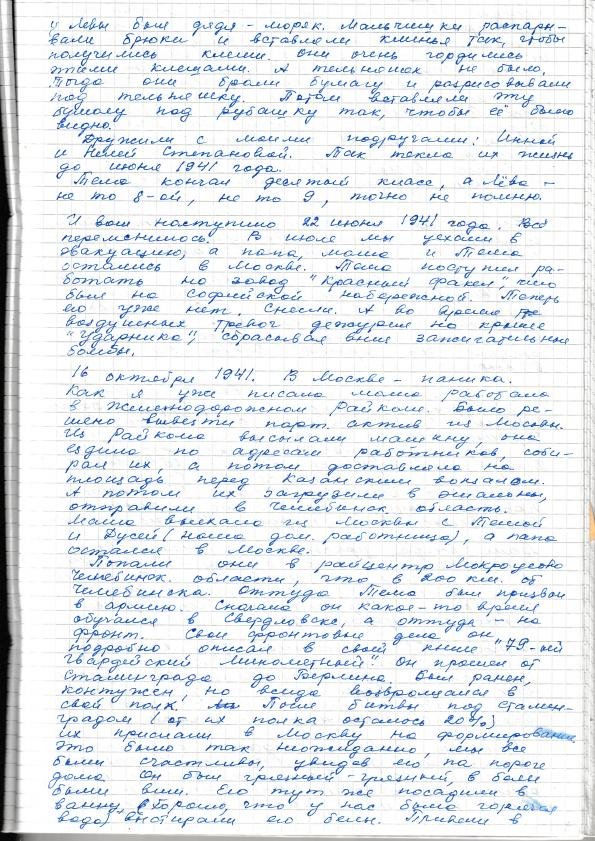
1941; the front; return from the war.
Lyova had an uncle who was a sailor. The boys flared[?]
their trousers and put in gores so that
they got bell-bottoms. They were very proud
of those bell-bottoms. And there were no striped singlets.
Then they took paper and drew
stripes like a singlet. Then they put that
paper under the shirt so that it would be
seen.
They were friends with our friends[?]: Ilyusha
and Kolya Strelkov. So it drew[?] them [closer?]
until June 1941.
Zhenya was finishing the ninth form, and Lyova —
either the 8th or the 9th, I don’t remember exactly.
And then came 22 June 1941. Every-
thing changed. In July we left for
evacuation, and Papa, Mama and Zhenya
stayed in Moscow. Papa [went?] to work
at the “Krasny Fakel” plant, which
was on Sofiyskaya Embankment. Now
it is gone. Torn down. And during
air-raid alerts they stood watch on the roof
of the “Udarnik,” throwing down incendiary
bombs.
16 October 1941. Panic in Moscow.
As I already wrote, Mama worked
in the Railway district Party committee. It was de-
cided to take the Party activists out of Moscow.
They called a car from the district committee; it
went round the workers’ addresses, gath-
ering them, and then brought them to
the square in front of Kazansky Station.
And then they were loaded into wagons
and sent to Tambov region.
Mama left Moscow with Tasya
and Dusya (our house worker), and Papa
stayed in Moscow.
They arrived in the district centre Morshansk
of Tambov region, 200 km from
Tambov. From there Zhenya was called
into the army. First he trained for a time
in Sverdlovsk, and from there — to
the front. He described his front-line days
in detail in his book “The 49th
Guards Mortar [Regiment].” He went from
Stalingrad to Berlin. He was wounded,
shell-shocked, but always returned to
his regiment. And after the battle of Stalin-
grad (20% of their regiment remained)
they were sent to Moscow for re-forming.
It was so unexpected; we were all
happy to see him on the threshold
of the house. He was filthy-filthy; there were
lice [in the bathhouse?]. They put him straight
in the bath (Good that we had hot
water), [rubbed?] him with linen. They took him into
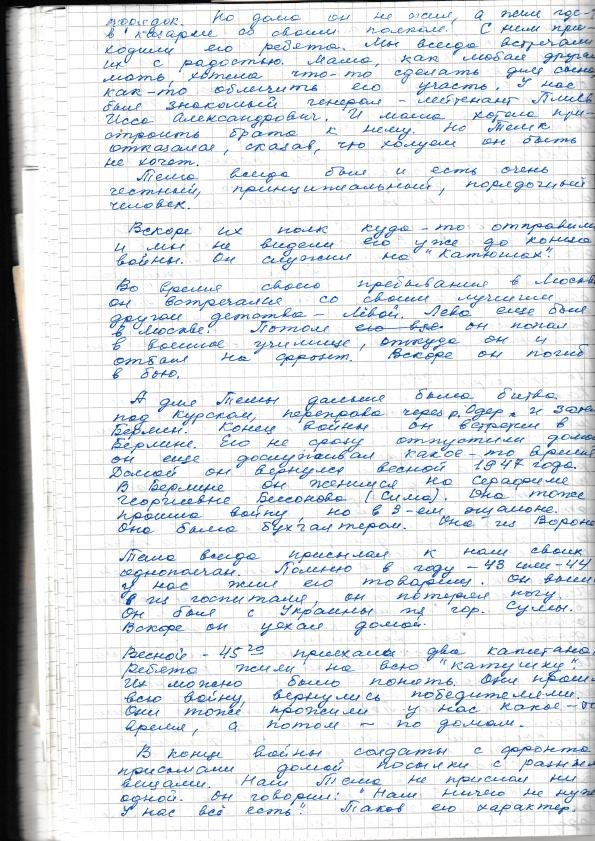
Katyushas, Berlin, marriage, character.
went. But at home he was not very [well], and then
in January he got up from his bed. His rela-
tives came to him. We always met
them with joy. Mama, like any other
mother, wanted to do something for her son,
to ease his lot somehow. We
knew a lieutenant-general, Pavel
Aleksandrovich. And Mama wanted to place
her brother with him. But Zhenya
refused, saying he did not want to be
[a staff officer?].
Zhenya always was and is a very
honest, principled, decent
man.
Soon they were sent somewhere [again?]
and we did not see him again until the end
of the war. He served on the “Katyushas.”
During his stay in Moscow
he met his best
childhood friend — Lyova. Lyova was still
in Moscow. Then he [everything?], he went
into a military school, and from there he
left for the front. Soon he was killed
in battle.
And for Zhenya what followed was: the battle
of Kursk, the crossing of the Oder and the tak-
ing of Berlin. He met the end of the war in
Berlin. They did not release him home at once;
he still served some time more.
He came home in the spring of 1947.
In Berlin he married Klavdia
Georgievna Vsevolodova (Sima). She too
had gone through the war, but in the 3rd echelon.
She was an Accountant. She was from Voronezh.
Zhenya always brought his fellow
soldiers to us. I remember in the year ’43 or ’44
a comrade of his lived with us. He had come
from hospital; he had lost a leg.
He was from Ukraine, from the city of Sumy.
Soon he went home.
In the spring of ’45 two [cripples?] came,
Zhenya’s boys from his “Katyusha.”
One could understand them. They had gone through
the whole war and returned as victors.
They too lived with us for a time,
and then — home.
At the end of the war soldiers from the front
sent home parcels with various
things. Our Zhenya did not send
a single one. He said: “We need nothing.
We have everything.” Such is his character.
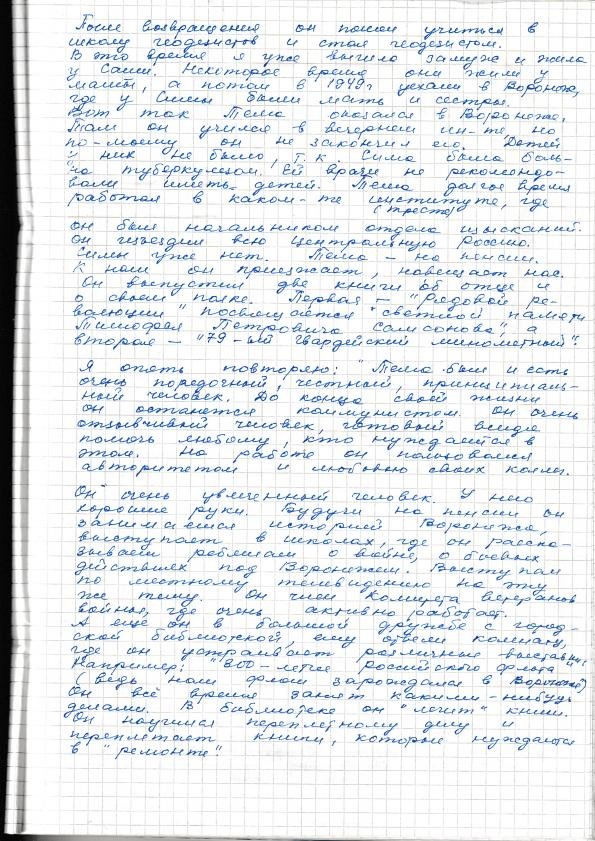
After the war — Vorobyovo, books, retirement.
After his return he went to study at
a school of surveyors and became a surveyor.
At that time I had already finished the 10th form and was living
with Sima. For a time they lived with
Mama, and then in 1949 they left for Vorobyovo,
where Sima had her mother and sister.
That is how Zhenya ended up in Vorobyovo.
There he studied at an evening institute, but
in my view he did not finish it. They had
no children, because Sima was ill
with tuberculosis. The doctors did not recom-
mend that she have children. For a long time Zhenya
worked at some institute (trust), where
he was head of the [publications?] department.
He travelled all over Central Russia.
There is no family any more. Zhenya — has none.
He comes to us, visits us.
He published two books about Father and
about his [folder? / regiment?]. The first — “A Rank-and-File Revo-
lutionary,” dedicated “to the bright memory
of Timofey Petrovich Samsonov,” and
the second — “The 49th Guards Mortar [Regiment].”
I repeat again: “Zhenya was and is
a very decent, honest, principled
man. To the end of his life
he will remain a Communist. He is a very
responsive person, always ready
to help anyone who needed
it. At work he enjoyed
the authority and love of his colleagues.”
He is a very keen man. He has
good hands. In retirement he
took up the history of Vorobyovo as well;
he speaks in schools, where he tells
the children about the war, about the fighting
near Voronezh. He also spoke
on local television on the
same subject. He is a member of the Committee of War
Veterans, where he works very actively.
And he is also on very friendly terms with the town
library; they gave him a room
where he arranges various exhibitions.
For example: “VO-series of the Russian fleet”
(for our fleet was born in Voronezh).
He is always busy with some
affair or other. In the Library he “treats” books.
He learned bookbinding and
binds books that need
“repair.”
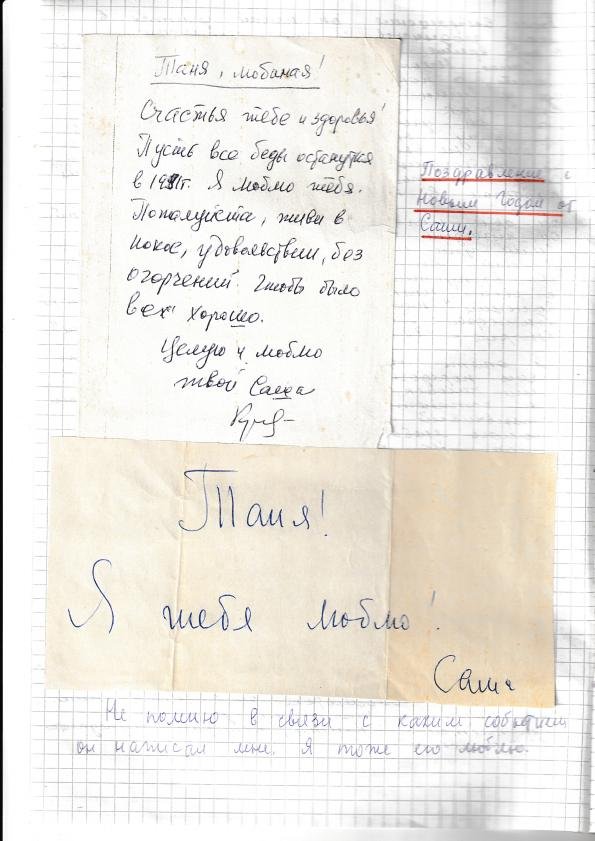
Greetings from Sasha.
[pasted note, top — black ink]
Tanya, beloved!
Happiness and health to you!
Let all troubles remain
in 1931. I love you.
I hope[?], live in
peace, pleasure, without
vexations! That everything
be well.
I kiss and love
your Sasha
[flourish]
[album caption, right, blue ink; red underlines]
New Year
greeting from
Sasha,
[pasted note, bottom — blue ink]
Tanya!
I love you!
Sasha
[album author’s caption]
I don’t remember in connection with what event
he wrote this to me. I love him too.
← Timofey Petrovich; sister Genya (pp. 080–089) · Notebook contents · Uncle Tyoma: documents and Stalingrad (RU) →