From the handwritten notebook “Our genealogy: the Samsonovs.” Tatyana Timofeevna’s voice; unclear places are in square brackets.
Birth, family, childhood
Tanya Samsonova (Krivosheina) Tatyana Timofeevna was born on 2 September 1926 in Moscow.
At that time my family lived in the Metropol (it was the First House of Soviets), number 405 or 407. I was born in the maternity home named after Gruziman[?] (on the Arbat) where 31 years later my younger son was born.
I was born into a family of office workers. My father, Timofey Petrovich Samsonov, was an active fighter for the cause of the Revolution. My brother described Father’s biography in detail in his book A Private of the Revolution. My mother, Samsonova (Morozova) Evdokia Konstantinovna (or as Father called her, “Eva”), was an office worker and later a Party worker. I remember myself from about three or four. Much of what I remember I have described in my accounts of Mama, Papa, my sister and my brother. In childhood we were very close: we played together, fought, made up… My childhood was wonderful; I remember it with warmth. I am grateful to my parents for their love, warmth, attention, care. Of course, as the youngest I was spoilt. In childhood we knew no want. Our “team” (brother and sister and I) was very united. I remember how one summer at the dacha we had done something wrong, and Grandmother complained to our parents when they came back from work. Mama was very angry and punished us terribly, and I joined them. Mama stood us under the balcony, and we ourselves lined up: Genya, Lelya and I. And Mama went to the window, watched us so we stood still, and shouted: “Hands at your sides!” And at that moment Grandmother was walking past, and I said to her: “May you perish, old woman!” (I was about five). Then they forgave us, because rain was starting. I remember we had an Irish setter; she was red and was called “Lavka” (Papa still sometimes went hunting then). She was the kindest and very clever dog. Once I was sitting on the stairs leading to the balcony and crying. About what — I do not remember. Lavka came up behind me and began to lick my hair, and then my face. I terribly wanted to cry. I hugged her and we sat together a long time on the steps!
When we still lived on Vozdvizhenka we had a houseworker, Natasha. I was probably two or three. Sometimes I had wet ital’yanki[?]. She was embarrassed by them and slapped me hard. When that happened I climbed under the bed and sat there very quietly. Later I too wanted to become a nanny and slap mams[?] the same way. And I also wanted to be a laundress and wash linen.
We were taken for walks in the Alexandrovsky Garden. It was not so crowded as now. If it was winter we slid down the hills, and if autumn [struck through], there were many fallen leaves and puddles in the garden. Of course we happily splashed through the puddles, raking the leaves. Sometimes Papa took us into the Kremlin (it was then closed to the public). Papa had a pass and he took us there. That was when we lived on Vozdvizhenka.
We lived on the 4th floor and went up on foot, because there was no lift then. The stair rails were beautifully made. Beautiful cast work with some pattern. Once I put my head through an opening in that design, then lifted my head, and it stuck. I tried to free myself, but no luck. I could not pull my head out. I cried, and Lelya with me. Then somehow I managed to free myself…
Then we moved to the new house on Serafimovich Street [entrance and flat number redacted]. Our windows looked onto the Moskva River and onto the back courtyard, which we called “Stinky.” The first girl I met was Raisa Fisher. She also lived in that entrance, only on the 9th floor. It turned out our parents (especially the fathers) knew each other well. And then I met Marina Takher (Usheva); she lived in entrance 10. She announced to me: “My papa has died, and Mama is sitting at Grandma’s crying.” Later Marina received an academic degree [details not given in the public version]. And then at the rest house “Volynskoe,” where we were with Mama, I met Natasha Sorokina. She also lived in entrance 10 on the 7th floor. We became friends. We played together. A kind woman, Zinaida Nikolaevna (she was apparently a teacher), taught us both to read and write. She was like a governess to Natasha. I remember one incident. It was still before school. I was at Natasha’s; we were fed, and then her papa put us to rest on a big sofa. And left us. I hated that terribly and decided to run away. I quietly got up from the sofa, quietly opened the door and “burst” into freedom. Natasha later remained connected with our house [exact present entrance and degree not given in the public version].
At the dacha I [struck through] also stood out. I remember I was about four. On the neighbouring dacha (No. 1) lived the Krylovs and the Milchakovs. The Milchakovs had a son, Tolya. At that time he was already a big boy. He went to the river to fish. And I, who knows what got into my head, went to them and said: “Your Tolya has drowned!” There was of course a panic. They ran to the river; they found Tolya. Why did I do that? I do not know. I cannot explain.
All my life I have loved water. I love to bathe wherever possible. Mama told me that when I was nine or ten months old she took me to the river, to the beach. She would sit me down saying: “Sit, don’t go anywhere.” And herself go swimming. The Moskva River was shallow then; you could ford it. As soon as Mama stepped away from me I stood up and climbed into the water (and I was only nine or ten months). When people began to shout: “Whose girl? Whose girl?” Mama of course knew it was her child. Even in advanced age, when I can, I bathe. Only my leg does not allow it (arthritis).
I learned to skate early. As I have already written, I learned at the rest house “Volynskoe” where we were with Mama. And Rotengolts, who was also resting there, helped me learn. (I was not yet at school.)
[struck through: Then] At eight I was put into school No. 19 on Sofiyskaya Embankment. I went to school already able to write and read. Our school is an old building, right opposite the Kremlin. Before the Revolution it was a boarding school for girls where home teachers were trained. In that boarding school in his young years Rachmaninov himself taught music.
And so I was in the 1st form. We were gathered in the school yard. Mama brought me. Raisa and I were put in a pair and led into school. Our teacher was the splendid Nina Ivanovna Avdeeva. She was already of an age. Our class was 19. She was a kind, intelligent, experienced teacher. She never raised her voice at us. She loved children and we answered her in kind. At the long break we were taken to the buffet. Everything was done in order, without hustle, without shouting and jostling. That summer there was renovation in our flat, and we still lived at the dacha. Mama asked permission not to bring me to school for 7–10 days, explaining that I was already “literate”: I could read, write and count. Permission was given, and I came to school after about 10 days. I entered the classroom, sat at a desk next to Raisa (so we had been seated on 1 September); it turned out my place was taken and I was seated with someone else, I don’t remember. Nina Ivanovna read to us a great deal about nature (Bianki and others), could write a clean hand “drop, hairline” (we had a separate penmanship lesson). I remember my first teacher with warmth and gratitude. She taught us much. Thank you to her.
In the lower forms we were walked to school and met. I don’t know why, but the boys in the yard called me “Varvara.” When I walked from school they shouted: “Varvara is coming!” In horror I waved my satchel every which way and ran after them. In general I was a very restless, lively and laughing girl. I easily climbed over fences, swam well, fought…!
And so four years passed, and we found ourselves in the 5th form. Our form teacher was Zinaida Nikolaevna Gan[?], teacher of Russian. There were rumours she had once been an actress. I well remember how in a literature lesson, explaining bylinas and folk tales to us, she sang Russian songs. And we sat as if rooted.
Explaining grammar rules (the spelling of adjective suffixes “an”, “yan”) she went to the window and, pointing at the glass, frame and windowsill, said: “Steklyanny, olovyanny, derevyanny” — exceptions, and they are written with two “NN”.
By then we were already Pioneers; our Pioneer leader was Galya Chelishcheva from the 8th or 9th form. She spent much time with us, and we ourselves were very active. Our unit: Inna Grebneva, Marina Takher, Kira Pronutskaya, and also some boys (I don’t remember who) were the most active: every day we put out our newspaper The Red Scarf. (We all gathered at Inna’s home), held meetings, often went to the theatre. Formerly on Theatre Square, opposite the Maly Theatre, was the Central Children’s Theatre. That is where we went almost as a whole unit. On holidays we always decorated our classroom. We always walked to school together: Inna, Zoya Zhertunova, Marina and I. We gathered near entrance 13, where Inna lived on the 2nd floor. Sometimes we knocked at her window, and then the whole company walked to school. In the 2nd courtyard, where the shop is, there was a fountain. And of course when it was not working we climbed into it. Once, either in autumn or spring, there was water and ice floes in the fountain. Of course we wanted to walk on those ice floes, but our shoes were not suited. And it happened before lessons, in the morning. But Inna had rubber overshoes; she went ahead (she was a diver) to measure the depth. She crossed the whole fountain, and before climbing out she slipped and with all her force flew back into the water. We rushed to lift her; she got out; she had to go home and change. We waited for her together. Sometimes in winter before lessons we all went at 7:30 to the rink on the “tserkovka” and skated until 8, then changed and went to school.
I studied well, but terribly disliked mathematics. (Then there was Kiselev’s[?] textbook.) I hated it with all my soul! something floats up from somewhere, someone set off for point A to point B, and so on. Having finished the 5th form I with the greatest pleasure drowned that textbook in the Moskva River.
Our company was very united. Sometimes, having scraped a little money together, we went to the park “Morozovka,” not Gorky’s, and bought ourselves ice cream. We chose by names unfamiliar to us: “Tu[t?], fruit, sandve,” and so on.
Sometimes at the beginning of summer we went to each other’s dachas (to Zorya Granovsk[aya?], to Inna Grebneva and the other way).
The years 37–38 we lived through in our own way. We could not understand where people were disappearing and why they were enemies of the people. And we were in the 3rd or 4th form. From our class Nina Sidorova disappeared, and from our entrance — the Pavlovskys, Rotengolts, Kallinovich, Milya Mulina, the Pukhalevskys, Svetlana Khana, Melenduk, Benenson, Nina Tsyto… In our history textbook there were portraits of Pukhalev, Egorov, Blyukher. At best we glued them over. And then spies seemed to be everywhere. And in our house a new zhidu[?] appeared. In our class it was Lelya Kabukova. We were struck by how she was dressed. Until then we paid no attention to clothes. Around us adults and children were dressed the same. And here the girl had a seal coat which was not left in the cloakroom but taken home, and after lessons their houseworker Pasha brought it. And that in the 4th form! Once Lelya invited me to her place (they lived in entrance 1 on the 5th floor). It was daytime. Her father, Bogdan Zakharovich, was at home. He asked my name and when he heard that my surname was “Samsonova” he said: “Yes, I knew your father when you were not yet there.” I was charming[?] in that house. But without freedom poor Lelka was restricted: she was not allowed to play in the yard.
Our yard. Before writing how we spent time in the yard, I must say that there were always many children in the yard, not as now. We had friends among both the big and the small. In winter we had a rink and a slide on the Tserkovka. In spring and autumn we rode bicycles, played volleyball and various games: “Ory and charuki,” “Cossacks and robbers,” “Shtandart” and others I have forgotten. Or simply walked the circle of the yard: from one courtyard into another.
Our club.
Our club was in entrance 3 on the 1st floor. The entrance was both from the yard and from the street. The club was run by Marta Yakovlevna Ruben. A splendid auntie. Kind. She treated the children very well. Now I think how she could stand our shouting and din. There were always many children in the club. In winter it was cold in the yard and everyone piled into the club. The club had 5 rooms. One small — Marta Yakovlevna’s office; the second — a games room: in the middle stood a table with a small billiard with balls. There were chess and draughts tables. In the third room various circles met. Inna and I were in the aircraft-modelling circle. There was a fairly large hall with a stage. The club had various circles: photo, music, rhythmics, drama, [struck through: Kra] naval.
The drama circle, as I remember, put on 2 plays: Owls and Lyubov Yarovaya. In Lyubov Yarovaya Inna and I took part. She played the old mother who seeks her sons, and I — Dunka. Lyubov Yarovaya was played by Nelya[?], Yarovoy by Marta Yak.’s son Igor, and others. The play was a success. Then Nelya Shaburova had the idea of staging The Fountain of Bakhchisarai. (At that time Nelya was at ballet school.) I also took part in that production (I was one of the khan’s wives). Maria of course was played by Nelya. And Nadya Pindina was in charge of the music. We had no ballet score, and she chose the music herself: Tchaikovsky, Schubert, and others. We made the costumes ourselves, and the scenery too. The ballet was also a success. And in the evenings older young people gathered. The naval circle met; sometimes there were dances. But that was all for the older ones, not for the little ones. How much joy and use our club brought. Children not only from our yard but from neighbouring yards came to our club. As I have already written, we were very active. When with Tolya Vozdvizhensky and the boys (Natasha, Shurik, Fedor, Krechkin) we put out a fine newspaper. Then we found Natasha’s address, bought flowers and went to his home. We rang the bell; they opened; Natasha seemed not to be home; we left the flowers. And still we managed to see the dog Vesely, who had also been beaten at the Pole.
During the events in Spain we did not stay aside either. In Moscow a museum dedicated to the events in Spain was opened. It was in Lopukhin Lane, by Kropotkinskaya (Prechistenka) Street. We learned through Antonina’s mama that a delegation from Spain would come there. Several of us went. We were not let in, but the delegation still did not come; we sat on the stairs and waited. Then we wanted to eat; we bought a loaf of black bread and also sat on the steps munching. Just then the delegation appeared. They were shown the museum, then invited to table, and we were lined up and led out to them in the hall. We said something, and then put our scarves on them. And they gave us small presents.
Not far from the chauffeurs was the “Red October” factory. We were taken there on excursions, where we could eat [struck through] free sweets as much as we liked. And before holidays we were invited to the factory club, where we took part in a concert, for which we were again fed sweets.
In a word we responded to any events that took place in the country. And we were then about 11–12.
6th form “a”. Attainment good, discipline — could not be worse. Especially in physics lessons. For some reason we took a dislike to the teacher, and the poor woman could do nothing with our class. Perhaps because she had a slightly strange pronunciation / e.g. “Communicating vessels are called such vessels,” she says, and we died of laughter. Once before her lesson we moved all the desks, blocking the aisle. And just then the headmaster came to the lesson. And at that moment someone shouted through the door — Alya Kazakova, a pupil of 6“b”, helped us. In the end a parents’ meeting was held and it was decided to split our class, merging it with 6“b”. At the end of the school year that was done. I went into 7“b”, and also Kira Troyanskaya, Tanya Rozenberg, Lyova Maderian and someone else, I don’t remember. That was a punishment for our united class for bad discipline. Well, what to do? Still we were together for all lessons.
Lying: Tanya Smirnova, Ira Voronina. 1st row sitting: 1. Tanya Rozenberg 2. Svetlana Bogorodskaya 3. Inna Grebneva 4. Marina Taker (Usieva) 5. Zoya Martynova 6. Tanya Samsonova 7. Stella Burgaft 8. —
2nd row (sitting) 1. Lelya Kobukova 2. Roza Kokhlova 3. — 4. Panova Zinaida Nikolaevna 5. Nadya Stepanova 6. Valya Shevchenko 7. Galya Kostyreva 8. Nonna Ivanova
3rd row (standing) 1. Valya Ivanova 6. Lilya Matalova 2. Lyuda Smirnova 7. Vova Volkov 3. Raisa Fisher 8. Zhenya Zaitsev 4. Zorya Grakhovskaya 9. Oleg Marabochkin. 5. Kira Pronyukai
Class photograph
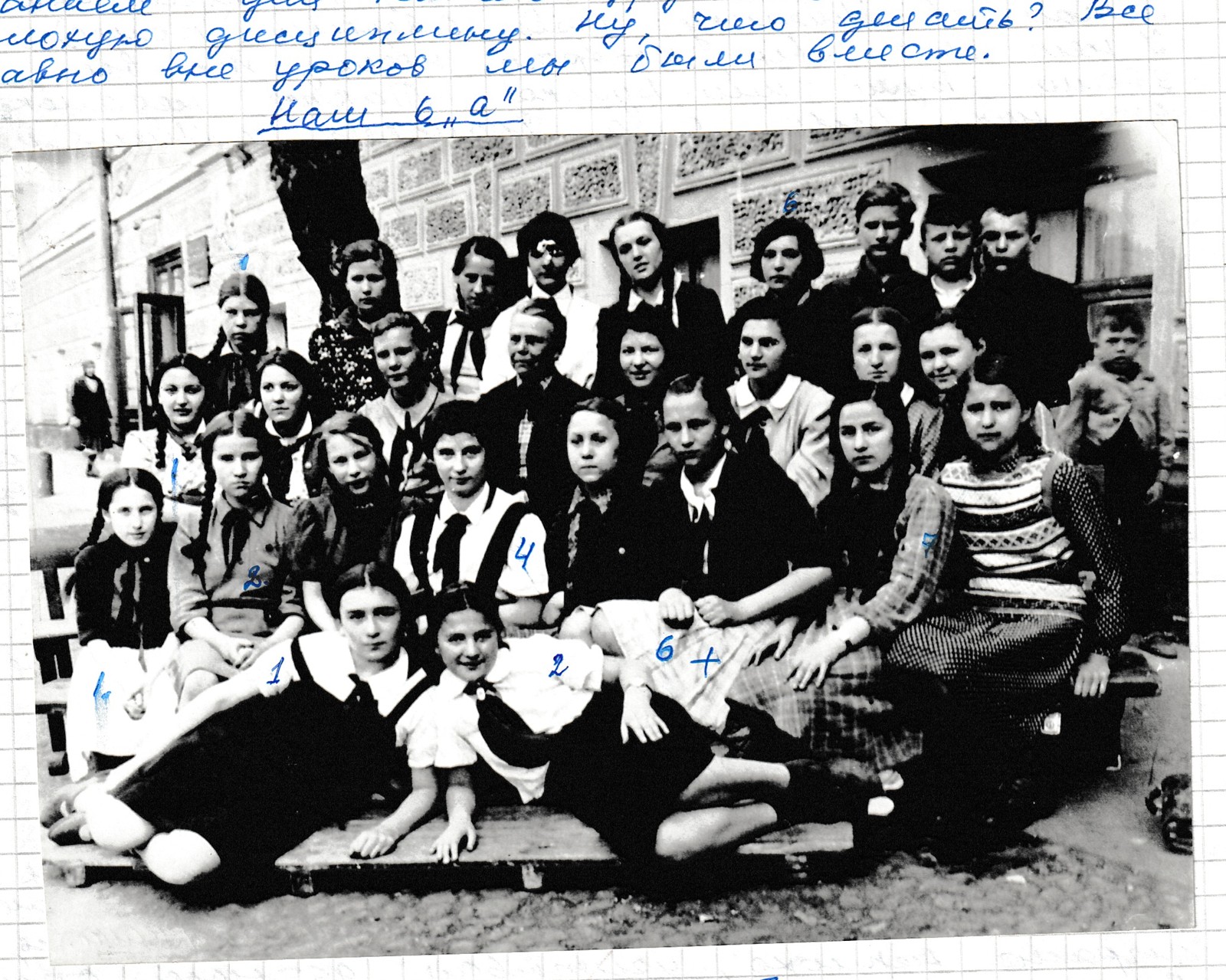
Our 6 “a”. Captions for the rows are on the notebook leaf.
The full line-oriented manuscript reading is on the Russian chapter . Unclear places remain marked [?].
← Uncle Tyoma: documents and Stalingrad · Notebook contents · School and war →