From the handwritten notebook. Tatyana Timofeevna’s voice. Children’s years of birth — without day and month until family confirmation for publication.
…the family there, but without departure. He did not agree. And then he was transferred to Aktyubinsk, and then to Moscow. As Sasha remembers, this time in Moscow the treatment was polite, and the investigator said “Vy” to him. They offered cigarettes. Once the investigator called him and said: “Well, Sasha, the case is finished. Go and collect your things; your father is waiting for you below. But quickly; we release until 18:00; hurry. Or if you like you may spend the night with us.” Sasha of course refused.
And so he came out. And waiting for him in the car were Dm. Aleks., Nina Vas., I and my mama. It was on M. Lubyanka. Sasha — in kirza boots, hair cut short, in a quilted jacket with a wooden suitcase. He, I think, poorly understood what was happening and whom he saw; he only “hushed” us, sat in the car and said: “Let’s get out of here!” My mama could not go with us because there was no room. We arrived in Kosino and at once arranged a shower for Sasha. And the shower was a summer one. I brought him linen, and he asked me: “did you miss me?” With that everything was said, as if there had not been 5 years of separation. We were together again.
Sasha was issued a passport. And he became a person with a passport! Having rested a little, he went to work at Stalproekt, where he was reinstated. We spent the whole summer in Kosino. His institute comrades came there. In general life quietly little by little was restoring itself.
One must give Sasha his due: he never asked me how I had lived those 5 years. No question, no reproach. As he said: “What was, does not interest me.” That is all. Only “my Sanechka,” who loved me very much, and I him, was capable of that. And he told very little of the horrors he had lived through. In autumn we moved to Moscow and went to work: I to school, he to Stalproekt.
In December 1954 misfortune struck us: my papa fell ill. First he had a mild stroke; they thought he would improve. And in January there was a second stroke — very severe. Papa was sent to hospital. Mama disappeared there; although the hospital was good (the Kremlin hospital), Father would not let her go. He was in hospital a long time. And after that he was sent to the Kratovo sanatorium (for old Bolsheviks). Mama went with him. It was drawing toward autumn. I visited them, but Papa was not very pleased with my friends. He was very photographed. In September we took him home. At first it was all right, and then his temperature rose and he was taken to hospital, from which he did not return. That happened on 28 October (Friday) 1955. That day we were at the hospital, but they would not let us to him; we went home, and at 11:30 at night they telephoned and said he had died. That is how it all ended. Papa was gone.
Mitya
Mitya had already gone to school in the 1st form. Mama began to be ailing. The house emptied. But life went on. I still worked at school, but I wanted to return and work in Moscow. I was already tired of travelling by electric train.
Mitya studied, but often had tonsillitis. Something had to be done about his throat. I took him for a consultation to a well-known otolaryngologist of the time. He advised removing his tonsils and adenoids. We began to look for where it could be done. We were lucky: the wife of Sasha’s comrade Boris Charka, working at the Morozov children’s hospital, was an ENT. Through her we arranged Mitya in hospital where he had the operation. We visited him so that we promised that after the operation he could eat ice cream and drink soda water. He had been deprived of all that.
And before that misfortune struck him when he was not yet at school. He was sitting in the yard with Baba Lesya when some healthy lad of about 16 ran past without looking and pushed Mitya; he fell on his back and hit his head on the asphalt. I was at work. Mama called a doctor; Mitya had to be hospitalized. At that moment I arrived, and Mitya was sent to the Morozov with concussion. We went there every evening. And then we took Mitya home under a signed undertaking. So our life flowed with its joys and sorrows.
We continued to work, but I still dreamed of moving to work in Moscow. And in summer 1956 I moved to work as a translator. Sasha returned. Summer 1954. By Petrovsky wood
By the Moskva River. Petrovsky wood. Summer 1954
After the return
Serezha
to Stalproekt. Then they were occupied with building a metallurgical plant in India, at Bhilai. I translated drawings, notes; I had Indian engineers under my care. Joking, one can say that part of the plant was built from my drawings. The plant works. Besides that I studied Russian with one Indian engineer, Mr Rajigapalan[?]. In 1957 Serezha was born to us. He was born in the same maternity home where I was born. That is the Grauerman maternity home on the Arbat.
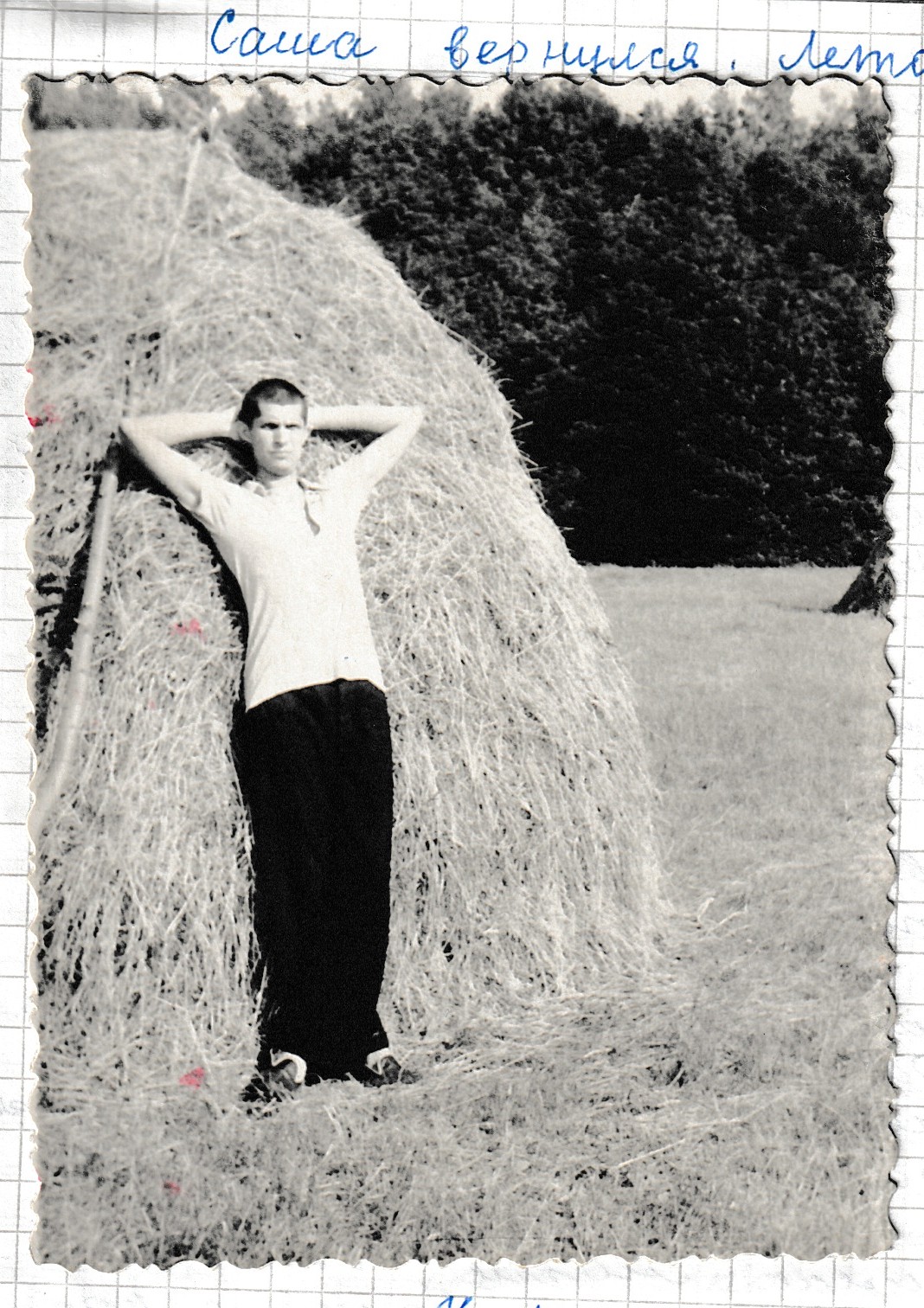
“Sasha returned. Summer 1954. By Petrovsky wood.” Sasha = A. D. Krivoshein, husband of T. T.
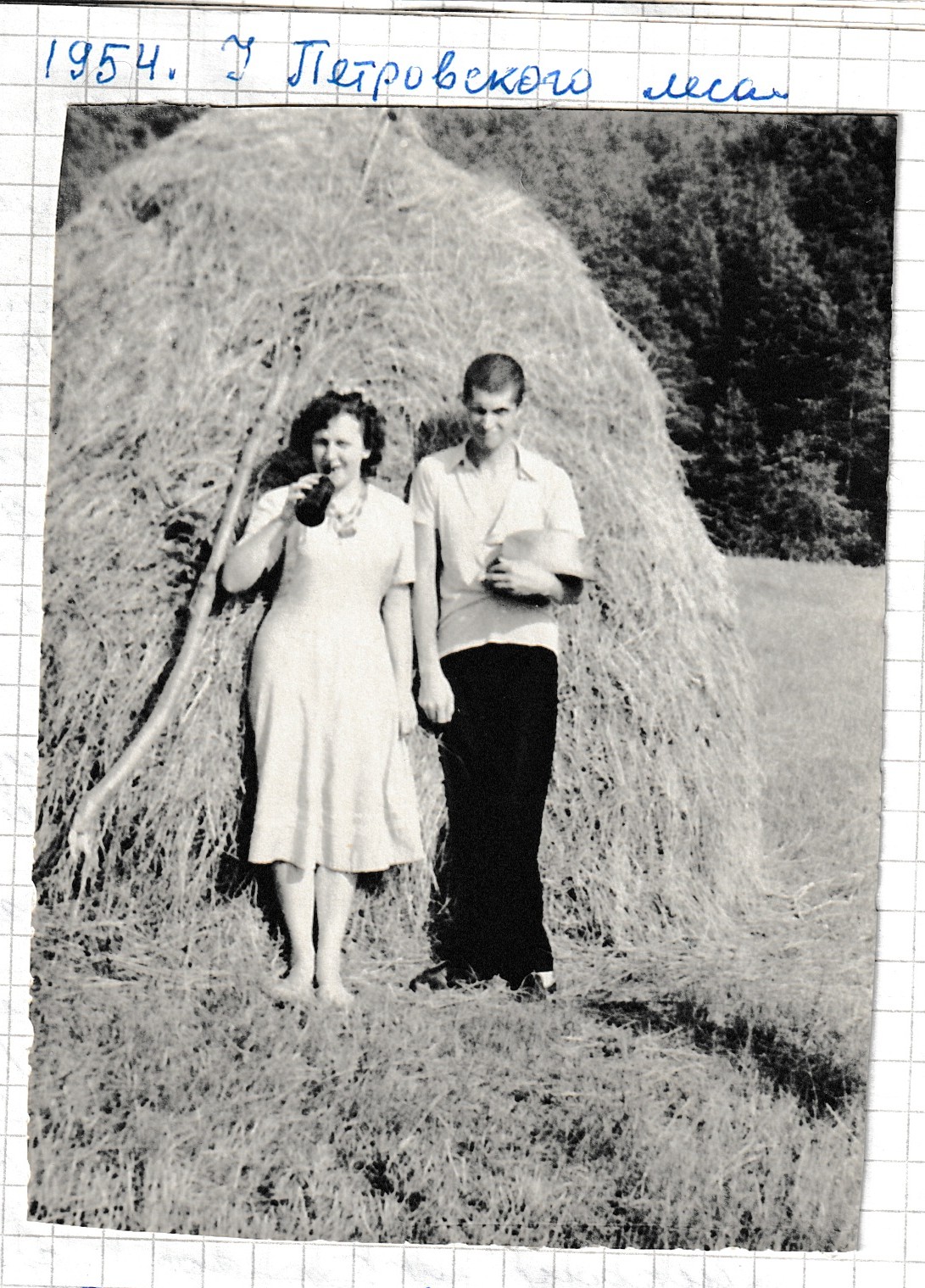
By the Moskva River. Petrovsky wood. Summer 1954.
After the return — a family frame.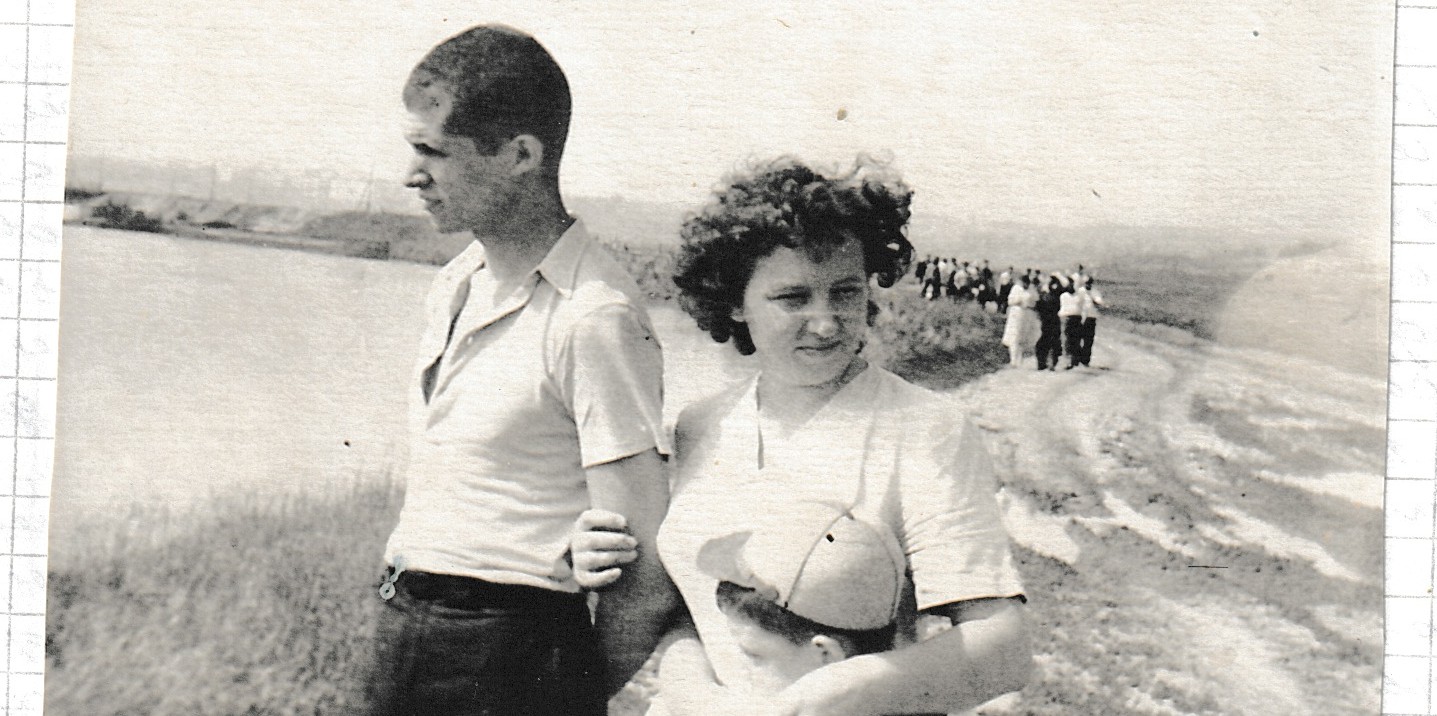
And so Mitya finished school, but not very successfully. He had to enter an institute. And the year was hard: that year both 10th and 11th forms finished school. That is, there were twice as many applicants to higher schools.
Mitya decided to apply to our institute, because I worked there, and Sasha had many comrades there who could somehow help. Mitya chose a hard faculty — physics. Study was rather hard for him, and he himself showed no special zeal. In the 1st semester he failed mathematics; he had to study all the holidays. At last he passed. And in the IInd semester he fell in love and everything went topsy-turvy. By the end of the year he had not sat 3 exams, i.e. he was to be expelled. Then Sasha, gathering his will, went to the dean of the faculty, who was his classmate, and they began to ask him for help. The dean was silent, and Sasha was silent. Sasha told me later that he decided not to leave until the dean decided what to do. Then the dean said: “Come to me in 2 hours.” Sasha came and the dean said Mitya should sit at least one exam, and 2 exams we will put off to autumn. So they did. All summer Mitya studied with teachers of mathematics and physics. By 1 September he had sat all exams, but then “shalyai-valyai” began again and he was transferred to another faculty. My friends helped him here. So Mitya is in the 3rd year of the faculty of rare metals. As if he began to study. In summer he went to Pitsunda to our sports camp. He arrived a little early, thin and very anxious. He had fallen in love and was thinking of marriage. How will you study and on what will you live? Answer: “I will move to the evening faculty and work.” “And where will you live?” We then lived on Leninsky Prospekt, and the flat was small. Then he said his chosen one was married and was going to divorce. She studies at the PMP faculty. I have forgotten her name. We talked very seriously and much about this, trying to hold him back from that step.
She often telephoned us, and he asked us to say he was not at home, had left. I told him one cannot hide forever and he must talk to her. They arranged a meeting, and Mitya came home thoroughly drunk. He kept wanting to go, but I would not let him. He lay down and fell into sleep. A call from her followed. I explained the next failure: Mitya cannot come, and asked her to meet me; we arranged a time near the metro. Sasha walked me. The young woman was a little late. Then we decided to walk along Yakimanka. She walks beside me saying: “Dima and I love each other.” To which I answered: “Very good, but now tell me about yourself.” She hid the fact that she was married and lived with her husband; there was no talk of divorce. She made on me the impression of a very light-minded young woman, not very clever, a little tactless. We talked and parted. Then I asked about her at the institute; those people’s opinion coincided with mine.
Then I talked long with Mitya about my impression. (I think that was his first love affair.) Then she telephoned many times, and Mitya did not come to the telephone. Of course he was chicken. So it went on rather long. Once I came to the telephone and said to her: “Understand me rightly; I speak to you as a woman. Think why he does not telephone you. You will understand everything.” She said: “Thank you” and [struck through] did not telephone again. Some time passed; Mitya was already married, and he thanked me for having managed to hold him back from that step.
Mitya with Grandpa Pesha. January 1954
Berdyansk. Sea of Azov 1965
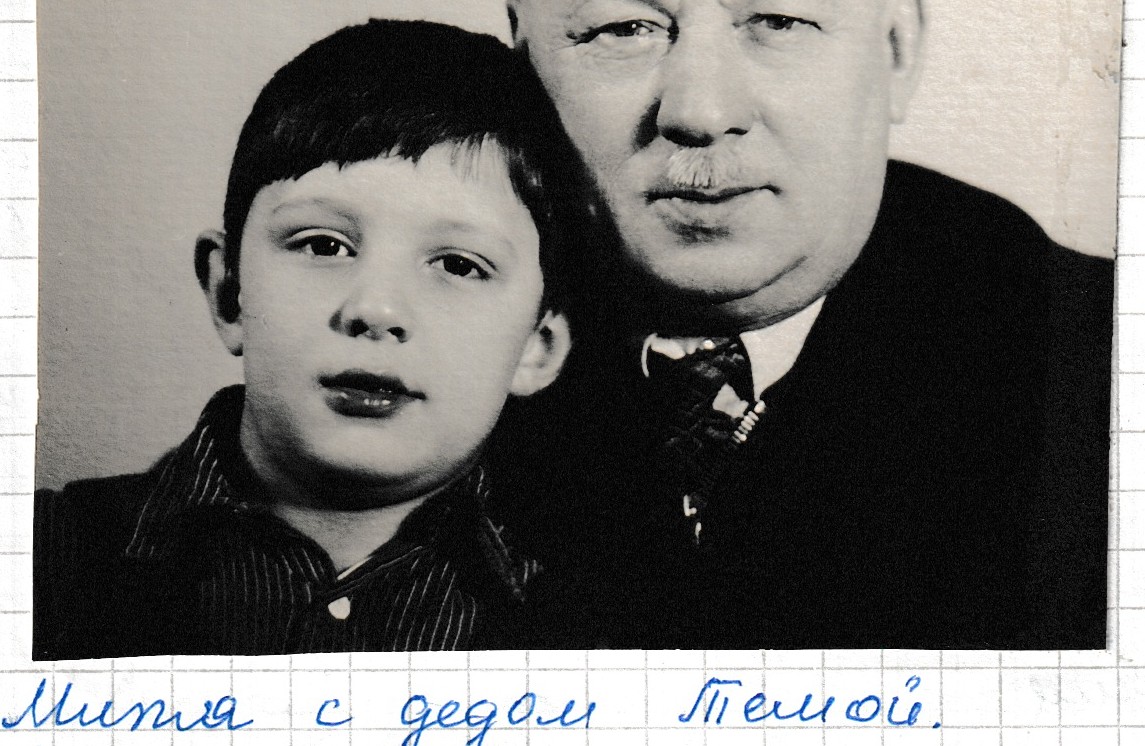
“Mitya with Grandpa Pesha. January 1954.”
“Berdyansk. Sea of Azov. 1965.”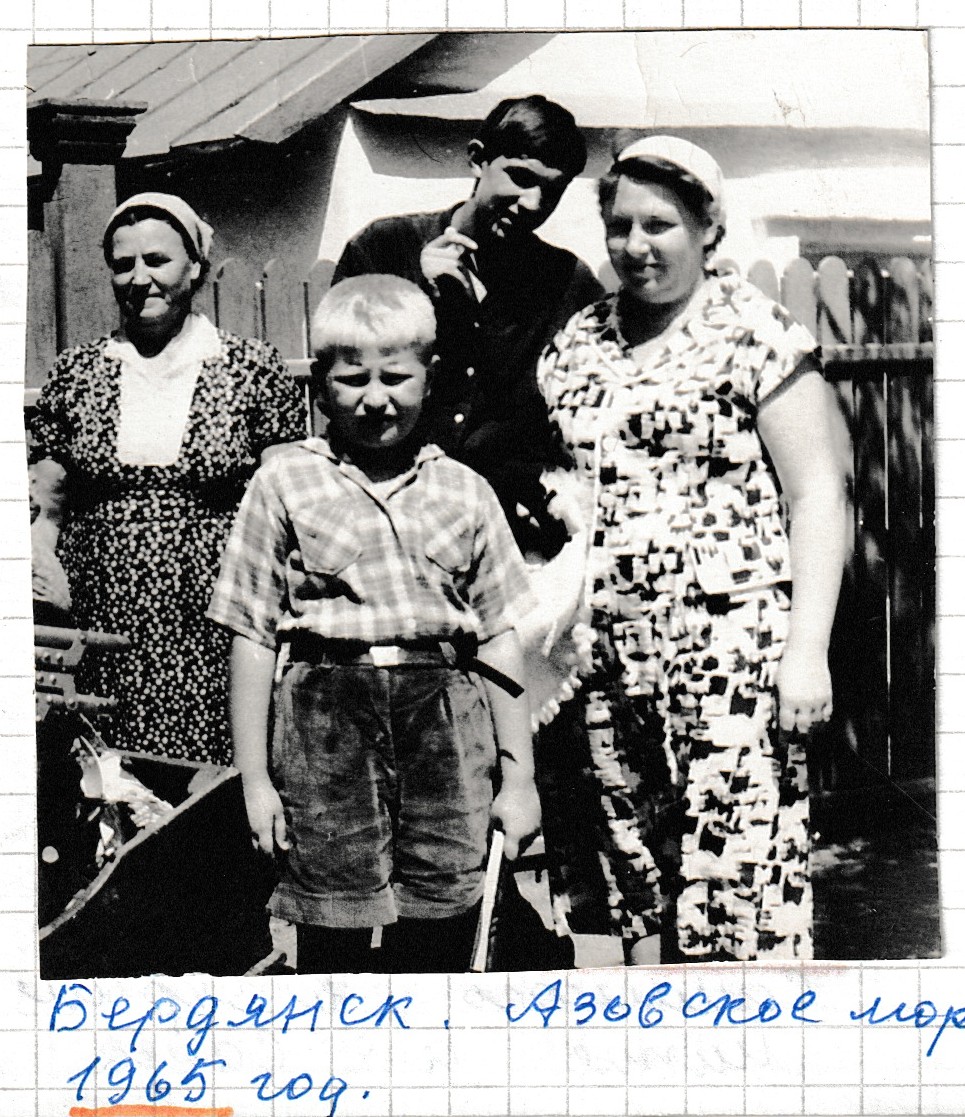
Mitya — on practical work in Uzbekistan.
In the last year he began to study well. And he was already seriously in love. After finishing the institute he married his fellow student Venta Roza. (Krivosheino). He has 2 sons. Good work. In youth he was keen on football, and loved very much to read. For some time he set himself to write. He sent his work to a newspaper. Somewhere there is a review of his work from Komsomolskaya Pravda. He finished postgraduate study, defended, candidate of technical sciences, docent. He teaches at the Moscow Aviation-Technological Institute. Thinks of a doctoral dissertation. There are printed works.
Kosino. 1954. The return
Summer 1954. Kosino. After Sasha’s return Mitya and Sasha.
In 1974 in summer the institute sent him on a traineeship to the USA, to a university in Los Angeles. He[?] spent[?] about 2 months there. The trip was unforgettable.
In 1979 we with Valentina (as we went to the GDR)[?].
In 1981 I went to the GDR and Hungar[y].
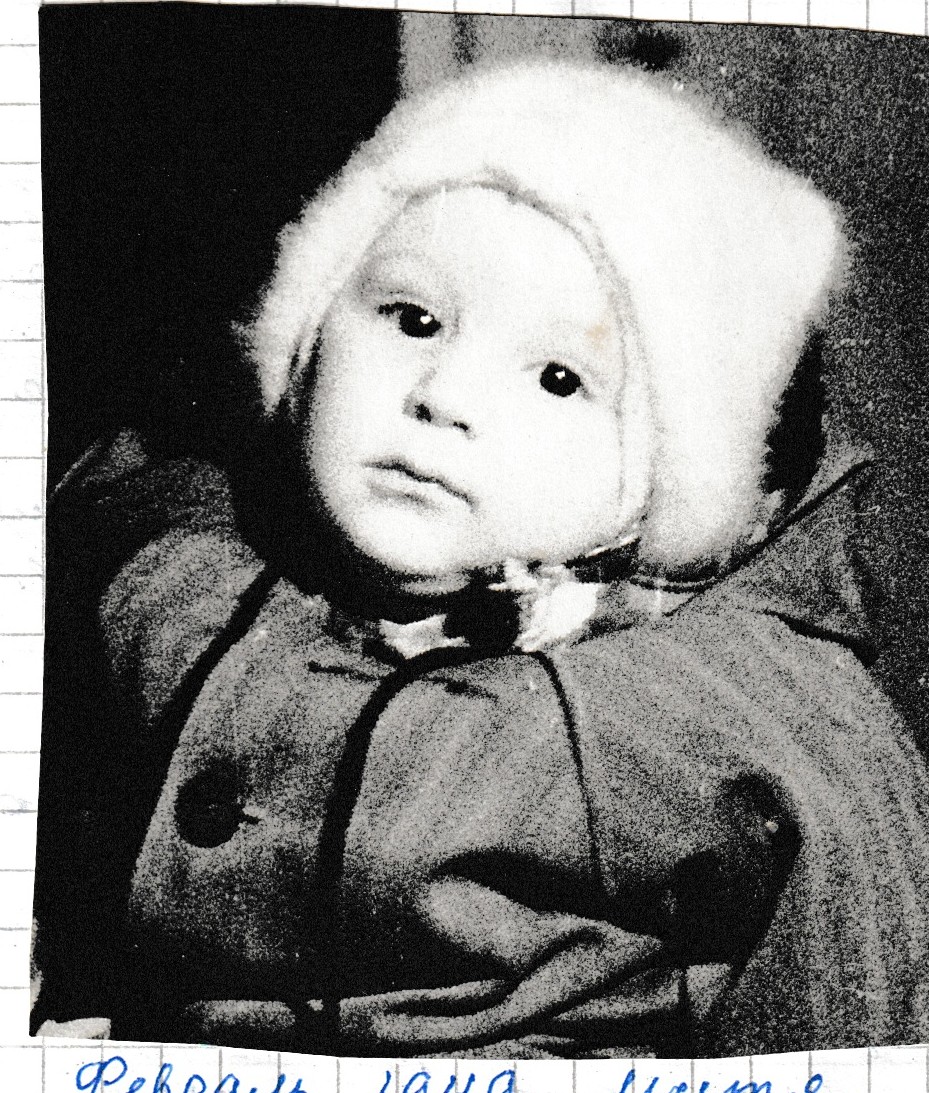
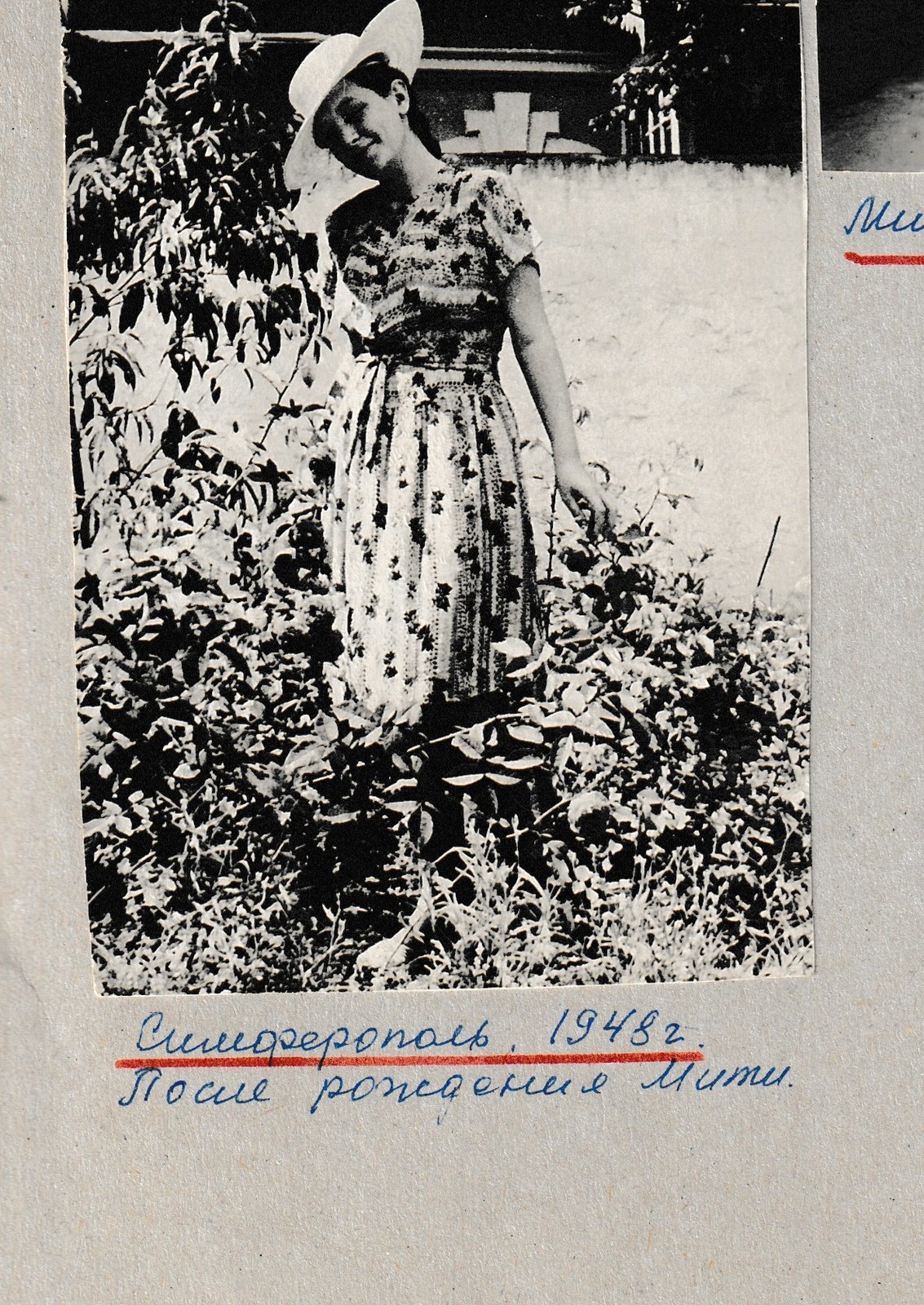
“February 1948. Mitya.”
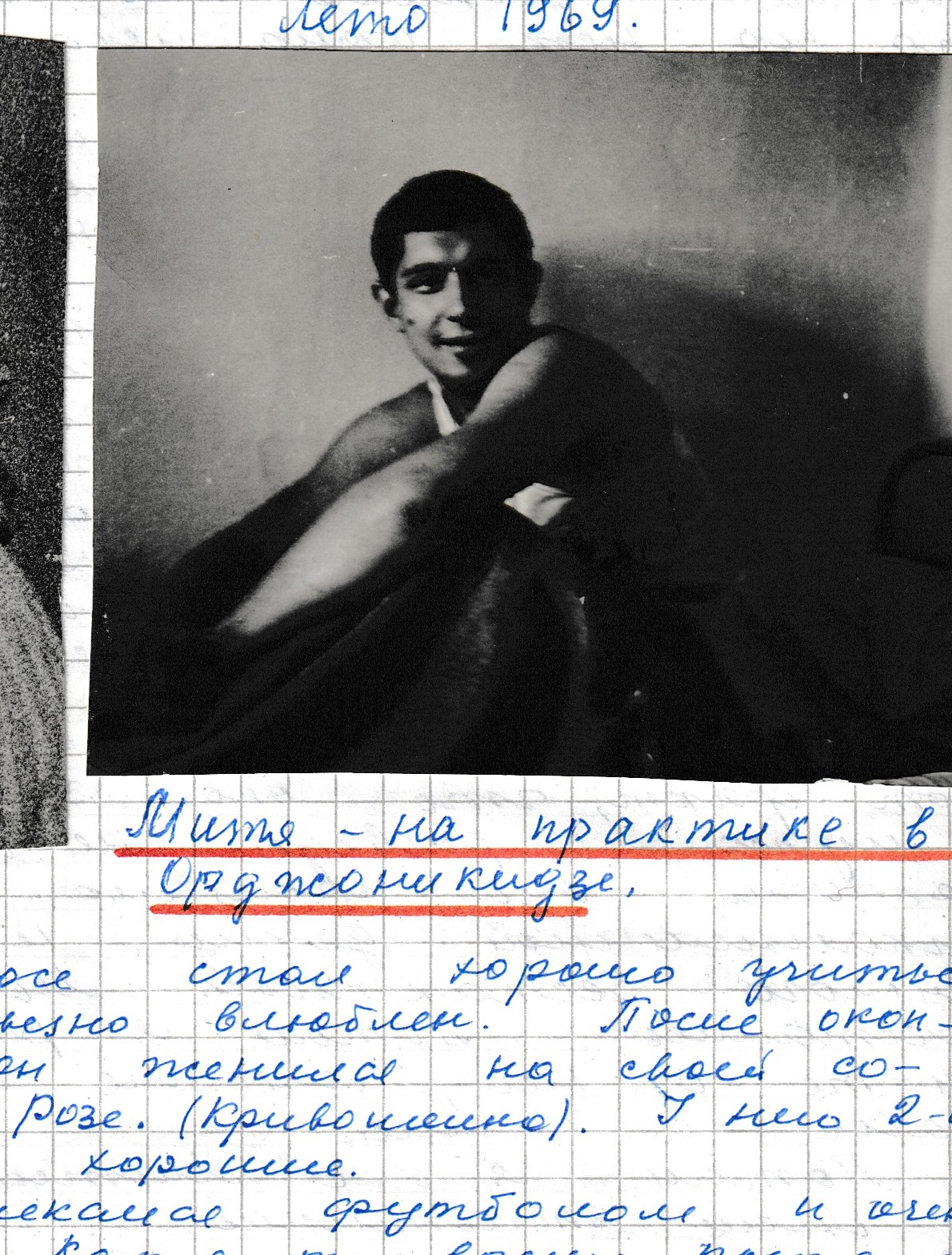
Mitya — practical work in Uzbekistan.
Kosino, 1954. Mitya and Sasha (A. D. Krivoshein).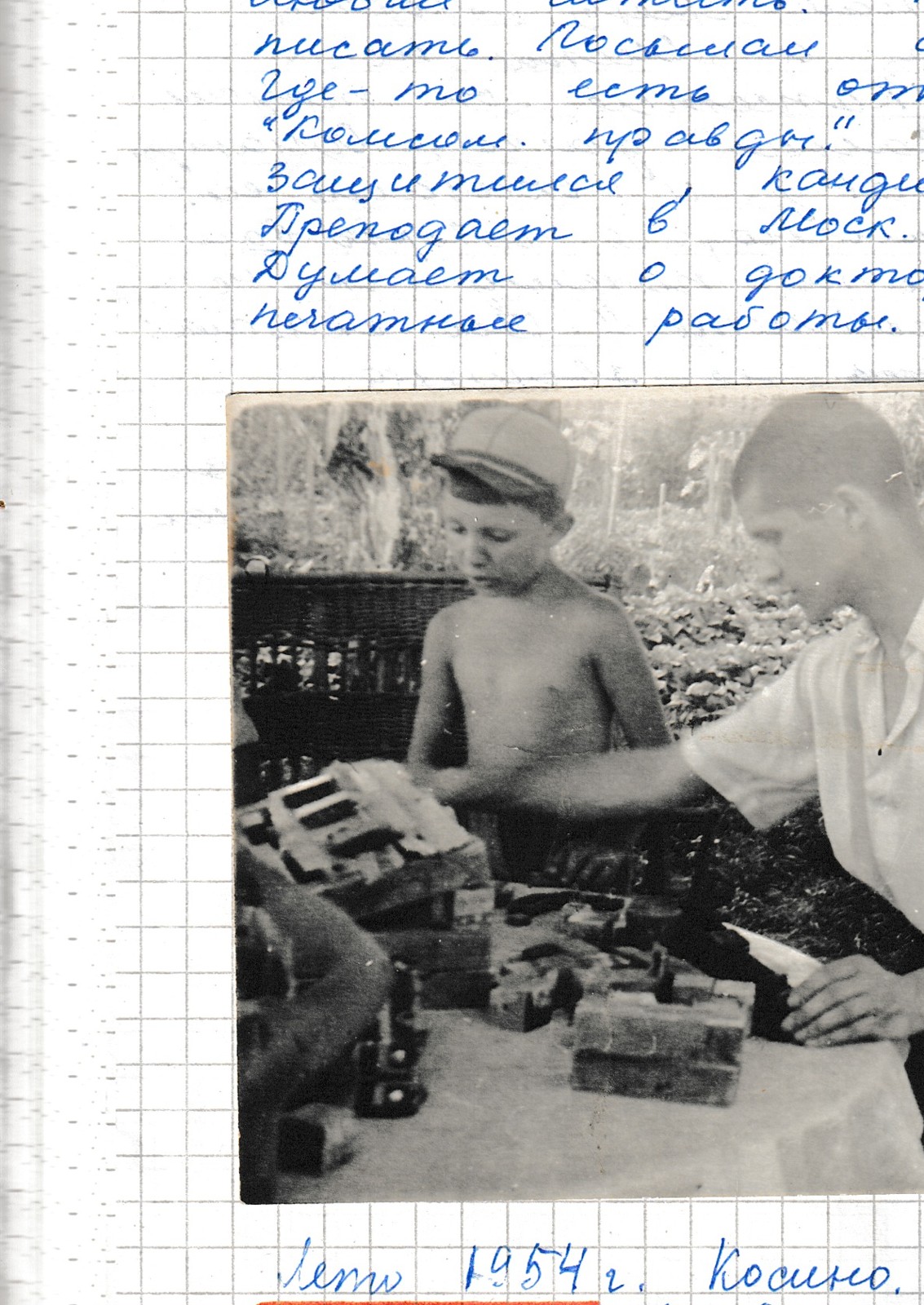
In the morning of 1957 another son was born to us. I very much wanted a daughter, but another little son was born. Sasha said to me: “You always do it your way.” We gave birth to Serezha in the Grutrilino[?] maternity home, where 38 years earlier I too was born. The boy was born very fair. Sanechka and my brother Genya came for us. He was in Moscow then. Mama and Mitya waited at home. Mitya was very glad of his brother, and it was he who gave his brother his name.
Serezha grew a very calm boy. At night he let us sleep and woke somewhere at 8–9. And when you went to him he always smiled. Sasha helped me a great deal with the household (nappies were his job). We most often walked in the Park of Culture. Once in the evening we four went for a walk: Sasha, I, Mitya and Serezha in the pram. It was somewhere in autumn, in October. Just then our country had launched the first satellite. We sat on a bench in the park and suddenly saw a moving light in the sky; it moved. That was the satellite. So we first saw our 1st satellite. The boys grew; I bustled about the household; Sasha worked. Everything was well with us; only we were a little short of means. We lived poorly. Serezha grew a calm boy. And then misfortune: Serezha fell ill with dysentery. Apparently he caught it in the communal flat[?], because at home all of us were well. We turned to a good doctor Veniamin Zinovyevich Arkadyevich[?]. He helped us greatly without any tests. For a long time after we turned to him about the children’s illnesses, and once he paid me a compliment: “You are a real Jewish mother.” And at that time after the operation Mitya’s heart was not well, and I took him to Zin. Arkadyevich. He said he could not put Mitya up. That is how I walk[?] stroll[?]: I push the pram, and Mitya walks beside (he was not recommended to run). In the end Mitya recovered. In the summer of that year (1958) we went to the state farm “Varskoe” in Ryazan province, where Grandpa was. At first he could not understand what waves were. He was very surprised when he entered the sea for the first time. And the sea was quiet. We went with him to Kaunas and Vilnius, to Palanga (Lithuania), to Suzdal. We also went with him around the Moscow region (Kuskovo, Abramtsevo). At school he did not study at full strength; he did not overwork himself. In the 7th form he went with the school to the GDR. I was already [struck through: then?] working at the institute. At first Serezha was put in the group, then removed. I went to the district committee and achieved his inclusion. Thanks that our institute people helped me there. So he studied, played football, had many friends! Even now, when they are over 40, they meet regularly. And meetings before New Year are a rule. Usually that happens at our place. The lads call him “the count,” and me “their mama.” Then the institute. He studied easily and without strain. When he went to an exam I did not even worry, not as with Mitya. (Then I shook with fear.) In the 3rd year playing football he broke his arm. His friends telephoned us and said they had taken him to the 1st City Hospital. Sasha and I went there and just saw him on a trolley with plaster on his right arm. He was left in hospital; the break was serious. Then with everyone on their feet. It was good that Tatyana Aleksandr. Kitsko worked there, and she organized good treatment for him. I went there daily, cleaned their ward. Having lain long, Serezha could not attend classes. Almost the whole autumn semester passed so. But he sat all credits and exams very well. Even the newspaper Stal wrote about him. Then he finished the institute and went to work at a research institute, then sat exams for postgraduate study and became a postgraduate student, defended his dissertation. In 1980 he married Galya Zaitseva who studied with him at the same institute but in different faculties. In 1981 Alyosha was born, and in 1990 Alyona.
Leaf 157: family photographs and notes — not published separately until the family decides (privacy).
I remember such an incident with Mitya. He was still at school, in form 7–8. He was invited to a birthday. He comes home pleased and says: “Mama, your son is the king of the pavilion!”
We always marked Mitya’s birthday.
I remember when he was about 2 we were alone at home (Leninsky Prospekt [address redacted]); to rinse him I soaped his head, fixed the soap; suddenly I hear someone going into the bath, then again; I rinsed the soap and look: my slippers are floating in the bath, and Mitya stands and laughs.
And I remember incidents with me. I was waiting for a trolleybus near the old university. I was returning home from Zinaida Aleksandrovna Sokolova. It was evening. I see a man walking around me; then he asks: “Are you a Muscovite?” “Yes.” Then he says: “You have a real Russian face. The artist Krasilov is now working on the picture Lenin at the 3rd Komsomol Congress. Your face would suit.” I refuse; a trolleybus approaches; I sit and he after me: “At least take our telephone, call. Krasilov will paint your portrait, and it may be shown in the Tretyakov.” In general he very much persuaded, and I refused. Then he got off after a stop. I came home and told Sasha. Papa says: “A new kind of acquaintance,” and Mama said: “You should have agreed.”
Another incident. On Leninsky Prospekt [address redacted] a trolleybus stops; a tipsy man gets out, saw me and says: “Lord, I haven’t seen such beauties for a long time.”
Another incident: once I was riding a trolleybus. Some man sat near me and said: “I am a camera operator; let me photograph you.” I told him: “I have a very unphotogenic face.” He said: “Believe me, it will all be fine.” I refused.
Things of that kind happened to me more than once.
Sailing and travel
In the 1950s I went in for sailing. I was a member of the club “Vodnik” on the Klyazma Reservoir.
“Rodina,” summer 1963. I raise the sail on Lake “Olympika.”
…the group I led…
I sailed on the “Olympika”; I had a sport rank and even judging rights. I took part in competitions.
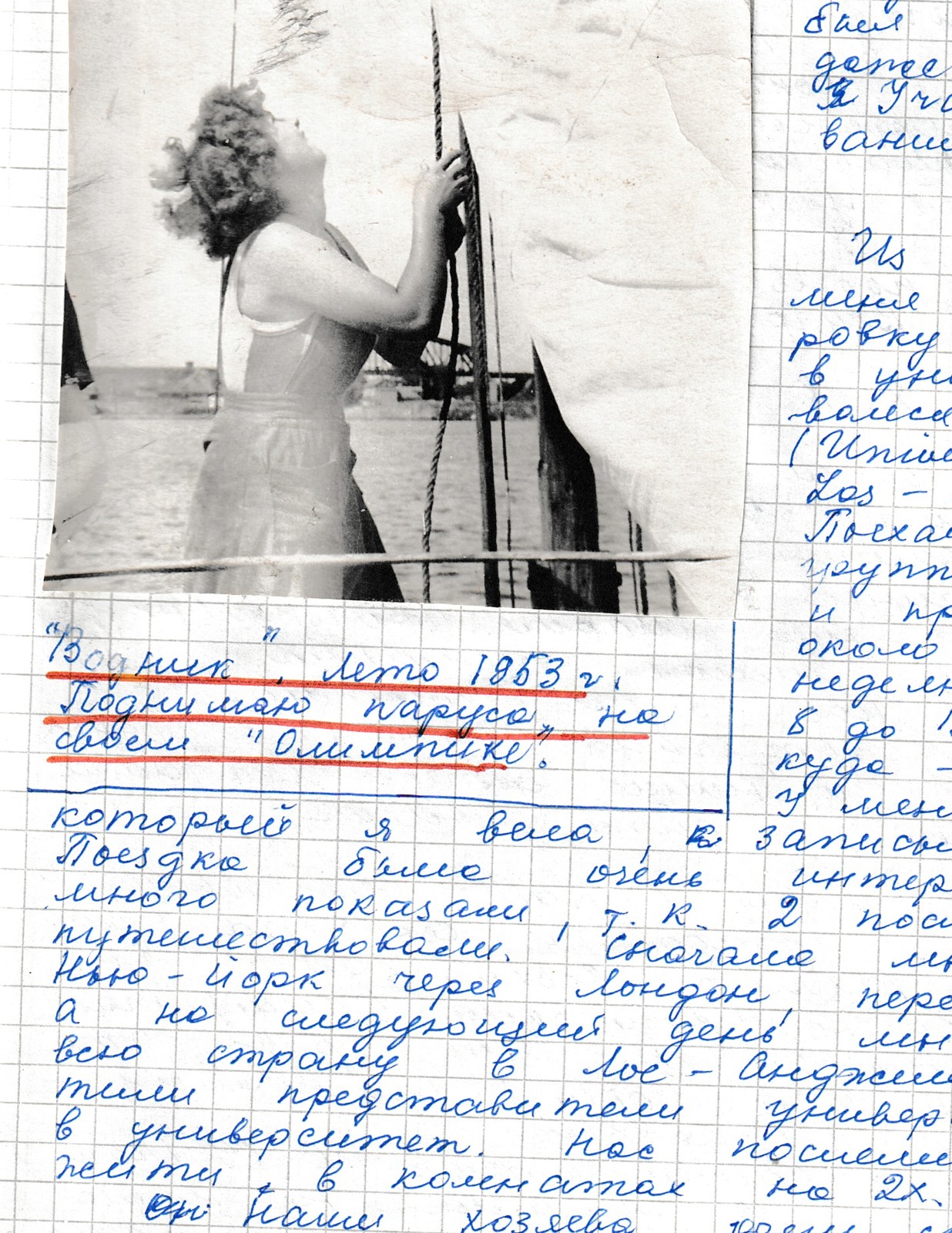
“Vodnik.” Summer 1953.
In 1975 the institute sent me on a traineeship to Los Angeles, to the university called UCLA (University of California, Los Angeles). I went in a group of 26 people; we stayed about three months. All week we studied from 9 until 13–14, and in the evening they took us somewhere. I was obliged to keep a diary every day.
The trip was very interesting; they showed us a great deal, because the last two weeks we travelled. First we flew to New York via London, spent the night there, and the next day flew across the country to Los Angeles, where university people met us and took us to the campus. We were housed in a student dormitory, two to a room. Our hosts tried hard to show us the country. Every evening was filled: a jazz concert, cinema, theatre. They showed us Universal Studio, Disneyland, the San Diego zoo, the Grand Canyon, Las Vegas, where we played the machines (I won $10 and lost $6). We were invited into American homes; when the course ended they took us by bus along the Pacific coast to San Francisco. Interestingly, the bus had a toilet! We spent three days in San Francisco. From there they took us to the Valley of the Moon (Jack London’s country); we saw his grave. Then on to Fort Ross (the Russian fort). It was built in the 19th century when the Russian–American fur company traded furs. The Russians nearly reached San Francisco. The fort is preserved (a historic monument) right on the Pacific shore. From San Francisco they put us on a plane and via Denver (Colorado) brought us to Sioux City, Iowa. From there via Chicago to Washington, then from Washington to New York. We visited the White House, the Capitol, the monuments to Washington, Jefferson, Lincoln, our Arlington Cemetery and much else. Then New York and home.
After that I was in the GDR, twice in Czechoslovakia, in Hungary.
Mushrooms, later years, Sasha
Sasha and I were keen mushroom-pickers and for some thirty years went to Luki in Vladimir province. Our hosts were very good people — the Kapustins and their children. Maria Grigorievna stood out especially: kind, clever, a dear woman. Our relations were the warmest. They received us as kin. Our children were there too, my mama[?], Tanya with Serezha, and even Alyosha.
One incident comes back. Toward evening a herd was driven past and Serezha (he was 4) cried in delight: “Oh, cows!” And Vasya (he was 5) said solidly: “Those are not cows, those are okotiny[?].” (he still used the o-sound). Sasha of extraordinary beauty. We went with Sasha in 1991 in spring for mushrooms. But that trip ended badly: I broke my leg. Sasha telephoned Stalproekt; they gave him a car and Serezha came for us. The break was serious; I lay seven days in the 1st City Hospital, then two months in plaster.
In December 1993[?] Sasha had an infarction; he was in hospital and after 21 days came home. He left work; we were together at home. At the end of August 1994 we went with him to a rest home, where he, as we thought, caught a cold — a heavy cough. We came home; the cough did not pass. The doctor said bronchitis. He took antibiotics; the cough did not stop; then he was put in hospital, where they found a tumour on the trachea. They did not treat him. So I was left alone. And he so much wanted to live to the year 2000! I miss him very much; I am so lonely. I live with Serezha and his family.
Earlier family photographs (public crops)
Winter 1950 — Mitya and I.
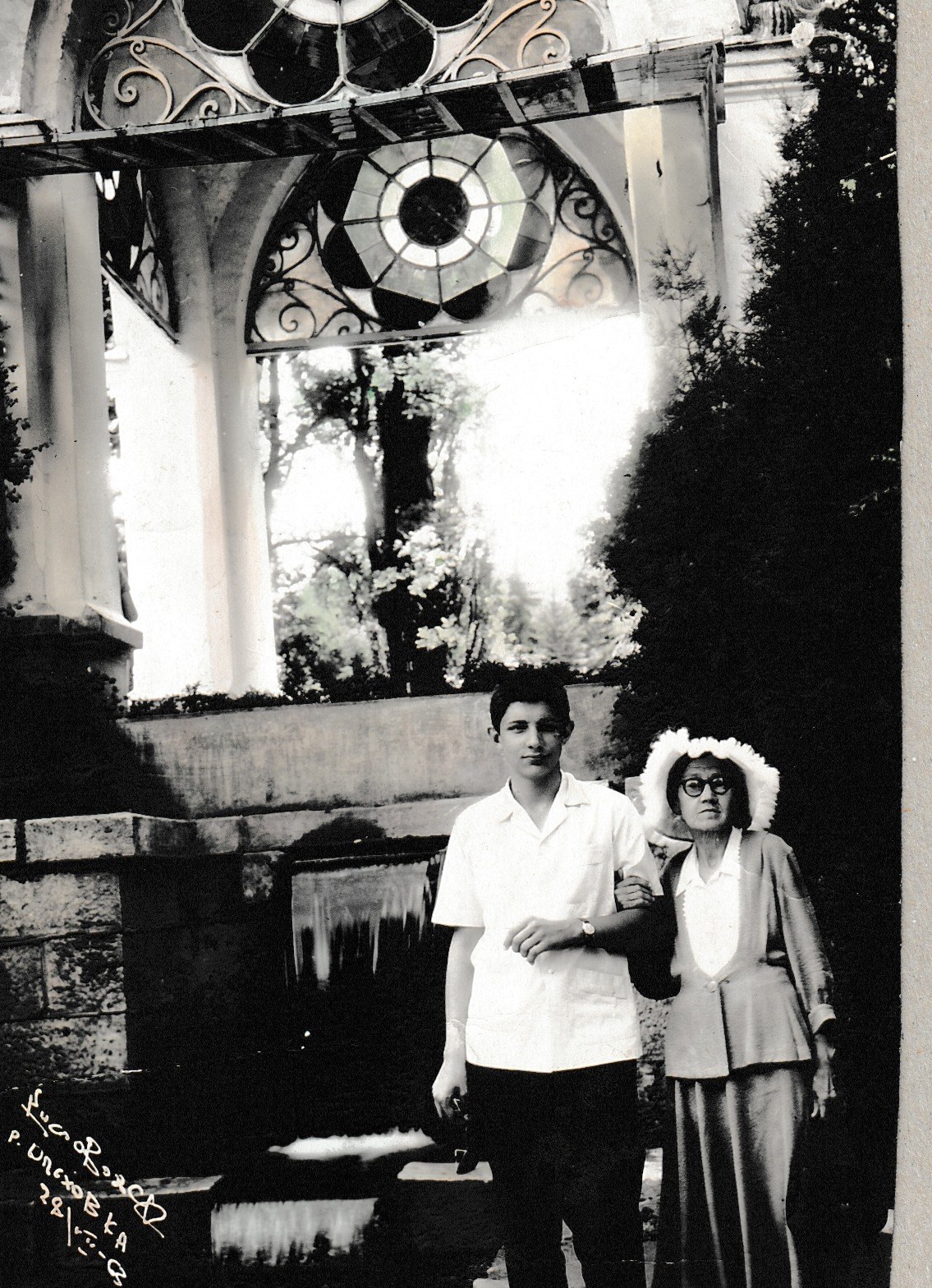
Kislovodsk; Simferopol 1948.
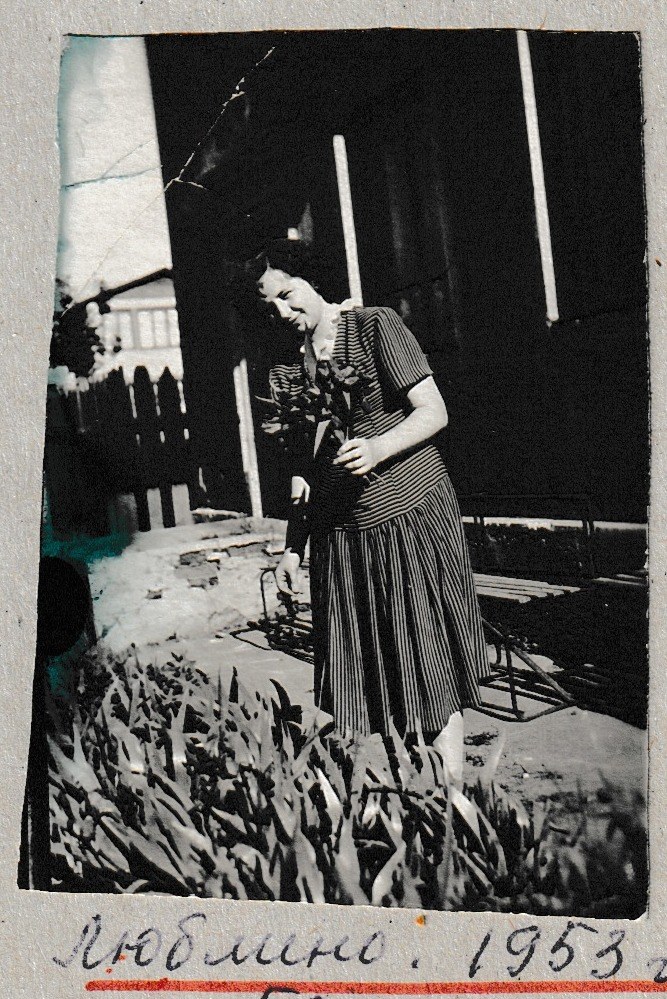
Lyublino / Yablonnaya, July 1953.
Leaves 155 and 157 are not shown as public photographs (living-person privacy). Full manuscript reading: Russian chapter .